Self-Care Energy Map
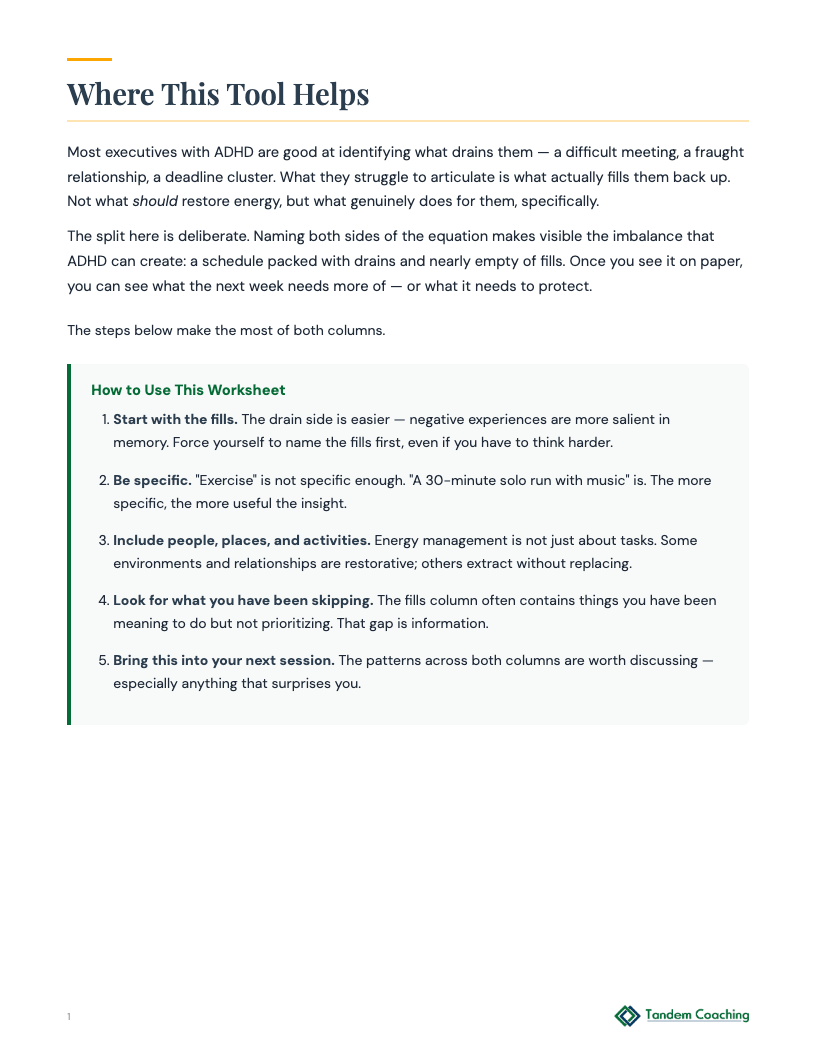
Record what personally replenishes or drains energy, then choose one realistic support without assuming a cause.
Get This Tool
Free, print-ready PDF.
When to Use This Tool
ADHD adult who feels chronically drained but can't identify what's taking their energy
A client who needs a concrete way to see which activities restore them versus deplete them
Person trying to build better self-care habits who doesn't know where to start
How to Introduce This Tool Plus
Looking at your fills and drains, which one support or boundary would be realistic to test without assuming why your energy changed?
Coaching Tool Disclaimer
This tool is designed for coaching contexts, not clinical use. If you or your client is in crisis, contact the 988 Suicide and Crisis Lifeline (call or text 988) or Crisis Text Line (text HOME to 741741).
Browse All Pages
Tool Classification
Domain
ADHD
Type
Worksheet
Phase
Discovery
Reflection
Details
15 min
Opener
As-needed
Topics
Self-Care
Executive Function
Identity
For the Coaching Practitioner
Plus
Coaching Scenarios
Plus
1 Senior manager with ADHD who schedules back-to-back meetings all week ▶
Context
A director of operations with ADHD who runs on adrenaline and caffeine. Recently promoted, now managing three teams across time zones. Came to coaching because they're making mistakes they didn't make before - missing details, forgetting commitments. They think they need better systems.
How to Introduce
Frame this as a reflective, not self-care advice. 'Before we build new systems, let's see what your current schedule is actually doing to your capacity.' some people often mistake depletion for laziness. Name that upfront: 'This isn't about working less - it's about seeing what refuels your focus versus what burns it.'
What to Watch For
The fills column will be sparse or filled with 'shoulds' - meditation, exercise, sleep. The drains column fills quickly with meetings and deadlines. Watch completion time: if drains take 2 minutes and fills take 8, they're not accessing real data about what restores them. They're performing what they think restoration looks like.
Debrief
Start with the ratio. Count the items in each column out loud. Then ask: 'When you look at your calendar for next week, what percentage is fills versus drains?' The gap between the two lists and their actual schedule is the conversation. Follow with: 'What's one fill you could protect this week without changing any meetings?'
Flags
Coaching scope: do not diagnose, interpret symptoms, or recommend treatment. Adapt or stop for distress and use licensed health or emergency support when appropriate.
2 Marketing executive who insists they don't need self-care because they love their job ▶
Context
VP of Marketing at a fast-growth startup. High performer who thrives on chaos and tight deadlines. Sought coaching for 'strategic thinking development' but mentions chronic Sunday anxiety and trouble sleeping. Believes self-care is for people who don't love what they do.
How to Introduce
Don't use the word self-care. Frame as performance optimization: 'Even race cars need pit stops. This maps what keeps your engine running versus what burns fuel.' Expect resistance to the fills column - they'll say work energizes them. Push back gently: 'Work can energize and drain simultaneously. We're looking for what restores capacity, not just what you enjoy.'
What to Watch For
They'll populate drains with external factors - difficult stakeholders, budget constraints - but resist naming work itself as draining. The fills column may be entirely work-related activities. Watch for perfectionism: if every item is precisely worded and categorized, they're managing the impression the tool creates rather than exploring honestly.
Debrief
Start with what they put in fills that surprised them. Don't challenge work-as-energizer directly. Instead ask: 'You listed strategy sessions as filling. What makes those different from budget reviews?' Help them identify the specific elements within work that restore versus deplete. The nuance is more useful than the category.
Flags
Coaching scope: do not diagnose, interpret symptoms, or recommend treatment. Adapt or stop for distress and use licensed health or emergency support when appropriate.
3 Finance director returning from medical leave who feels guilty about boundaries ▶
Context
CFO at a mid-size nonprofit, back from three-month medical leave for stress-related health issues. Previously worked 60+ hour weeks and prided themselves on availability. Now has doctor's orders to maintain boundaries but feels guilty saying no to requests that used to be automatic yes responses.
How to Introduce
Frame as recalibration, not restriction. 'Your capacity changed - not permanently, but right now. This tool helps you see what builds capacity back versus what spends it down.' Acknowledge the guilt directly: 'Most people returning from leave feel like they should be grateful just to be back. That guilt can make it hard to see what you actually need.'
What to Watch For
The drains column may be filled with guilt-inducing items - saying no, disappointing colleagues, not being available. Fills column might be sparse because they haven't given themselves permission to prioritize restoration. Watch for minimizing language: 'I guess this drains me a little' versus clear acknowledgment of impact.
Debrief
Start with the guilt items in drains. Ask: 'What would happen if you moved some of these guilt-based drains to neutral?' Don't try to eliminate the guilt, but help them see it as information rather than instruction. Then move to fills: 'Which of these fills could you protect without asking anyone's permission?'
Flags
Coaching scope: do not diagnose, interpret symptoms, or recommend treatment. Adapt or stop for distress and use licensed health or emergency support when appropriate.
4 Tech lead who discovers their team interactions are their biggest energy drain ▶
Context
Engineering team lead at a software company, promoted from individual contributor six months ago. Excellent technical skills but struggling with people management. Came to coaching to improve delegation and team communication. Assumes the problem is lack of management training.
How to Introduce
Position as a leadership energy audit. 'Before we work on delegation techniques, let's see what parts of leadership energize you versus what parts cost you.' Many new managers assume all people-work is draining because it's unfamiliar. This tool separates unfamiliarity from genuine energy mismatch.
What to Watch For
They may put 'team meetings' in drains but be more specific about which team interactions drain versus energize. Watch for overgeneralization - 'people stuff' versus specific types of conversations. The fills column might be entirely technical work, which signals they haven't yet found the people-leadership activities that work with their wiring.
Debrief
Focus on the specificity within team interactions. Ask: 'You listed team meetings as draining. What about one-on-ones?' Help them identify which people-leadership activities align with their strengths versus which feel like performance. Follow with: 'What's one type of team interaction you could do more of without it feeling like extra work?'
Flags
Coaching scope: do not diagnose, interpret symptoms, or recommend treatment. Adapt or stop for distress and use licensed health or emergency support when appropriate.
Tool Flow
Plus
Requires
- None - standalone tool
→
Produces
- named energy fills and drains inventory
- fills-to-drains ratio visible on one page
Pairs Well With
Life
Optional Multi-Area Goal Notes
Use this worksheet to explore values and identity and turn the client’s observations into one optional next step.
Why it pairsUse the fills-and-drains ratio to set monthly intentions that protect energy - not just fill calendar space.
ADHDMonthly Well-Being Options Planner
A client wants to use Monthly Well-Being Options Planner as an optional reflection
Why it pairsOnce you have a named fills inventory, this planner converts that awareness into a concrete monthly self-care routine.
ADHDSleep Routine Options
A client wants general sleep-routine options to discuss safely
Why it pairsWhen sleep appears as a drain on the energy map, this guide gives ADHD-specific practices to address it directly.
Related Articles

Remote vs In-Person ADHD Coaching: The Research
Read article →
Executive Function Strategies for ADHD Leaders: Working Memory, Impulse Control & Flexibility
Read article →
Organize Your Success – ADHD Coaching to Master Organizational Skills
Read article →
ADHD Mentorship: Support Networks That Work
Read article →