Track how often distractions interrupt your work each week with a simple, ADHD-informed log that makes patterns and triggers clear.
Free, print-ready PDF.
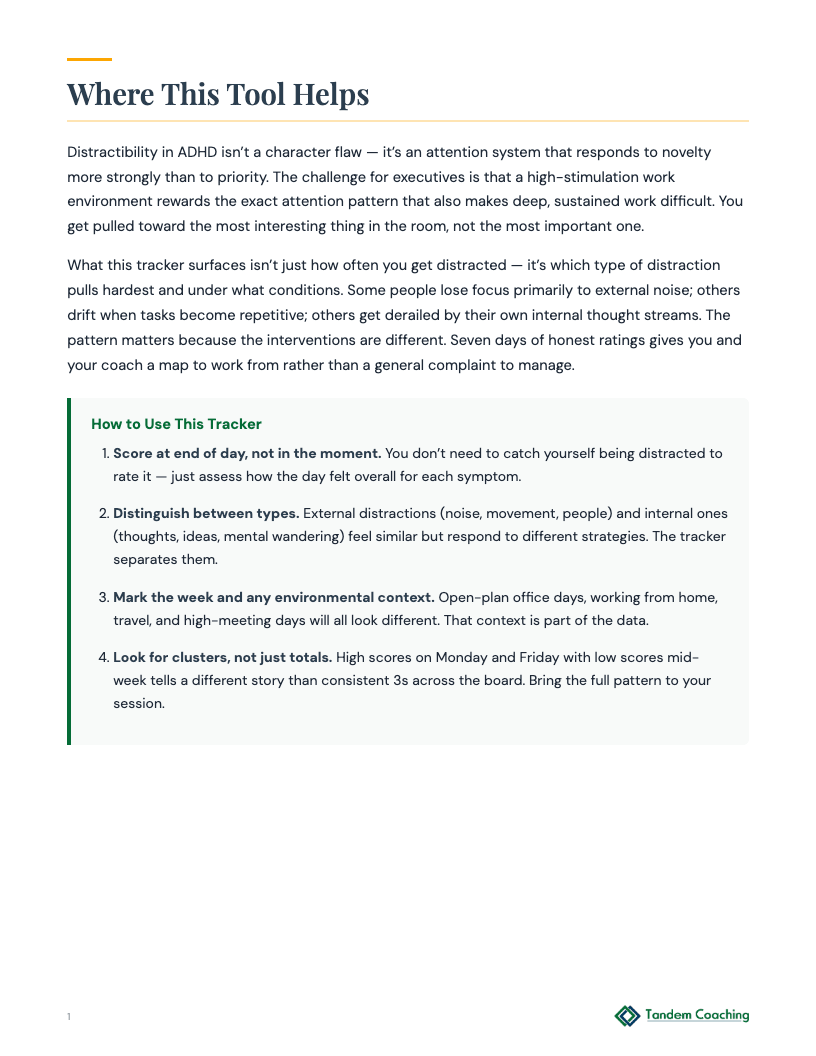
Each time you notice you've drifted off task this week, log it here. The goal isn't to judge the number - it's to see what's pulling your attention and when.
A principal engineer recently promoted to tech lead who's finding it impossible to complete deep coding work while managing team interruptions. They think the problem is poor time management but suspect something deeper is affecting their ability to focus.
Frame this as a diagnostic, not a deficit inventory. 'Before we design focus strategies, let's map what's actually pulling your attention away from code.' Many technical leaders resist tracking because it feels like admitting weakness. Reframe: 'This identifies which interruptions are worth the cost and which aren't.'
Items 1, 2, and 5 will likely spike on high-meeting days. If items 8 and 9 are consistently high while external distraction items are low, the issue isn't interruptions - it's task engagement. Watch whether they rate weekend coding sessions differently than weekday work.
Start with the contrast between meeting-heavy and coding-focused days. 'What do you notice about Tuesday versus Thursday?' Then examine items 8 and 9 specifically: 'When you rated difficulty with repetitive tasks, what kind of coding work were you thinking about?' This distinguishes between environmental and neurological factors.
If items 7, 9, and 10 are consistently 4-5 across all contexts, including weekend personal coding, the distractibility isn't situational. Severity: moderate. This suggests core ADHD symptoms that may need medical evaluation alongside coaching interventions.
A creative marketing director who performs well in campaign execution and client meetings but can't stay focused during quarterly planning or budget reviews. They frame it as the content being unstimulating rather than an attention regulation issue.
Present as a pattern detector, not a symptom checker. 'You've identified that certain types of work pull your attention differently. Let's track that across a full week to see what else might be in that category.' Expect resistance to rating high-energy work days - they'll want to skip those.
They'll likely underrate distraction symptoms on days with client presentations or campaign launches. Look for whether item 8 (repetitive tasks) gets honest ratings or gets skipped entirely. If they rate creative work days as all 1s and 2s, they're defending rather than observing.
Start with the days they rated as low-distraction. 'Walk me through Tuesday - what made that different?' Then contrast with planning session days. The question that opens this up: 'What would need to be different about strategic planning for your brain to engage with it the way it engages with campaign work?'
If the client refuses to acknowledge any attention difficulties on 'interesting' work days, they may be using task preference to avoid recognizing ADHD symptoms. Severity: low. Continue coaching but return to this pattern - the resistance itself is diagnostic information.
An operations manager seeking coaching for what they describe as inconsistent performance. They excel during system outages and urgent projects but struggle with routine operational tasks and preventive planning work.
Frame as a performance pattern analysis. 'You've noticed your focus varies by situation. This tracker will show us what conditions actually support your attention versus what feels like it should.' Don't mention ADHD initially - let the data speak first.
Items 8 and 9 will likely spike during routine weeks and drop during crisis periods. Watch for whether they rate crisis days honestly or romanticize them. If all routine work gets rated 4-5 and all urgent work gets rated 1-2, the pattern is clear but they may not see it yet.
Start with their lowest-scoring days. 'What was happening during work when you rated most items as 1 or 2?' Then examine the contrast: 'How did your attention feel different during the server outage versus during the quarterly review prep?' This surfaces the stimulation-attention connection.
If the client shows a strong inverse relationship between task urgency and distractibility symptoms, this suggests ADHD presentation where dopamine regulation depends on external pressure. Severity: moderate. Explore whether they're unconsciously creating crises to maintain focus.
A remote team leader convinced their focus problems stem from working from home - kids, noise, household distractions. They're considering expensive office renovations and co-working space memberships as solutions.
Position as an environmental audit. 'Before investing in workspace changes, let's get clear data on what's actually disrupting your focus.' Many remote workers assume external factors are the primary issue. The tracker will show whether that assumption holds up across different home conditions.
If items 7, 9, and 10 (internal distractions) consistently rate higher than items 1, 2, and 5 (external distractions), their hypothesis is wrong. Watch whether they rate quiet house days differently than noisy ones. Look for resistance to acknowledging internal distraction patterns.
Start with external versus internal item clusters. 'Compare your ratings on items 1 and 2 with items 9 and 10. What pattern do you see?' If internal distractions dominate, ask: 'What would change about your workspace investment if the primary issue isn't environmental?'
If external distraction items consistently rate 1-2 while internal distraction items rate 4-5, the client's environmental attribution is likely avoidance of recognizing ADHD symptoms. Severity: low. Address the misattribution directly - expensive environmental changes won't solve internal attention regulation issues.
ADHD adult who needs a single page to capture the whole week ahead
ADHDADHD adult who thinks in weekly chunks but keeps missing the bigger picture
ADHDADHD adult who loses track of the month because they don't have a calendar view