Strengths-in-Context Reflection
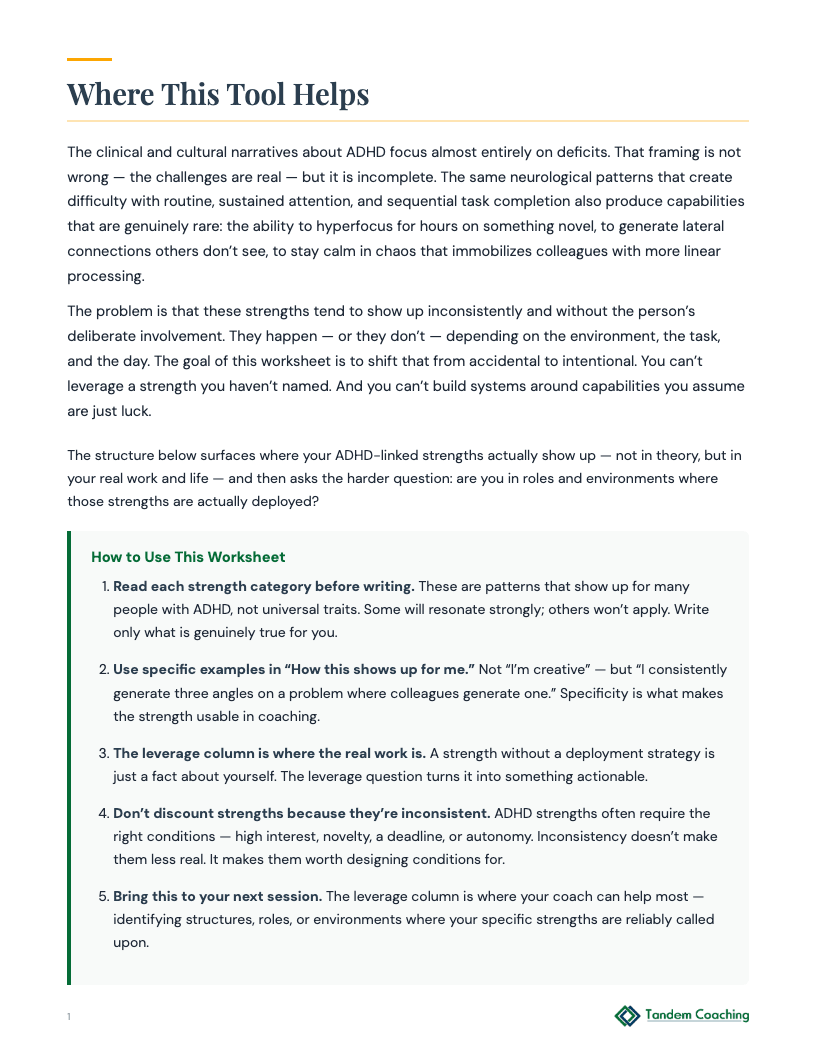
Use client-owned examples to identify possible strengths and conditions that help them show up.
Get This Tool
Free, print-ready PDF.
When to Use This Tool
ADHD adult who is stuck in a deficit narrative and needs help recognizing the cognitive advantages that come with their wiring
A client and coach who are building a strengths-based foundation before tackling ADHD challenges
Person who has been told what's wrong with their ADHD brain but hasn't been shown what's right
How to Introduce This Tool Plus
Which possible strength is supported by a concrete example, and what conditions helped it show up?
Browse All Pages
Tool Classification
Domain
ADHD
Type
Worksheet
Phase
Discovery
Reflection
Details
15 min
Opener
As-needed
Topics
Executive Function
Identity
Mindset
For the Coaching Practitioner
Plus
Coaching Scenarios
Plus
1 Mid-career software engineer considering management transition after ADHD diagnosis ▶
Context
A senior developer with 8 years experience was diagnosed with ADHD six months ago. Their company offered a team lead role, but they're hesitant because they've internalized messages about ADHD making leadership impossible. They see only their organizational struggles, not their technical problem-solving gifts.
How to Introduce
Frame this as capability mapping, not deficit repair. 'Before we decide whether management fits, let's map what you actually bring to leadership that others don't.' Expect resistance to the hyperfocus section - many newly diagnosed adults dismiss their deep work capacity as 'just obsession.' Name that upfront: 'Hyperfocus isn't a character flaw. It's a cognitive tool most people don't have.'
What to Watch For
Notice if they fill creativity and problem-solving sections quickly but struggle with empathy and interpersonal sections. This suggests they've been in individual contributor roles so long they can't see their people skills. Also watch for minimizing language - 'I guess I'm okay at...' instead of owning genuine capabilities.
Debrief
Start with the sections they filled most confidently. Ask: 'Which of these strengths would transfer directly to leading a team?' Then move to sparse sections: 'What would you need to see in yourself to believe you have leadership capabilities?' The question that opens this up: 'What do your colleagues already come to you for that isn't technical?'
Flags
Treat every strength label as a hypothesis. Keep only client-owned examples and do not infer a trait from ADHD.
2 Marketing director whose These strengths are misaligned with corporate structure demands ▶
Context
A marketing director at a Fortune 500 company excels at campaign creativity and crisis management but struggles with quarterly planning cycles and routine reporting. They're on a performance improvement plan for 'inconsistent execution' despite delivering breakthrough campaigns that significantly exceeded targets.
How to Introduce
Position this as a role-fit analysis, not a self-improvement exercise. 'Your results say you're effective. Your reviews say you're inconsistent. Let's map where your brain works best and see if there's a structural mismatch.' Many high-performing ADHD professionals assume they need to fix themselves rather than find better-fitting environments.
What to Watch For
Look for a pattern where they fill hyperfocus, creativity, and problem-solving sections with rich examples but leave energy and adaptability sections thin. This suggests they're in a role that uses some These strengths while suppressing others. Also notice if all their examples come from crisis situations rather than routine work.
Debrief
Start with the leverage column. Ask: 'Looking at what you wrote, what percentage of your current role actually uses these strengths?' Then: 'What would a marketing role look like that was designed around these capabilities instead of despite them?' The key question: 'Are you trying to fix yourself for the wrong job?'
Flags
Treat every strength label as a hypothesis. Keep only client-owned examples and do not infer a trait from ADHD.
3 Entrepreneur whose ADHD-driven success is creating unsustainable business practices ▶
Context
A startup founder built a successful consulting firm by leveraging their ability to hyperfocus on client problems and generate creative solutions under pressure. Now with 15 employees, they're burning out trying to maintain the same intensity while managing operations, and their team is struggling with the unpredictable workflow.
How to Introduce
Frame this as scaling strengths, not managing weaknesses. 'You built this business on capabilities most people don't have. Now we need to figure out how to preserve what works while building systems that don't require you to be superhuman every day.' Expect resistance to acknowledging that their strengths might need boundaries.
What to Watch For
Notice if they fill every section enthusiastically but struggle with the leverage column. This suggests they know their strengths but haven't considered how to deploy them systematically rather than reactively. Also watch for examples that all involve personal heroics rather than sustainable practices.
Debrief
Start with their strongest examples and ask: 'Which of these require you personally, and which could be systematized?' Then: 'What would it look like to design your role around your hyperfocus periods instead of fighting them?' The crucial question: 'How do you preserve your creative edge while building a business that doesn't depend on crisis?'
Flags
Treat every strength label as a hypothesis. Keep only client-owned examples and do not infer a trait from ADHD.
4 Recently diagnosed executive who built career compensating for unrecognized ADHD ▶
Context
A VP of Operations received an ADHD diagnosis at 45 after their teenager was diagnosed. They've been successful through extreme organization systems and working 60-hour weeks, but they're exhausted and wondering if they've been fighting their brain their entire career instead of working with it.
How to Introduce
Present this as archaeological work, not assessment. 'You've been successful despite not knowing how your brain works. Let's dig into what you're naturally good at that you might have been over-managing.' Many late-diagnosed professionals have buried their natural strengths under compensation strategies and can't see them anymore.
What to Watch For
Look for difficulty filling any section quickly - they may have spent decades suppressing natural ADHD traits and genuinely not know what their unmanaged strengths look like. Also notice if they describe strengths in past tense, as if they've trained themselves out of them. Completion may take longer than usual.
Debrief
Start with: 'What surprised you about what you wrote?' Then ask: 'Looking at your career wins, which of these strengths were actually in play even if you didn't recognize them?' The question that creates movement: 'What would your work look like if you designed it around these capabilities instead of around managing your challenges?'
Flags
Treat every strength label as a hypothesis. Keep only client-owned examples and do not infer a trait from ADHD.
Tool Flow
Plus
Requires
- None - standalone tool
→
Produces
- named ADHD-linked strength inventory
- strength-to-role deployment strategy
- conditions list for reliable performance
Pairs Well With
ADHD
ADHD Challenges Worksheet
ADHD adult who is newly diagnosed and wants structured space to name which challenges are most affecting their daily life
Why it pairsOnce you've mapped strengths, the challenges worksheet lets you frame friction domains against assets the client already owns.
ADHDAttention Context Log
Use this tracker to notice patterns in executive function and habits over time before drawing conclusions.
Why it pairsThe conditions list from the strengths worksheet gives you a hypothesis to test against the distraction tracker's real-time event log.
ADHDOptional Screen Use Context Log
Use this tracker to notice patterns in habits and time management over time before drawing conclusions.
Why it pairsUse this to check whether novelty-seeking strength identified in the worksheet is being routed into compulsive scrolling instead of purposeful work.
Related Articles


Remote vs In-Person ADHD Coaching: The Research
Read article →
Executive Function Strategies for ADHD Leaders: Working Memory, Impulse Control & Flexibility
Read article →
Organize Your Success – ADHD Coaching to Master Organizational Skills
Read article →
ADHD Executive Coaching: What It Is and How It Works
Read article →