ADHD Challenges Worksheet
A clinician-designed worksheet to pinpoint the ADHD challenges most disrupting your day, so you can focus your next steps with clarity.
Get This Tool
Free, print-ready PDF.
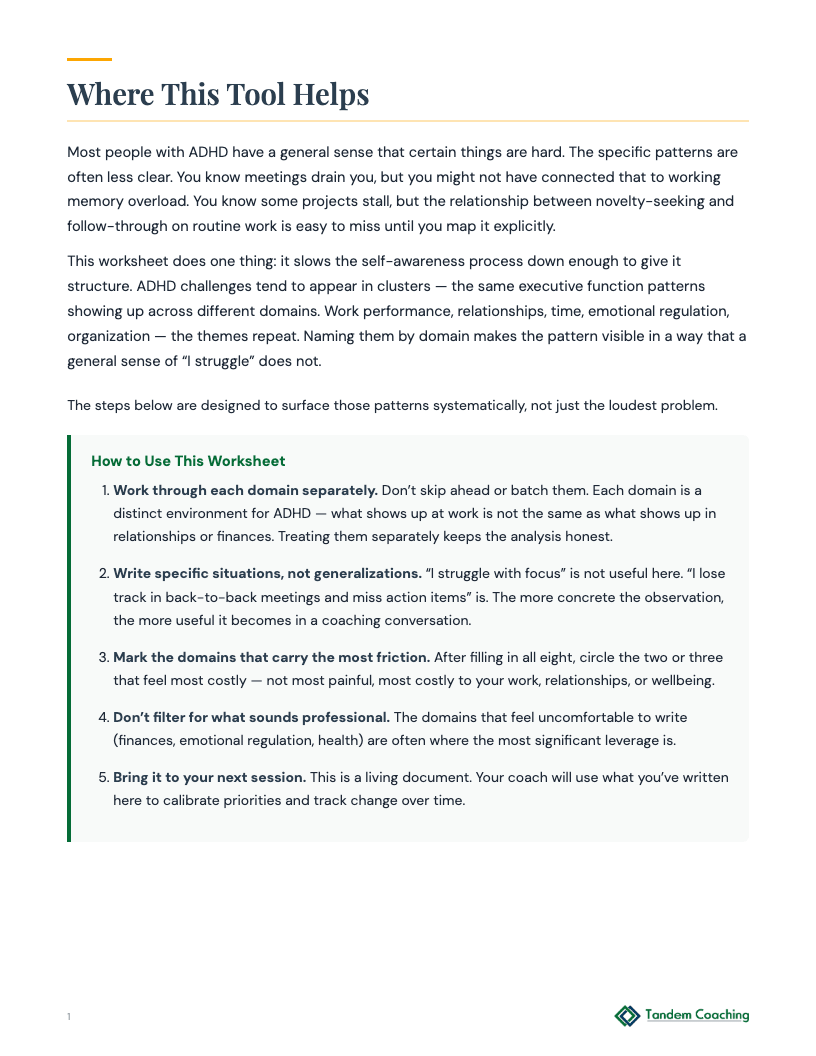
When to Use This Tool
ADHD adult who is newly diagnosed and wants structured space to name which challenges are most affecting their daily life
A client who is frustrated by recurring difficulties but hasn't mapped which ADHD patterns are actually behind them
Person who knows something is hard but can't articulate it clearly enough to work on it in coaching
How to Introduce This Tool Plus
This is about naming what's hard without judgment. Which of the challenges on this sheet resonate most with your experience right now?
Browse All Pages
Tool Classification
Domain
ADHD
Type
Worksheet
Phase
Discovery
Reflection
Details
15 min
Opener
As-needed
Topics
Executive Function
Identity
Mindset
For the Coaching Practitioner
Plus
Coaching Scenarios
Plus
1 Senior engineer promoted to team lead struggling with people management ▶
Context
A principal engineer recently promoted to engineering manager at a tech startup. Excelled in individual contributor role but now reports feeling overwhelmed by meetings, one-on-ones, and administrative tasks. Thinks the problem is time management but can't explain why technical work felt effortless while management feels chaotic.
How to Introduce
Frame this as a diagnostic before building management systems. 'Before we design your leadership approach, let's map where the friction actually lives.' Many high-performing individual contributors resist acknowledging that people management requires different executive functions than technical work. The domains will reveal whether this is skill gaps or ADHD patterns showing up in a new context.
What to Watch For
Notice if Domain 1 (Work Performance) gets filled quickly while Domain 5 (Relationships & Communication) stays sparse. This suggests the client is still thinking in technical terms. Watch for generalizations like 'meetings are hard' versus specifics like 'I lose track of action items when three people talk at once.' Speed through emotional regulation often means avoidance.
Debrief
Start with the contrast between Domain 1 and Domain 5. Ask: 'Read me what you wrote for work performance, then relationships. What's different about how you described those?' Then: 'When you were coding, what executive functions did you rely on most? Which of those don't work in management?' This connects past success patterns to current friction.
Flags
If Domain 4 (Emotional Regulation) is nearly empty but Domain 5 shows interpersonal conflict, the client may be disconnected from their emotional responses to management stress. Severity: moderate. This pattern often precedes burnout in new managers. Continue coaching but monitor for signs that the role transition is triggering deeper identity issues.
2 Marketing director who fills out forms perfectly but avoids real problems ▶
Context
A marketing director at a mid-size company who presents as highly organized and articulate. Came to coaching for 'strategic thinking development' but consistently deflects when conversations move toward specific challenges. Has systems for everything but team performance is declining and CEO feedback suggests execution gaps.
How to Introduce
Present as a calibration exercise, not self-assessment. 'Your systems look solid from the outside, but something's creating friction between planning and results. This maps where effort goes versus where impact happens.' Expect resistance to domains that feel like admitting failure. Frame challenges as information, not judgment: 'We're looking for patterns, not problems.'
What to Watch For
Completion time under 15 minutes signals surface-level engagement. Look for corporate language ('stakeholder alignment challenges') instead of specific situations ('I avoid difficult conversations with the sales director'). If Domain 3 (Organization) is detailed but Domain 4 (Emotional Regulation) has generic entries, the client is performing competence rather than examining patterns.
Debrief
Start with the domain they wrote least in. Not 'what did you notice?' but 'Domain 4 has two lines while Domain 1 has eight. What made emotional regulation harder to write about?' Then ask: 'If your team filled this out about working with you, which domain would look different?' This shifts from self-protection to external perspective.
Flags
Client writes detailed organizational systems but can't name specific emotional or interpersonal challenges. This pattern often indicates perfectionism masking executive function struggles. Severity: moderate. The avoidance itself may be the primary issue. Consider whether the client's identity is built on appearing competent and whether coaching can address that directly.
3 Operations manager discovers ADHD patterns after years of compensation strategies ▶
Context
An operations manager at a logistics company, recently diagnosed with ADHD at age 34. Built successful career through intense systems and workarounds but now questioning whether their coping mechanisms are sustainable. Experiencing burnout and wondering which struggles are ADHD versus normal work stress.
How to Introduce
Frame as separating ADHD patterns from compensation strategies. 'You've built systems that work, but some require more energy than they should. This helps us see where ADHD is driving the bus versus where you're managing it effectively.' Normalize that successful adults often can't distinguish between ADHD challenges and their solutions to those challenges.
What to Watch For
Look for over-detailed responses that describe elaborate workaround systems rather than the underlying challenges. If Domain 3 (Organization) reads like a productivity blog, the client is describing solutions, not problems. Watch for domains where they write 'this used to be hard but I fixed it' - those are often the most energy-expensive areas.
Debrief
Start with the domains that have the most system-heavy language. Ask: 'You wrote about your project tracking system in Domain 3. What happens when that system breaks down or you don't have time to maintain it?' Then: 'Which of these domains requires the most daily energy to manage, even when it's working?' This reveals the cost of compensation.
Flags
If the client describes elaborate systems for basic tasks but minimizes the energy cost, they may be heading toward or already in burnout. Severity: moderate to high. The transition from 'my systems work' to 'my systems are exhausting' often requires more than coaching - consider referral for ADHD-specific therapy or psychiatry consultation for medication evaluation.
4 Finance executive whose ADHD shows up differently in high-stakes situations ▶
Context
A VP of Finance at a publicly traded company who manages complex analysis and board presentations effectively but struggles with routine administrative tasks and team communication. Recently missed a regulatory deadline due to 'oversight' and is questioning whether their executive presence masks underlying attention issues.
How to Introduce
Position this as mapping where executive function demands vary by context. 'You perform well in high-stakes situations but routine work creates different challenges. This tool separates the environments where ADHD helps from where it creates friction.' Many executives resist acknowledging attention issues because they associate ADHD with poor performance, not variable performance.
What to Watch For
Notice if Domain 1 (Work Performance) shows a split between complex/novel work versus routine tasks. Look for language like 'boring meetings' or 'administrative stuff' - these often mask working memory or attention regulation challenges. If Domain 8 (Communication) shows confidence in presentations but struggles with email or one-on-ones, that's a pattern worth exploring.
Debrief
Start with the contrast between high-stakes and routine performance. Ask: 'You mentioned board presentations go well but team meetings are difficult. What's different about those environments for your brain?' Then: 'The regulatory deadline you missed - which domain does that pattern show up in most?' This connects the presenting incident to broader patterns.
Flags
If the client shows strong performance in novel/complex situations but significant struggles with routine compliance tasks, this may indicate ADHD masquerading as executive competence. Severity: high in regulated industries. The pattern suggests risk for future compliance issues. Continue coaching but strongly consider referral for ADHD evaluation and potential medication consultation.
Tool Flow
Plus
Requires
- None - standalone tool
→
Produces
- 8-domain ADHD challenge inventory with specific examples
- starred highest-friction domains for coaching focus
- cross-domain pattern identification across life areas
Pairs Well With
ADHD
Strengths-in-Context Reflection
ADHD adult who is stuck in a deficit narrative and needs help recognizing the cognitive advantages that come with their wiring
Why it pairsOnce you've mapped the highest-friction domains, this worksheet prevents coaching from anchoring entirely in deficit by naming what already works.
ADHDAttention Context Log
Use this tracker to notice patterns in executive function and habits over time before drawing conclusions.
Why it pairsUse this after the worksheet to test whether the starred domains actually show up as real-time distraction events during the week.
ADHDOptional Screen Use Context Log
Use this tracker to notice patterns in habits and time management over time before drawing conclusions.
Why it pairsAfter attention friction shows up in the challenges inventory, this tracker tests whether compulsive scrolling is a concrete driver behind it.
Related Articles


Remote vs In-Person ADHD Coaching: The Research
Read article →
Adaptive ADHD Leadership: 7 Strategies That Work
Read article →
ADHD Mentorship: Support Networks That Work
Read article →
Leading With ADHD: Executive Leadership Strategies That Work
Read article →