Contain intrusive worries so you can stay focused during the day, using an ADHD-coaching worksheet grounded in CBT-style worry scheduling.
Free, print-ready PDF.
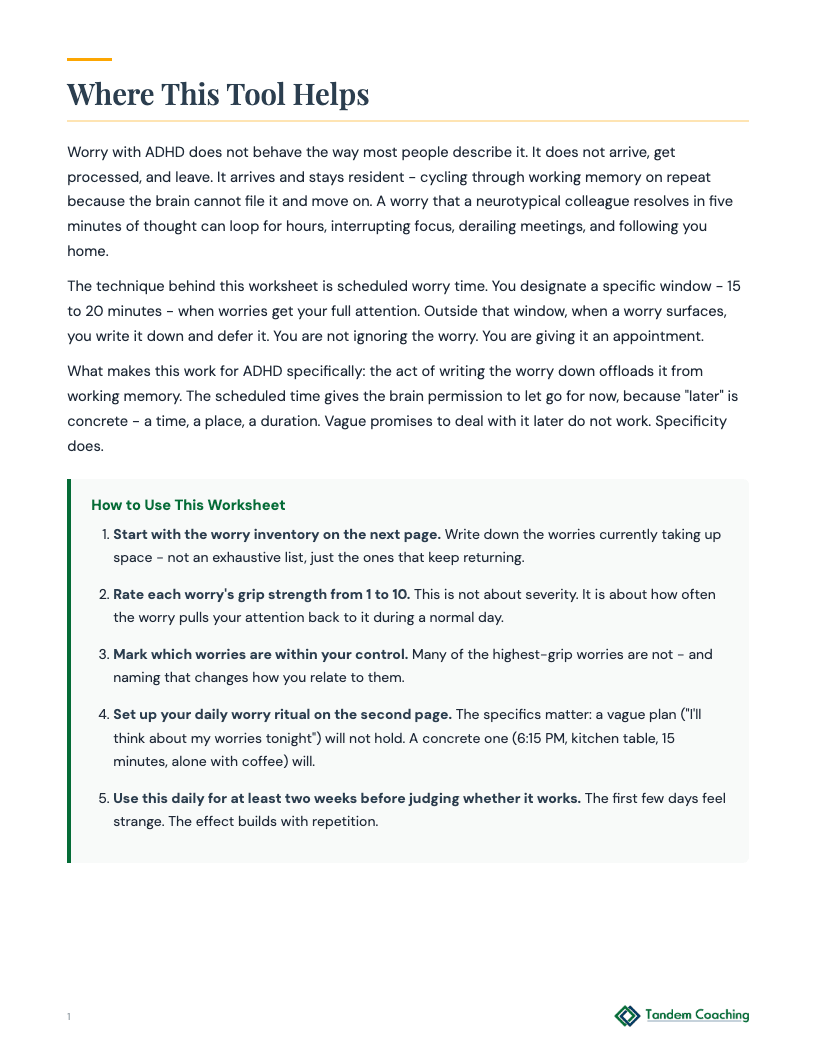
Trying to stop worrying doesn't work. Scheduling it does. This worksheet sets up a worry inventory and a specific daily ritual so the worries have a time and place - and the rest of the day doesn't have to hold them.
A client with ADHD works as a data analyst and has identified that worry interrupts their focused work sessions. A thought about an unresolved problem - a conversation they need to have, a bill they have not paid, an email they have not sent - surfaces during focused work, they feel the pull to address it immediately, and the work session ends. They have tried ignoring the worry but find it intensifies. They have tried addressing it immediately but then the task they were working on cannot be resumed.
Frame this as a scheduled acknowledgment system, not a suppression system: 'You are not putting the worry away. You are giving it a specific time when you will actually address it, which means you can stop carrying it through your work session.' The ADHD-specific failure mode here is not returning to the worry at the designated time. Pre-frame that explicitly: 'The practice only works if the designated worry time is actually used. If you write it down and never look at it again, you train yourself that the Jar is a trash can, not a deferral system.' Set the worry time before introducing the tool - the client should know exactly when their 15-minute window will be before they start writing anything into the Jar.
Watch for the client's Jar entries becoming increasingly abstract over time - from 'I need to call my insurance company about the billing error' to 'I'm worried about money.' The specificity of the entry predicts whether the designated worry time will be productive. If entries are abstract, the client is using the tool for emotional discharge but not for problem-solving. Redirect: 'What specifically would you need to do to address that worry? Write that, not the feeling.' Also watch for the Jar being used for catastrophic future scenarios that have no actionable step - 'What if I lose my job?' These need a different response than deferral.
Start with the carry-forward question: 'Which worries from last week did you actually address during your worry time?' The ratio of written-to-addressed worries tells you whether the Worry Time is functioning. If the client wrote 12 worries and addressed 2, either the worry time is too short, the items are not actionable, or the worry time is not being used. Then examine a specific item that was successfully deferred and addressed: 'Walk me through what happened during your worry time for that one.' The mechanics of a successful deferral cycle are more useful than general encouragement to keep using the tool.
Array
A client with ADHD has a strong rumination pattern - they return to the same worries repeatedly across a day, rehearsing possible outcomes and responses. Working memory limitations mean that each time the worry surfaces, it feels as urgent as the first time, with no sense of having already thought about it. The client is exhausted by the repetition but cannot stop it through intention alone.
Name the working memory mechanism explicitly: 'Your brain keeps returning to the worry because it has no reliable way to store the fact that you already thought about it. Writing it down externally gives it a place to be held so your brain can stop holding it.' Some clients will push back: 'I've tried writing things down and I just ignore the list.' The distinction with the Worry Jar is the designated return time - the list matters because there is a scheduled moment to revisit it. Without the worry time, the Jar does not function. Build the scheduled worry time into the client's calendar during the session before they leave.
Watch for the client reporting that the Jar reduces worry during some days but not others. Ask what differentiates the days where it works from the days it does not. Often the pattern is that the Jar works when the worry is moderate but fails during high-anxiety states. This is normal - grounding strategies work less well during peak anxiety - and worth naming so the client does not conclude the tool is broken. The Jar is most effective as a maintenance tool during moderate states, not as an emergency intervention during acute anxiety.
Start with the frequency question: 'How many times did the same worry appear in the Jar in a single week?' High frequency of the same worry is a signal either that the worry is not being addressed during worry time, or that the worry is not addressable through action (it is a genuine uncertainty or catastrophic scenario). For the second category, the coaching conversation should shift from 'how do we address this worry' to 'how do you hold uncertainty that cannot be resolved.' For the first category, examine what is blocking the action step.
Array
A client with ADHD is a team lead who has a recurring weekly one-on-one with their director that produces significant anticipatory worry for 24-48 hours beforehand. They know the meeting is rarely as bad as they anticipate, but the anticipation still derails their work. They want to keep the worry from occupying the two days before the meeting.
Frame the Jar as a container for anticipatory worry specifically: 'You are pre-filling the Jar with the concerns you already know you will have about the meeting, so you are not generating them throughout the day.' Walk the client through a practice session during coaching: identify the specific worries they have about the upcoming meeting, write them into Jar entries, and then schedule a 15-minute worry time one hour before the actual meeting. The proximate worry time matters here - it gives the anticipatory worries a concrete resolution point that is close enough to feel real.
Watch for the client's pre-meeting Jar entries being about outcomes they cannot control ('what if she tells me I'm not meeting expectations') rather than actions they can take. Entries about uncontrollable outcomes do not benefit from the standard Worry Time structure - they need a different coaching intervention around tolerance of uncertainty. Sort the Jar entries with the client: 'Which of these are worries you can do something about? Which are worries about what someone else will do?' The actionable ones go into the Jar. The uncertainty ones need a different conversation.
After the meeting has occurred, revisit the Jar entries: 'Which of these came up in the actual meeting? Which didn't?' This creates a calibration loop - the client sees, over multiple cycles, which of their anticipatory worries are accurate and which are not. Most clients discover that their worst-case scenarios are rarely what actually happens, but they also discover that some concerns are worth preparing for. The Jar data builds a more accurate prediction model over time.
Array
ADHD adult whose focus breaks down in specific environments or situations
ADHDADHD adult who can't see patterns in their emotional or energy fluctuations across the week
ADHDA client needs an immediate physiological tool for managing acute stress or reactivity