

Home Reset Checklist
Room-by-room checklist for ADHD adults to complete a full home reset without guessing what to do next, built from ADHD coaching strategies.
Get This Tool
Free, print-ready PDF.
When to Use This Tool
ADHD adult who needs a concrete room-by-room checklist to complete a full home reset
A client who gets stuck mid-cleaning because they don't know what 'done' looks like
Person who wants a printable reference so they don't have to hold the task list in their head
How to Introduce This Tool Plus
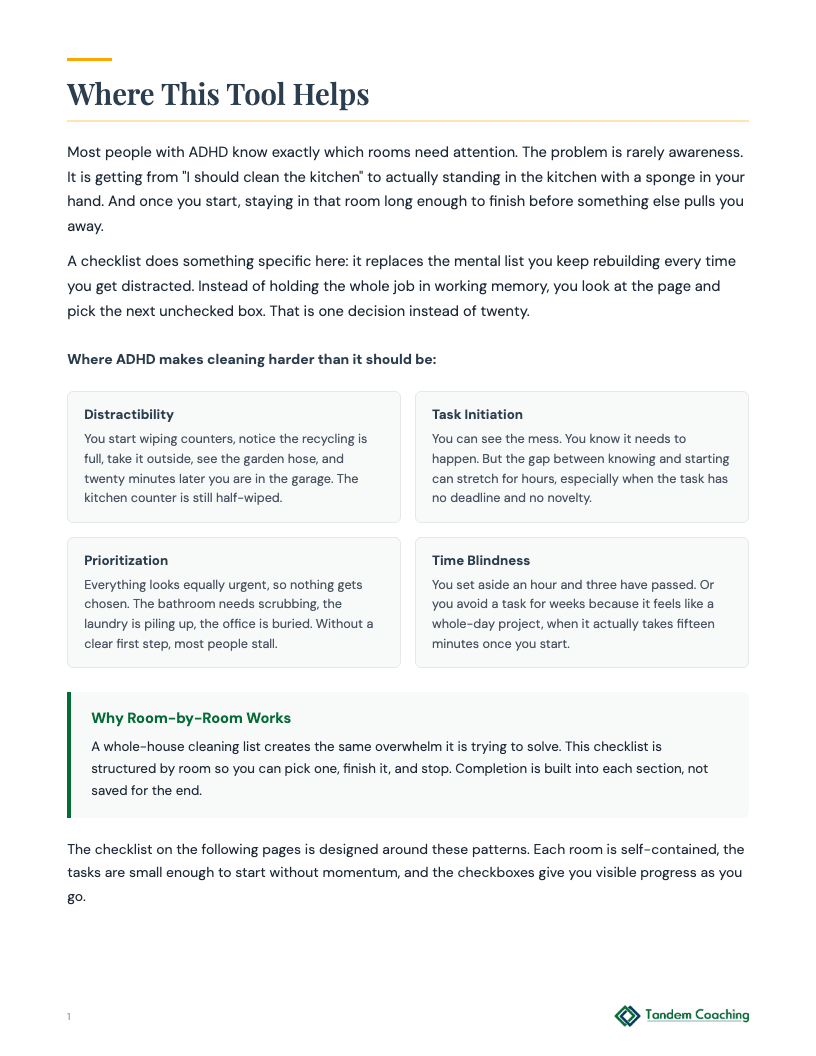
One of the most useful things about a checklist is that you don't have to decide what to do next - you just look at what hasn't been checked yet. This one covers the full home, room by room.
Browse All Pages
Tool Classification
Domain
ADHD
Type
Checklist
Phase
Action
Details
15 min
Between sessions
As-needed
Topics
Executive Function
Habits
Time Management
For the Coaching Practitioner
Plus
Coaching Scenarios
Plus
1 Executive whose home chaos is bleeding into work performance ▶
Context
A senior director reports difficulty focusing at work and mentions offhandedly that their home is 'a disaster.' When pressed, they describe a living space that's gone from manageable to overwhelming over six months of a high-pressure project. The environment is now a source of shame that compounds their cognitive load.
How to Introduce
Frame this as a functional reset, not a cleaning task. 'When the environment is disorganized, the brain keeps a background tab open tracking everything out of place. This checklist closes those tabs one room at a time.' Name the ADHD-specific pattern upfront: 'Most people start with motivation and run out before the kitchen is done. This tool is designed for that - you pick one room, you set a timer, and you stop when it rings whether you're done or not.'
What to Watch For
If the client picks the hardest room first - the storage room, the home office - they're framing this as a performance task rather than a reset. Redirect to the easiest visible room. If they describe wanting to 'do it all in one day,' the perfectionism pattern will guarantee failure; the tool's value is the 15-25 minute limit, not completion.
Debrief
Start with what actually happened, not what was planned. 'Which room did you do, and did you stop at the timer?' Then move to the cognitive experience: 'What did you notice in the first five minutes versus the last five?' The before/after shift in mental clarity is the coaching data - not the cleanliness of the room.
Flags
If the client's description of their home environment includes language about being 'disgusted with myself' or 'I can't have anyone over,' the shame load around the environment may be doing more damage than the disorganization itself. Severity: moderate. Response: continue with the tool, but open space to separate the person's worth from their environment before assigning the task.
2 New manager overwhelmed by competing demands at home and work ▶
Context
A recently promoted manager is struggling with the transition from individual contributor to people manager. They're working longer hours and their domestic routines have collapsed. Their partner has raised concerns about the state of their home, adding relationship friction to an already stressful period.
How to Introduce
Position this as a small-win tool during a transition that has few of them. 'You're in a period where most of the wins are slow or invisible - building relationships, learning new systems. This gives you a visible, completable win in 20 minutes.' Be specific about what the checklist does and doesn't ask for: 'You're not expected to deep-clean anything. The task is to move visible clutter to where it belongs, room by room, in short bursts.'
What to Watch For
Watch for the client treating this as a low-priority homework item they squeeze in when everything else is done. That framing means it never happens. If they're reporting back 'I didn't get to it,' ask what time of day they attempted it - ADHD clients often assign tasks to future-self at peak energy, then find that time eaten by other demands.
Debrief
Ask specifically about the timer experience. 'Did you stop at 25 minutes, or did you keep going?' Clients who override the timer are often in a cycle of either all-or-nothing effort - which this tool is designed to interrupt. Then ask: 'Did you notice any shift in how the space felt after one room?' Small environments changes often have outsized mood effects worth naming.
Flags
If the client cannot identify any 15-minute window in their day that is genuinely available for non-work tasks, the workload itself may be unsustainable. Severity: moderate. Response: use the checklist failure as a lever to examine whether the new role's demands are actually manageable or whether the client needs to renegotiate scope.
3 Client rebuilding routines after a depressive episode ▶
Context
A freelance designer in their early 30s is returning to work after a three-month mental health leave. Their home became severely disorganized during the episode and now the disorganization reinforces their sense of being 'behind' and 'broken.' They are working with both a therapist and a coach, with the coach focused on rebuilding functional routines.
How to Introduce
Name the shame spiral before it starts. 'When a space gets to a certain point, just looking at it takes energy - it reminds you of what fell apart. This tool isn't about catching up; it's about interrupting that loop. One room, one timer. You don't owe the space a full recovery in one session.' Ask about the lowest-friction room - not the worst one, the easiest one.
What to Watch For
The room they pick tells you about their current capacity. If they pick the most visible or most shameful room, they're trying to prove something. If they pick a room they barely use, they may be protecting themselves from confronting the parts of the home that carry the most emotional weight. Both are informative. Watch also for reported completion time: under 10 minutes likely means they did a surface pass without fully engaging.
Debrief
Start with the emotional experience before the physical result. 'How did it feel to be in the room while you were doing it?' Then: 'Was there a moment where you wanted to stop before the timer went off?' The goal here is not to produce a clean room - it's to build evidence that they can initiate and complete a bounded task. That's the data worth tracking.
Flags
If the client reports being unable to enter the worst rooms of their home at all - not avoidance but active distress at the threshold - this is outside the scope of this tool. Severity: high. Response: pause the home-reset work, flag the observation to the client directly, and explore whether the therapist is aware of this specific pattern.
Tool Flow
Plus
Requires
- None - standalone tool
→
Produces
- room-by-room task completion record
- reusable printable cleaning checklist
Pairs Well With
ADHD
ADHD Brain Dump
ADHD adult who feels overwhelmed by competing demands and can't prioritize what to work on first
Why it pairsRunning the brain dump first clears the mental backlog that would otherwise pull your client off-task mid-checklist.
ADHDOptional Digital Context and Cleanup Notes
Use this checklist to review habits and executive function without assuming every item applies.
Why it pairsOnce the physical reset is done, the familiar checklist format carries your client's momentum into their digital environment.
ADHDWeekly Household Task Grid
A client wants to use Weekly Household Task Grid as an optional reflection
Why it pairsThe completed reset checklist gives you the exact task list to distribute across the scheduler's weekly grid.
Related Articles


Measuring Progress in ADHD Executive Coaching: Complete Guide
Read article →
Technology Tools for ADHD Executive Success: Complete Guide
Read article →
Remote vs In-Person ADHD Coaching: The Research
Read article →
You Have the Title but Not the Room
Read article →