Sort your to-dos by impact and effort to choose what to do next. A proven prioritization matrix used in coaching and planning.
Free, print-ready PDF.
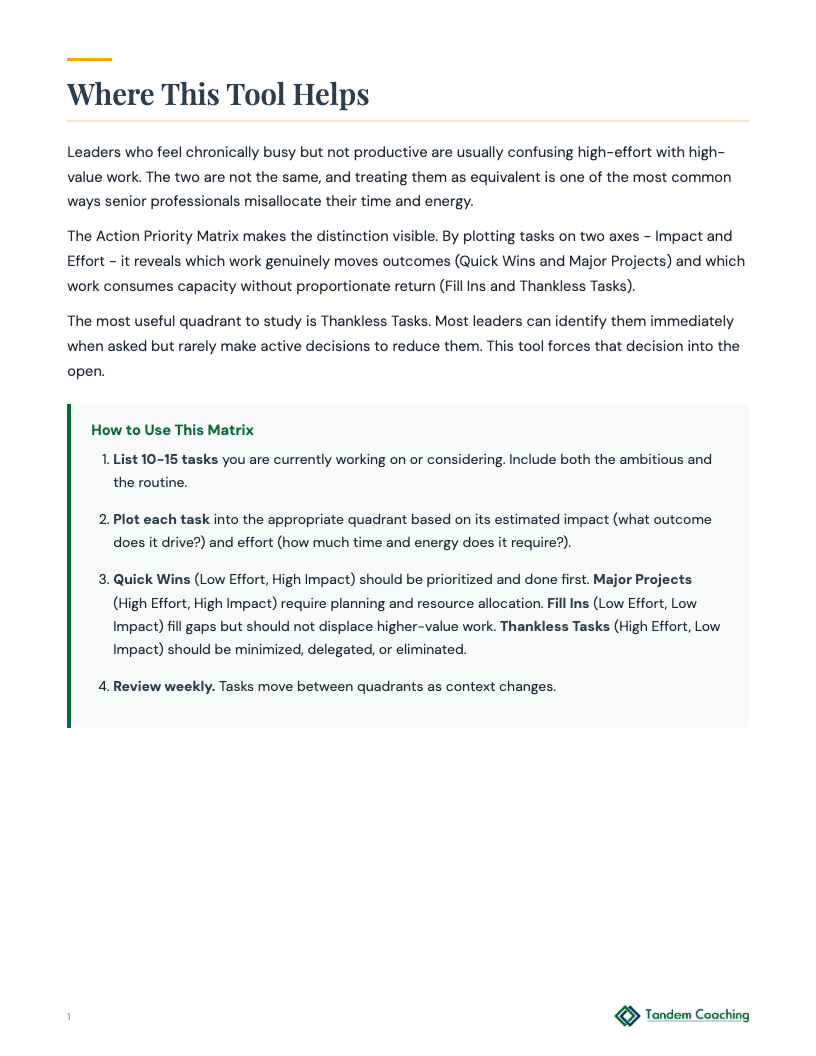
After placing your tasks in the four quadrants, what landed in 'quick wins' that you could act on this week — and what's in 'thankless tasks' you might stop doing altogether?
A client who is a director of product at a software company arrives at each coaching session with a list of fifteen to twenty active tasks and no clear sense of where to start. She is spreading effort across all of them without visible traction on any. The action priority matrix - which plots tasks by impact (high/low) against effort (high/low) - converts the undifferentiated list into four quadrants: quick wins, major projects, fill-ins, and tasks to eliminate or delegate. The primary value in her situation is not the quadrant labels but the act of sorting - the matrix forces a judgment about relative importance that she has been avoiding.
Frame the matrix as a decision-forcing tool rather than a planning framework: 'Every week you come in with a list and no clear starting point. The list isn't the problem - the absence of sorting is. This matrix forces you to make a judgment about every task: how much effort does it actually require, and how much impact does it actually produce? Bring your current task list to our next session and we'll map every item together. The goal is to finish the session with three tasks in quick wins and a clear picture of what you're going to stop doing.' Walking through it together in session the first time increases the accuracy of the effort and impact estimates.
Watch for the client rating most tasks as high impact - the matrix only works when the impact axis is calibrated honestly. Ask: 'You rated six tasks as high impact. If you could only complete one of them this week and had to abandon the other five, which one would you choose?' Forced-choice calibration reveals what high impact actually means for this client. Also watch for tasks that belong in the eliminate or delegate quadrant (low impact, high effort) being rated high impact because the client feels obligation to them rather than because they actually produce results. The obligation-versus-results distinction is the primary coaching conversation generated by this tool.
After mapping the current task list: 'What's in the quick wins quadrant? How many of those could you complete this week?' Quick wins completion is the most immediate behavioral change the matrix enables. Then examine the eliminate/delegate quadrant: 'What have you kept doing in this category that doesn't belong there? What would it take to actually stop doing one of those tasks this week?' The elimination conversation is harder than the prioritization conversation and deserves its own time.
Array
A client who is a chief operating officer at a professional services firm is consistently working sixty-five to seventy hours per week and describes being the only person who can do many of the tasks on his list. His coach has explored delegation before, and the client insists that delegation would require more time to explain than to do himself. The action priority matrix provides a structure for this conversation that bypasses the delegation-resistance by starting with impact and effort analysis - the tasks that land in low-impact/high-effort quadrant are elimination and delegation candidates before any discussion of delegation competence.
Position the matrix as a business case for elimination, not a delegation training exercise: 'Before we talk about how to delegate, I want to see what deserves to be delegated or eliminated altogether. Those are different questions. This matrix plots every task by how much it's actually moving the business versus how much of your time and energy it requires. Bring your last week of tasks - everything you spent time on, not what was on your task list. We'll map them and let the matrix surface what doesn't belong in your week rather than you defending what does.' The 'everything you actually did' instruction rather than 'planned tasks' produces more accurate data.
Watch for the client placing tasks in high-impact quadrants as a defense mechanism against examining them - the same tasks that consume the most time are often rated highest impact to justify the time spent. Ask the forcing question: 'If this task didn't get done for a month, what would the business impact be?' The thirty-day absence test is a better impact calibration than self-report. Also watch for low-effort tasks being used to fill time between high-effort ones landing in fill-ins rather than being recognized as candidates for elimination - if a task has low impact and is only low effort because it's become routine, the routinization doesn't make it worth keeping.
After mapping: 'What's in your eliminate/delegate quadrant that would free up the most hours if you stopped doing it this week?' That question converts the analysis into a specific time-savings estimate. Then ask: 'Is there anyone on your team for whom one of these tasks would be a development opportunity rather than a burden?' The reframe from 'offloading' to 'developing' often makes delegation more accessible for COOs who resist it as a sign of disorganization.
Array
A client who is a principal at a management consulting firm has been in a low-output period for six weeks following a difficult client engagement. She has a backlog of internal projects and business development tasks and describes feeling unable to get started on any of them. The action priority matrix is used here not as a prioritization tool but as a momentum-building tool: the quick wins quadrant identifies tasks that can be completed within the week with visible results, and beginning with those tasks interrupts the stalled pattern without requiring the client to tackle the most complex or highest-stakes items first.
Frame the goal as momentum rather than priority: 'You have a backlog and you're not getting into it. We're not going to start with the highest-priority items because the highest-priority items are also the hardest to start. We're going to start with quick wins - tasks that can be completed in a day or less and produce something visible. This matrix sorts your backlog by effort and impact. The quick wins quadrant is where we're going first. Complete the matrix tonight and identify three quick wins you could finish by Friday.' The explicit goal of three completions by Friday creates a concrete short-horizon target.
Watch for the client completing the matrix but identifying no quick wins because she has rated all tasks as either high effort or low impact. If this happens, ask: 'Is there anything on this list that has been on your backlog for two or more weeks and isn't complex - something you've been avoiding not because it's hard but because you haven't gotten around to it?' That question often surfaces tasks that were rated as low-priority but are actually quick wins that got lost under the high-priority items. Also watch for the client selecting quick wins and then not completing them by the agreed time - the non-completion is diagnostic of whether the stall is situational or more persistent.
Start with what was completed: 'Which quick wins did you finish by Friday? What happened to the ones you didn't complete?' Completion versus non-completion tells the coach whether the momentum strategy is working. If completions happened: 'What did it feel like to finish those things after six weeks of stall?' Naming the emotional experience of completion reinforces the pattern. If nothing was completed: the coaching conversation needs to examine what specifically interrupted the attempt - whether the task selection was wrong, whether something got in the way, or whether the stall is more resistant than anticipated.
Array
I start the year strong but lose momentum by March
CareerI earn decent money but never know where it goes by end of month
ExecutiveI want to audit how well my business actually operates across all major functions

![Why is Leadership Development Important? [Quick Answer]](https://cdn.tandemcoach.co/wp-content/uploads/2024/08/TC-215.jpg)