Career Coach Certification: What Actually Counts in 2026
What is career coach certification?
Career coach certification is a professional credential showing you are trained to coach people through career decisions. It is not a legal license, since coaching is unregulated, but ICF accreditation is the credential corporate clients and employers recognize. You can earn it new or add it as a specialization.
You have decided you want to work as a career coach, and now you are staring at an alphabet soup of credentials: CCP, CPCC, IACC, CCC, and somewhere in the mix, ICF. Every program that sells one of them will tell you theirs is the one that matters. None of them will tell you the harder truth, which is that career coaching is unregulated and you are not legally required to hold any of these at all. This guide does what the sales pages will not: it ranks the career coach certifications by what actually holds up, answers whether you need a credential in the first place, lays out the real cost and time, and points you to the right path for where you are starting from.
Key Takeaways
- Career coaching is unregulated, so no certification is legally required; a credential is a signal of competence and credibility, not a license.
- ICF accreditation (ACC, PCC) is the durable, transferable signal; vendor certificates like the NACE CCP, PARWCC CPCC, and IACC are narrower and niche-locked.
- The NCDA CCC is a career-counseling credential, which is a related but distinct profession from coaching.
- New to coaching: get ICF-credentialed (ACC, then PCC). Already credentialed: add a career specialization through ICF Continuing Coach Education (CCE) rather than a second full credential.
- An ICF ACC runs roughly $4,000 to $7,000 all-in over six to twelve months; vendor certificates cost less and take less time, which is also why they signal less.
Do You Actually Need to Be Certified?
No. Coaching is unregulated in the United States, the United Kingdom, and the European Union. There is no license, no board you must register with, and nothing that legally stops you from taking on your first client tomorrow. Anyone can use the title. That is worth hearing plainly, because the entire first page of search results has a commercial reason to imply otherwise.
That holds right across the field. Career coaching, like life coaching, sits outside any licensing regime, even though the work itself is substantial: the help clients rely on to navigate career transitions, think through a job search, and steady a working life in motion. The absence of a license says nothing about how hard the work is to do well.
What a certification buys you is not permission. It buys two things. The first is competence: a real training program teaches you to coach rather than to advise, and that skill is the actual product you will be selling. The second is credibility, and this is where it earns its cost. Corporate buyers and HR procurement teams increasingly screen for recognized credentials before they will hire a coach for outplacement, leadership, or career-transition work. In private practice, a credential shortens the time it takes a prospective client to trust you, and it justifies a higher rate. If you understand what career coaches actually do day to day - helping people clarify direction, weigh decisions, and act with confidence rather than handing them answers - you can see why the training matters more than the certificate hanging on the wall.
So the honest framing is this: you do not need to certify to start, and you should be skeptical of anyone who tells you otherwise. You need one when you want corporate access, premium rates, or simply the confidence of knowing you can do the work well. For most people serious about a coaching career, that case arrives quickly.
The Certification Field, Ranked by What Holds Up
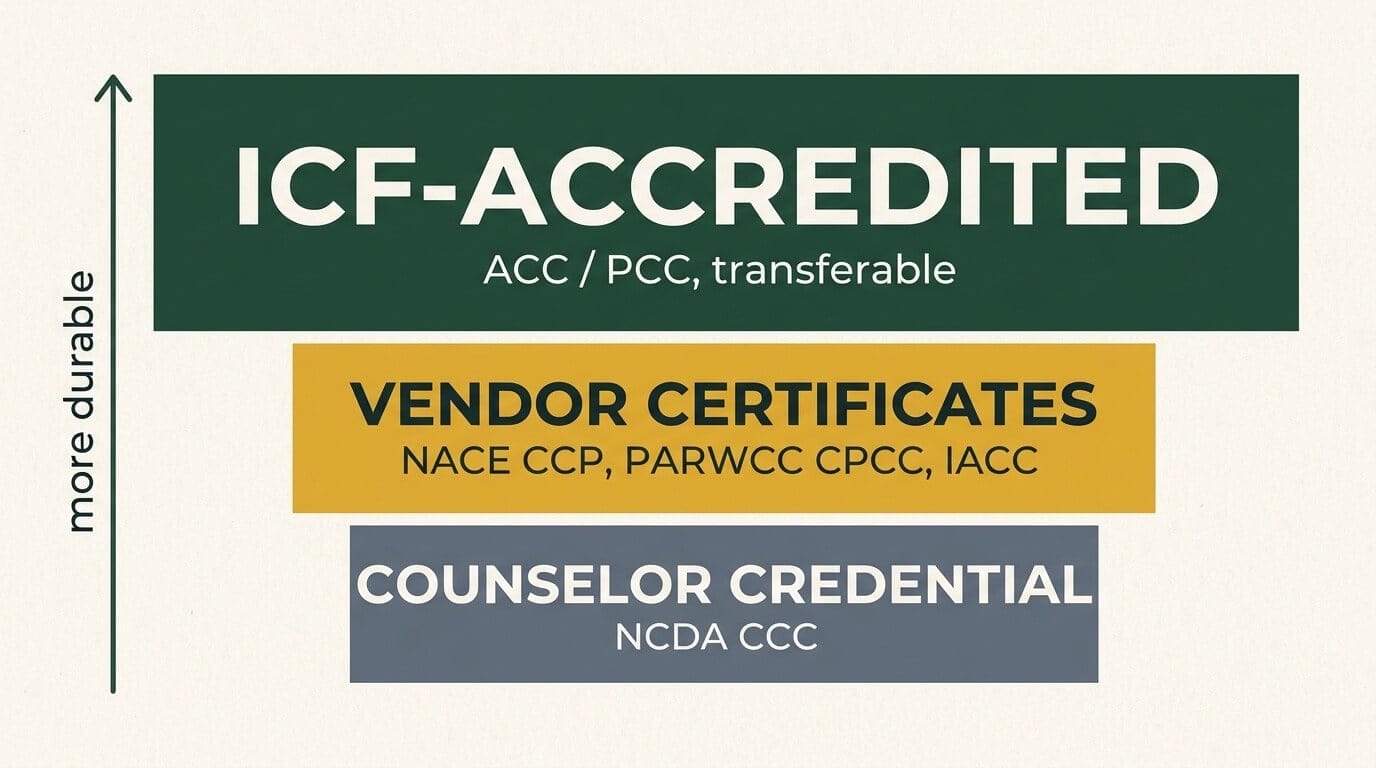
Here is the comparison no single vendor will write, because each one is selling its own badge. What holds up in a hiring conversation or a procurement review is not the issuer's own marketing. It is whether an independent body assessed your work against a standard that someone outside the program recognizes. By that measure the field sorts into three tiers: ICF-accredited credentials, standalone vendor certificates, and counselor credentials from an adjacent profession.
| Credential | Issuing body | ICF-accredited | Training / experience | Typical cost | Best for |
|---|---|---|---|---|---|
| ICF ACC / PCC | International Coaching Federation | Yes - the standard | 60 - 125+ training hours, 100 - 500+ coaching hours, mentor coaching, performance review | ~$4,000 - $7,000+ all-in | Coaches who want a recognized, transferable credential |
| NACE CCP | National Association of Colleges & Employers | No - routes to BCC | ~12 self-paced modules | ~$1,000 - $1,500 (member pricing) | Career-services staff in universities |
| PARWCC CPCC | Prof. Assoc. of Résumé Writers & Career Coaches | No | 8 - 12 weeks plus an exam | ~$1,395 - $1,570 + ~$175 membership | Résumé writers adding career coaching |
| IACC certification | International Association of Career Coaches | No | Self-paced, on-demand | A few hundred dollars | A fast, low-cost vendor badge |
| NCDA CCC | National Career Development Association | No | Career-development coursework | Varies | Career counselors (a different profession) |
The rigor-ranking behind the table is straightforward. An ICF credential - Associate Certified Coach (ACC) or Professional Certified Coach (PCC) - is a professional certification assessed by an independent body, and it travels: it is recognized across every coaching niche and across borders, so it is not locked to the program that issued it. A vendor certificate like the NACE CCP, the PARWCC CPCC, or an IACC certification confirms you completed one organization's curriculum. Some of those career coaching programs teach genuine coaching skills, but the badge is narrower and does not transfer. PARWCC's CPCC program, for instance, is built around résumé writing and career documents - a real craft, but a narrower one than coaching. There is no single best career coach credential for every situation; there is only a clear ranking by what endures. The NCDA CCC sits in career counseling, which is a related but distinct profession with its own standards.
Two distinctions trip up almost everyone, and no neutral source clears them up. First, "CPCC" is overloaded: here it means PARWCC's Certified Professional Career Coach, which is a different credential from the Co-Active CPCC designation you may have seen elsewhere. Second, the NACE program routes graduates toward a Board-Certified Coach (BCC) outcome through the Center for Credentialing & Education, not toward ICF. If you want the detail on the coaching ladder itself, what each ICF credential requires lays it out, and how ICF compares with other certification bodies goes deeper on the cross-credential picture. You can also read NACE's own framing on NACE's career coach certification program page to see the BCC route stated plainly.
Why ICF Accreditation Is the Durable Signal
If one credential is going to outlast the others on your resume, it is the ICF one, and there are three concrete reasons why. The first is reach. The International Coaching Federation operates in more than 160 countries, so an ICF credential is understood whether you are coaching in Dallas or Dubai. A vendor certificate rarely means anything outside the program that granted it.
The second is corporate recognition. When an organization buys coaching - for a leader in transition, for an outplacement program, for an internal talent initiative - procurement and HR professionals use ICF credentials as a filter. A vendor career-coach certificate generally does not clear that bar for a coaching engagement, however good the training behind it was. The third reason is transferability. An ICF credential is yours across every specialty you ever practice, from career to leadership to team coaching. It is built on assessed coaching hours, mentorship, and demonstrated competency against the ICF code of ethics and its ethical and professional standards, which is exactly what makes it portable. A niche badge is locked to its niche.
This is the standing from which Tandem writes, plainly and as a matter of fact: we are an ICF-accredited training provider led by Master Certified Coaches, so we have no stake in any single vendor badge and every reason to point you toward the credential that actually holds up. None of this requires restating the ICF application mechanics here; how ICF credentialing works covers the requirements step by step, and ICF publishes the full ladder on its ICF credentials overview. The one piece worth carrying into the next section is this: becoming an ICF certified professional coach is the start of a path, not the end of it. Once credentialed, you add focused specialties through Continuing Coach Education rather than starting over.
Already Credentialed? The Career Specialization Route
If you already hold an ICF credential, you have done the hard part - the assessed coaching hours, the mentor coaching, the demonstrated competency. Going out to buy a separate vendor career-coach certificate now usually means paying again for fundamentals you already have, in order to get a narrower badge than the one you are already holding. For most experienced coaches, that is buying the same thing twice.
The route ICF built for exactly this is CCE, and it is worth being precise about the acronym: here CCE means ICF Continuing Coach Education, the hours that count toward maintaining and renewing your credential. (It is not the Center for Credentialing & Education, the body behind the BCC mentioned earlier - same three letters, different organization.) Instead of a second full credential, you add a focused career-coaching specialization: the conversations specific to job transitions, professional reinvention, and career identity, plus the coaching methodologies and frameworks that make that work land. Those hours strengthen your coaching practice, count toward renewal, and keep your durable ICF credential at the center. For experienced coaching professionals, the work here is depth rather than basics: the frameworks and the knowledge specific to career conversations, applied in your actual coaching sessions so the coaching process holds steady when a client's question is about their livelihood. It builds on your original coach training instead of repeating it.
This is the efficient path for an experienced coach moving into career work, and it is the one no vendor sales page will show you because it does not sell them a from-scratch enrollment. Tandem's career coaching specialization for credentialed coaches is a CCE course built for precisely this move - adding the career lane to a coaching business you have already established. The decision rule is simple: a full vendor certificate makes sense if you hold no coaching credential yet; a CCE specialization makes sense if you already do.
Once you hold the credential, the efficient move is to add a specialty, not to buy a second beginning.
What It Costs - and Whether It's Worth It
Real numbers help, so here they are without the padding. An ICF ACC credential, all-in - accredited training, the required mentor coaching, and the ICF application fee - commonly runs somewhere between $4,000 and $7,000, rising as you move toward PCC. A vendor certificate sits lower and narrower: PARWCC's CPCC runs roughly $1,395 to $1,570 plus about $175 in membership, and self-paced options from providers like ed2go or a university continuing-education arm such as Texas State University sit lower still. For the full line-item ICF picture, what ICF certification costs breaks it down properly; the goal here is the shape of the investment, not every receipt.
The Credential That Holds Its Value
An ICF credential is the investment that pays back in corporate access and rate. Tandem’s MCC-led ACC program is the accredited, transferable path - see what it includes.
Time follows the same pattern. An ICF ACC typically takes six to twelve months once you account for the coaching hours you have to accumulate and have assessed. A vendor certificate can be done in eight to twelve weeks because it is testing completion of a curriculum, not assessed practice. That speed is a real difference, and it is also exactly why the faster credential signals less.
Is it worth it? Honestly, it depends on what you are buying it for, and you should be clear-eyed before you spend. It is worth it when your goal is corporate or outplacement work, where a recognized credential is the price of entry and justifies a premium rate, or when you simply want the competence to coach well rather than improvise. Where I would slow you down is if you are reaching for a credential as a substitute for building a practice. No certificate fills a calendar, and a coaching career is built on the work of finding clients and helping others, not on the letters after your name. If you are already credentialed, the math shifts entirely: a CCE specialization is additive and a fraction of the cost of starting over.
Which Path Is Right for You
Strip away the alphabet soup and the decision comes down to where you are starting from. Three paths cover almost everyone.
- New to coaching. If you have decided to become a career coach, the durable move is to become a certified career coach through ICF. The ACC is the entry credential and the PCC is the professional standard most coaches build toward; together they give you the skills needed to coach well and the foundation every later specialty sits on. Tandem's MCC-led ICF ACC certification program is built for new coaches, and when you are ready to advance to the PCC level the path continues without starting over.
- Already ICF-credentialed. Add career coaching through a CCE specialization rather than a second full credential. It is faster, it is cheaper, and it builds on the credential you already hold instead of duplicating it.
- Career-services professional or counselor. One question settles it: are you advising, or are you coaching? If your work is advising - assessments, résumé strategy, career guidance, and labor-market guidance for job seekers in a tight job market - the credential you already hold fits the job, and the career services teams in universities and workforce development programs are built around exactly that. If you want to coach, meaning you partner with someone on their own career goals and the longer arc of their working life - their career paths, their career advancement, the career management calls only they can make - rather than handing them answers, then ICF is where that skill is recognized, and what you hold already complements it. For context on the client side of that work, career coaching for job seekers shows what the engagement looks like from the other chair.
Whichever path is yours, the move that holds up over a career is the credential an independent body assessed. Everything else is a faster way to a narrower badge.
The credential that holds up is the one an outside body assessed, not the one whose only authority is the company that sold it.
Frequently Asked Questions About Career Coach Certification
Do you need a certification to be a career coach?
No. Career coaching is unregulated, so there is no legal requirement and anyone can use the title. A certification is a signal of competence and credibility rather than a license. You need one when you want corporate clients, premium rates, or the confidence of formal training, which is the case for most serious coaches.
Which career coach certification is most respected?
For coaching proper, an ICF credential - ACC or PCC - is the most widely recognized and the only one that transfers across niches and borders. The NACE CCP carries weight inside university career-services roles. Vendor certificates like the PARWCC CPCC are respected within their niche but do not travel as far.
Is ICF certification required for career coaching?
Not legally. You can coach without it. In practice it is close to required for corporate and outplacement engagements, because HR and procurement teams use ICF credentials as a screening filter. For private-practice career coaching, it is strongly advantageous but optional.
How much does career coach certification cost?
An ICF ACC runs roughly $4,000 to $7,000 all-in, including accredited training, mentor coaching, and the application fee. Vendor certificates such as the PARWCC CPCC cost far less, around $1,400 to $1,570 plus membership, and are narrower in scope. See what ICF certification costs for the full breakdown.
How long does it take to get certified?
An ICF ACC commonly takes six to twelve months, because you have to accumulate and have assessed real coaching hours. A vendor certificate can be finished in eight to twelve weeks since it confirms completion of a curriculum rather than assessed practice. A CCE specialization for an already-credentialed coach is shorter still.
I'm already an ICF coach - how do I specialize in career coaching?
Add a career-coaching specialization through ICF Continuing Coach Education (CCE) rather than buying a second full credential. The specialization hours count toward your renewal and build on the credential you already hold. Tandem's career-transition CCE course is built for exactly this move.
Get ICF-Credentialed with an MCC-Led Program
If you are starting fresh, the durable path is an ICF credential. Tandem’s ACC certification is taught by Master Certified Coaches and built to take you from new coach to a credential that actually travels.
Explore the ACC Program →