Change Management in Project Management: Closing the Adoption Gap
How can I close the adoption gap in change management?
Embed change management as a lens on every project decision, not a parallel workstream. Add change impact assessment to scope decisions, include adoption readiness in go/no-go criteria, build adoption time into the schedule, and measure utilization alongside technical metrics. The gap closes through coaching competencies, not process additions.
The ERP implementation was a textbook project success. Delivered two weeks early. Under budget by 8%. Every requirement met. At the six-month review, system utilization was at 45%. The project team had delivered a solution. What they had not delivered was adoption.
The project manager had managed every dependency, every risk, every deadline. The one thing he had not managed: the 200 people whose daily work changed because of his project. That gap between project delivery and organizational adoption is where change management lives. And the skills to close that gap are not on the PMP syllabus.
Change management in project management is the discipline of embedding human adoption into every project decision—from initiation through closure. It addresses how people experience, resist, and ultimately embrace project-driven change, distinct from standalone change management that operates as a separate organizational function.
The gap between delivering a solution and delivering adoption is not a process problem. It is a capability problem, and coaching develops it faster than any certification. Roman Pichler’s workshop talk on dealing with difficult stakeholders illustrates how agile practitioners approach the resistance and readiness dynamics that project managers often underestimate.
The Integration Gap: Why Parallel Workstreams Fail
Most organizations treat change management as a discipline that runs as a separate workstream alongside the project plan. This parallel approach creates a parallel universe. The project team builds the solution. The change team prepares the people. Neither fully understands what the other is doing. At go-live, the solution meets the people, and the gaps between those parallel workstreams become visible in adoption numbers.
Make Every Project Decision a Change Decision
If your change plan lives in a parallel universe, we’ll help you integrate impact and readiness into scope, schedule, and budget choices.
The myth that change management is a distinct discipline that can be staffed separately from project delivery persists because it is organizationally convenient. It allows project managers to focus on what they know: scope, schedule, budget, quality. It lets someone else handle the messy human dimension. The problem is that scope decisions create change impacts. Schedule decisions affect people’s readiness. Budget decisions determine whether adoption receives resources or just attention.
Change management is not a separate work plan. It is a lens applied to every project decision. Who is affected by this scope change? What does this timeline adjustment mean for people’s readiness? How does this technical decision create or remove adoption barriers? When these questions are embedded in project decision-making rather than delegated to a parallel team, integration happens. When they are not, the project delivers outputs while the organization fails to achieve outcomes.
Scope decisions create change impacts. Schedule decisions affect readiness. Every project decision is a change decision—most project managers just don’t see it that way.
Where Change Management and Project Management Intersect
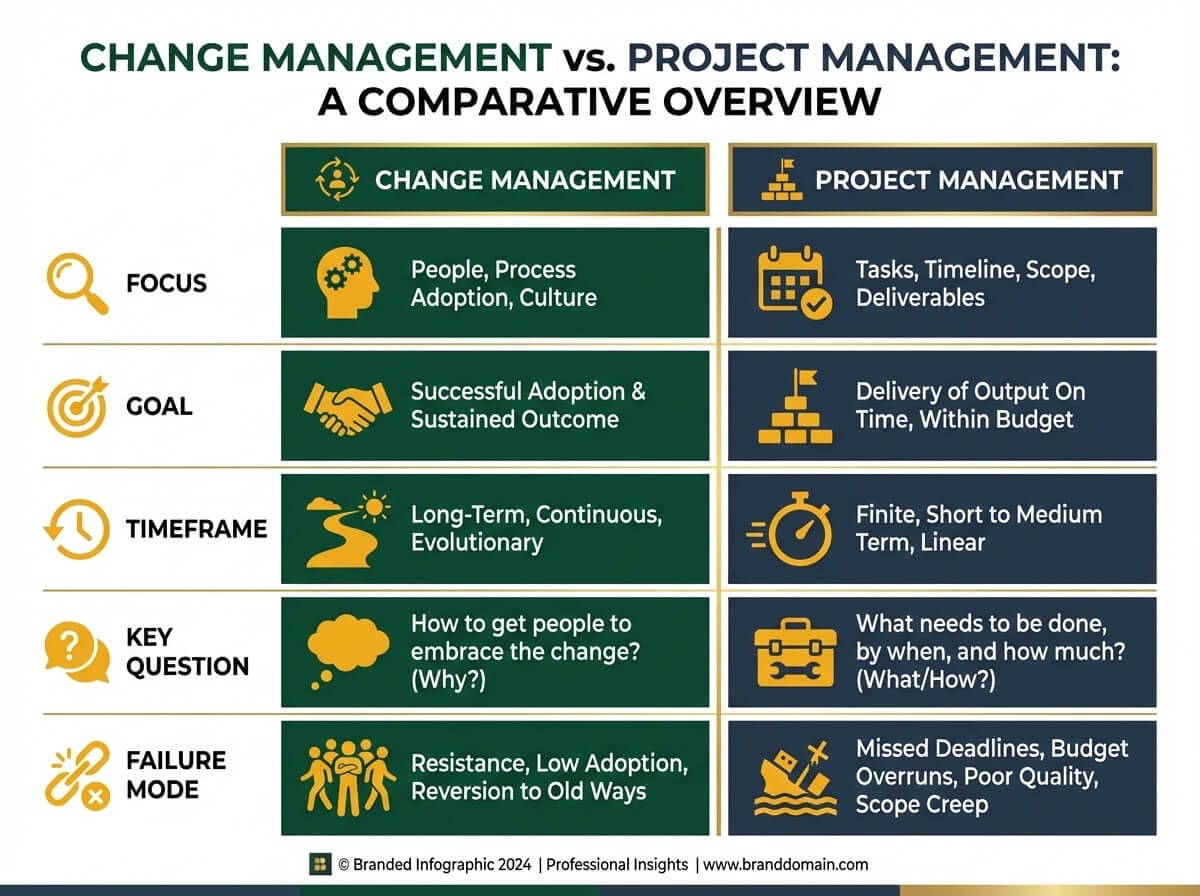
Project managers manage scope, schedule, and risk. Change managers manage adoption, resistance, and readiness. The two disciplines share a project but approach it from opposite directions.
| Dimension | Project Management | Change Management |
|---|---|---|
| Focus | Delivering the solution on scope, time, budget | Ensuring people adopt the solution |
| Goal | Project outputs meet requirements | Business outcomes through changed behavior |
| Timeframe | Charter to close-out | Awareness through sustained adoption |
| Key Question | “Is the deliverable ready?” | “Are the people ready?” |
| Failure Mode | Missed deadlines, scope creep, budget overrun | Low adoption, workarounds, reversion to old ways |
The overlap between those two columns is where integration either happens or fails. At each project phase, PM decisions create change implications that most project plans ignore.
| Project Phase | PM Focus | CM Integration Point | The Gap |
|---|---|---|---|
| Initiation | Scope, stakeholders, business case | Change impact assessment, readiness evaluation | Project charters define what will be delivered. Few define who will need to change. |
| Planning | WBS, schedule, resource plan | Communication plan, training plan, change risk assessment | The schedule allocates time for building. It rarely allocates time for adoption. |
| Execution | Scope, schedule, quality, risk | Adoption support, resistance engagement, sponsor visibility | Risk registers track delivery risks. The highest-impact risks rarely appear. |
| Closure | Handoff, lessons learned, close-out | Reinforcement plan, sustainment handoff, capability transfer | Project closure and change closure are different events. |
The planning phase gap deserves specific attention. The change management process needs to be built into the project schedule as work that requires time and resources. If the plan does not include the period between system go-live and people actually using the system effectively, the plan is incomplete. That period is not buffer. It is the adoption work that determines whether the project investment produces business value.
During execution, PMI research on project success factors consistently links integrated change management to higher rates of meeting objectives. The reason is straightforward: project risk registers typically track delivery risks while the highest-impact risks to the project’s business value are sponsor disengagement, middle management resistance, and change fatigue. None of those appear on a standard risk register.
The Coaching Skills Project Managers Need
Four specific capabilities bridge project management and change management. These are not additional certifications to pursue. They are coaching competencies that make existing project management skills more effective at producing organizational outcomes, not just project outputs.
Develop Stakeholder Reading and Resistance Skills
Learn to treat resistance as data, spot disengaged sponsors, and facilitate the conversations that move teams from compliance to adoption.
Stakeholder reading
Project management methodology teaches stakeholder identification and engagement planning. What it does not teach: reading what stakeholders are not saying. The VP who attends every status meeting but never asks questions is not engaged. He is observing. The director who agrees in meetings but sends contradictory emails afterward has not been won over. Understanding the difference requires the kind of attunement that coaching develops. Without it, the project manager reports green on stakeholder engagement while resistance builds underground.
Resistance engagement
When a key user group pushes back on requirements, the project management instinct is to escalate or negotiate. The change-capable project manager asks first: what is this resistance telling us? Sometimes it reveals a design flaw the project team missed. Sometimes it reveals a readiness gap that training alone will not close. The response depends on the diagnosis, and the diagnosis requires treating resistance as data rather than obstruction.
The quality of resistance also shifts over time. Early pushback sounds like “why are we doing this?” which signals that the rationale has not landed. Later pushback sounds like “how do we handle the exception cases?” which signals genuine engagement with the change. Project managers who track this shift can predict adoption trajectories more accurately than any survey instrument.
Early resistance asks “why.” Late resistance asks “how.” If you cannot tell the difference, you are reading your project wrong.
Sponsor development
Project sponsors receive status reports. Change-capable project managers develop sponsor capability: preparing them for difficult conversations with resistant teams, coaching them on visibility during implementation, helping them understand that their role in adoption extends beyond approving budgets. When a sponsor delegates change activities to the project team and disengages, the most effective re-engagement tactic is making the disengagement visible through its consequences: “The business outcome you committed to the board requires 80% adoption by Q3. We are at 30%.”
Adaptive facilitation
Project management facilitation runs efficient meetings with agendas, decisions, and action items. Change facilitation holds space for the uncertain, emotional conversations that determine whether people adopt or comply. A requirements workshop that surfaces only functional needs misses the deeper question: what are people afraid of losing? Both facilitation styles are needed. The coaching strategies that develop leadership capability build exactly this range. One style is rarely developed in project management training alone.
The project manager who can hold both modes in the same meeting produces better outcomes than one who can only run efficient agendas. When the team needs to surface concerns about a go-live timeline, the efficient facilitator moves to the next agenda item. The adaptive facilitator lets the conversation run because the concerns contain information the project plan needs.
Integration in Practice
A network upgrade across 12 offices illustrates what integration looks like when it moves from theory to project execution. The project plan was technically meticulous. What the project manager did not anticipate: each office had developed local processes around the existing network’s quirks. The upgrade eliminated those quirks and the workarounds built around them. People had not just used the old network. They had adapted their daily work to its limitations.
The project manager who recognized this as a change problem, not just a technical problem, made four adjustments that shifted the outcome:
- Added a “change impact” column to every scope decision, forcing the team to assess who was affected and how
- Included adoption readiness alongside technical readiness in go/no-go criteria for each office
- Built time for local adaptation into the schedule, recognizing that each office needed to rebuild workflows around new capabilities
- Measured utilization alongside uptime as success criteria, so the project was not declared complete until people were actually using the new system
None of these adjustments required a separate change management workstream. They required a project manager who understood that delivering a network nobody uses effectively is not delivery. Tracking change metrics alongside project metrics made the adoption gap visible before it became a post-implementation surprise.
The cost of ignoring this integration is not abstract. Each office that rejected the new network configuration required a second deployment cycle. The rework cost exceeded the original project budget for those offices. The organizations that build change into the project from initiation spend less overall than those that bolt it on after adoption failures surface.
The most reliable indicator that CM/PM integration is working: the project risk register includes human adoption risks alongside technical risks, and those human risks have mitigation plans with the same rigor as the technical ones.
Common Failure Patterns
Three failure patterns recur across projects that attempt to integrate change management. Recognizing them early determines whether integration produces results or becomes another governance exercise that satisfies checklists without changing outcomes.
The plan-as-artifact. The project team creates a change management plan because the methodology requires one. It sits in the project repository. Nobody updates it. Nobody uses it to make decisions. From the outside, the project appears to have change management covered. Underneath, nobody on the project team actually knows who is affected by the change, what they need to do differently, or whether they are ready. The plan documents what should happen. Nothing in the project structure ensures it does happen.
Sponsor delegation. The executive sponsor signs the project charter, approves the budget, and delegates everything else to the project manager. When adoption stalls, the project team lacks the organizational authority to address it. The sponsor’s absence is felt in every meeting where someone asks “why are we doing this?” and the project manager cannot answer with the strategic credibility the question requires. Re-engaging a disengaged sponsor requires framing adoption gaps as their business problem, not the project’s change management problem.
Compliance without adoption. Usage dashboards show 90% login rates. Satisfaction surveys return positive numbers. And people have built workarounds that bypass the new system for anything that matters. Compliance metrics measure whether people touched the system. Adoption metrics measure whether people changed how they work. The distinction is the difference between a successful change management outcome and an expensive self-deception.
Compliance metrics measure whether people touched the system. Adoption metrics measure whether people changed how they work. One of those is worth tracking.
Building PM Change Capability
The PMP does not develop change leadership capability. Prosci certification does not develop project management rigor. The intersection requires a different kind of professional development: the executive coaching that develops these capabilities and makes both disciplines effective. Listening beyond what is said. Reading resistance as data. Facilitating conversations where the real barriers surface. These are not project management skills or change management skills. They are coaching competencies that amplify both.
Key Takeaways
- Change management is not a parallel workstream. It is a lens applied to every project decision from initiation through closure.
- The highest-impact risks to project value (sponsor disengagement, middle management resistance, change fatigue) rarely appear on standard risk registers.
- Resistance quality shifts over time: “why” signals rationale gaps, “how” signals genuine engagement. Track the shift to predict adoption.
- The coaching capabilities that bridge PM and CM (stakeholder reading, resistance diagnosis, sponsor development, adaptive facilitation) are not taught in PMP or Prosci programs.
The test of a project is not whether it delivers on time and on budget. It is whether what was delivered gets used. If your project plan accounts for deployment but not adoption, if your risk register tracks technical risks but ignores the humans, if your timeline ends at go-live instead of at genuine usage—the project will succeed on paper and fail in practice. Close that gap. It is a coaching capability, not a process add-on, and it is the difference between delivering outputs and delivering outcomes.
Turn CM/PM Integration into a Repeatable Playbook
In a free consult, map your next project’s adoption risks, sponsor moves, and readiness checkpoints—before go-live exposes the gaps.
Book a Free Consultation →