
AI and Coach Training: What to Focus On While You Learn the Craft
Picture a coaching session on a sunny patio. The client is wrestling with something hard, and the coach offers one question: when you imagine the end of this year, feeling deeply satisfied in this part of your life, what do you see? The client’s eyes widen. They start describing a room in detail, the faces around a table. The coach notices a shift in their posture, names it, and the client says they feel physically lighter, as if a weight has lifted. ICF shared that scene to make a simple point about what coaching actually is.
That same stretch of weeks, the coaching internet filled up with a very different story. Artificial intelligence. AI tools entering coaching. AI rewriting how learning gets delivered. And running underneath all of it, a quieter worry that lands hardest on the people who are new: if you are training to become a coach right now, are you learning a craft that a machine is about to make optional?
It is a fair question to sit with, especially this week. International Coaching Week is running, and the profession is doing two things at once - celebrating the human work of coaching while openly arguing about what AI does to it. So it is worth walking through what the noise actually means for your training.
Key Takeaways
- The current AI wave puts pressure on coaching’s pace and proof, not on whether human coaches are needed. The craft you are training in still has to be learned by a human.
- Presence, deep listening, and the ability to notice what a client is not saying get more valuable as AI tools spread. Over-invest in them while you train.
- ICF is raising its standards for mentor coaching and supervision this year. A clearer, stronger credential protects the investment you are making.
- Use AI as a study partner for the work around your sessions. Keep it out of the live coaching hour, where presence is the whole point.
What the AI Conversation Actually Means for Coaches in Training
AI is moving into coaching and learning quickly, and most of the headlines are about speed and measurement. For someone in training, the pressure AI creates falls on how fast organizations expect results and how hard coaches will be asked to prove their value. It does not land on whether a human coach is needed in the room.
Look at what is actually happening. Workhuman launched a tool called Future Leaders that uses workplace data - recognition, collaboration patterns, contribution signals - to flag high-potential employees years before a traditional succession process would. GP Strategies, a learning company that has been around for sixty years, rebranded itself as The Learning Velocity Company and argued in CLO Magazine that the binding constraint on learning and development today is speed - learning has to move as fast as the business now moves.
The numbers GP Strategies put behind that are worth knowing, because they describe the world your future clients work in. Only 19% of learning and development teams are seen by their own organizations as strategic partners. 98% of learning leaders say they want to measure the impact of their work, but fewer than one in four have the budget to do it. And nearly a third of leaders name fear of failure as the single biggest barrier to adopting new ways of working.
Read that as a coach in training and a pattern shows up. Organizations are starving for two things: people who can move at the speed the business now demands, and credible evidence that human development actually works. Coaching answers both. What it asks of you is that you become genuinely good - good enough that your value is obvious. AI raises the bar on what “good” has to mean. It does not remove the need for you to clear it. If you want a sense of how fast the field itself is growing, the broader state of the coaching industry tells a story of expansion, not contraction.
The Coaching Skills That Matter More as AI Spreads
As AI tools become ordinary, one part of coaching grows in value: the work that happens in a human body, in real time, between two people. Go back to that patio session ICF described. The coaching happened when the coach caught the shift in the client’s posture and chose to name it. The question alone would not have done that, and a transcript would have missed it entirely.
Strengthen Your “Noticing” on Purpose
If you’re practicing presence and deep listening but not sure what you’re missing, a consultation can help you focus your reps where it counts.
That noticing is a trainable skill, and it sits at the center of the ICF core competency model. Coaching presence, the levels of listening, the discipline of working with what is in front of you rather than what you assumed - these competencies are exactly what your assessors watch for, and exactly what a language model cannot perform.
Consider how this plays out. Say you are coaching someone who tells you, in steady and reasonable words, that they are fine with a decision their team made. A tool processing the words would record agreement. A trained coach hears the half-second pause before “fine,” sees the jaw tighten, and gently asks about it. That is the moment coaching earns its keep.
A model can summarize everything your client said. It cannot feel the moment the room changes.
So while you are in training, spend your attention deliberately. When you practice, do not just track whether you asked a clean question. Track what you noticed and what you missed. Ask your mentor coach to push you on the things you walked past. The coaches who will thrive in an AI-saturated market are the ones who built their noticing on purpose, in front of real people, while it was still uncomfortable.
Why ICF Is Raising the Bar - and Why That Helps You
While the AI debate runs, ICF is making a quieter move that matters more for your path. It is tightening its standards. Over the coming months ICF is rolling out clearer recognition for mentor coaches and coaching supervisors, part of a strategic focus area it calls Coaching Excellence and Value.
If you are new, that can read as more hoops. It is the opposite. Until now there has not been a clear, consistent way to identify who is qualified to help you refine your craft after you certify. Mentor coaches and supervisors are the people who challenge your thinking and deepen your practice once you are working with real clients. A credential that names that role clearly makes your development path easier to navigate, not harder.
There is a market reason this helps you too. When a profession raises its own standards, the credential behind it gets more credible to the buyers who hire coaches. In a moment when anyone can spin up an AI “coaching” chatbot, a rigorous, recognized certification is what separates a professional coach from a piece of software wearing the word. The stricter ICF gets, the more your certification is worth.
This is also a reason to look hard at the program you choose. The mentor coaching and supervision built into your training is where a lot of your real growth happens. Strong programs already treat ongoing supervision and mentor coaching as central rather than as a box to check, and that is a good question to ask before you enroll anywhere.
Ethics When Your Practice Touches AI Tools
The first place AI will show up in your practice is the software around the session - the note-taker, the transcription service, the scheduling assistant that quietly summarizes your calls. That is where new coaches most often skip an ethics conversation they should be having.
ICF recently walked through how its Ethics and Compliance function works, including the Ethical Conduct Review process that handles complaints. Demystifying that process makes one thing clear: ethics is something you practice in every choice about a client’s information, not a form you sign once and forget.
With AI tools, the choices are concrete. If an app is recording or transcribing a session, your client has to know, has to understand where that data goes, and has to consent in plain language before the tool is ever switched on. Confidentiality is the ground that trust grows from, and trust is the thing your whole coaching relationship depends on. A convenient tool that quietly erodes it is not a good trade.
An AI note-taker that joins your calls by default is an undisclosed third party in a confidential conversation. Get explicit, informed client consent before any tool records, transcribes, or analyzes a session - and put it in your coaching agreement.
Build this habit while you are still training, when the stakes are lower. Decide now what you will disclose, what consent you will ask for, and what you simply will not let a tool do. Those lines are far easier to hold when you drew them early than when a client is already on the call.
Treat Your Development as Something You Can Measure
Remember the GP Strategies finding that almost every learning leader wants to measure impact and very few can. That gap is an opening for coaches who can show their value rather than just assert it. The habit that makes that possible is one you can start building today, in training.
ICF has been pushing the profession in the same direction with its Research Panel, which connects working coaches with researchers so that the field grows on evidence instead of assumption. You do not have to wait until you are credentialed to take part in that. Responding to a research request, contributing your experience, treating your own growth as something observable - all of it builds the evidence base, and it builds your habit of paying attention to outcomes.
Practically, this means keeping honest records of your own development. After your practice sessions, write down what you tried, what shifted for the client, what you would do differently. Notice patterns across weeks. When you reach client work, that same discipline lets you talk about your impact in specific terms - which is exactly what the organizations hiring coaches are desperate to hear.
A coach who can say “here is what changed and here is how I know” stands out in a market flooded with vague promises. AI did not create that advantage, but the pressure to prove value made it sharper.
How to Train for a Craft AI Cannot Shortcut
So what should you actually do with all of this while you are in a training program? Be deliberate about where AI helps and where it gets in the way.
AI is a genuinely useful study partner. It can explain a competency you are foggy on, quiz you before an assessment, draft reflection prompts, or help you tidy up your session notes. Used that way, it speeds up the learning around the work. What it cannot do is log your practice hours for you. It cannot sit in the discomfort of a hard session and build your presence. It cannot develop the essential skills every aspiring coach has to master, because those are built through repetition with real people.
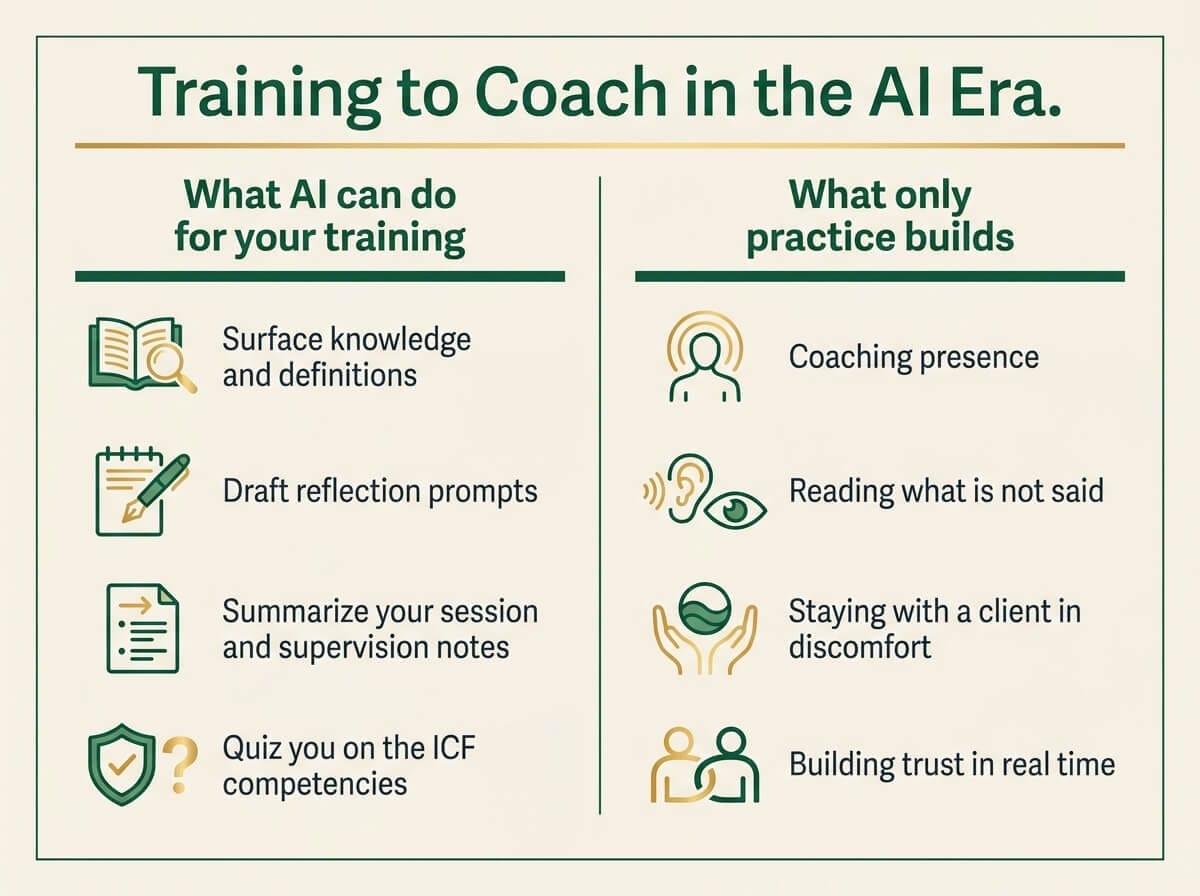
That line gives you a simple way to plan your training. Put your real energy into the things that only practice grows: coaching hours, mentor coaching, observed sessions, the slow work of developing presence. Let AI handle the edges - the review, the recall, the drafting - so you have more room for the reps that matter.
One more thing worth saying plainly. The fact that AI cannot do this work sets a standard rather than handing you a loophole. The bar for a human coach is being genuinely good at the human part, and being good at it takes the hours. There is no version of this where you skip the practice and still arrive.
It is International Coaching Week, and the profession is celebrating the thing AI keeps making more obvious - the value of a person who can be fully present with you while you think. That person is who you are training to become. The tools will keep changing. The work of learning to sit with another human being and help them find their own way will not. Keep showing up for the reps. That is where coaches are made.
Frequently Asked Questions
Will AI replace human coaches?
AI tools can summarize, prompt, and surface patterns, and they will keep getting better at it. They cannot hold presence, read what a client is not saying, or build trust in real time. Those are the heart of coaching, and they remain human work. AI is reshaping the tasks around coaching far more than the coaching itself.
Should I learn to use AI coaching tools as a new coach?
Yes, for the work around your sessions - scheduling, study, note-taking, marketing drafts. Learn what the tools do so you can make informed choices. Keep them out of the live coaching hour, and never let a tool record or transcribe a client without explicit, informed consent.
Does AI change ICF certification requirements?
The core requirements - training hours, coaching hours, mentor coaching, observed assessments - have not been replaced by anything AI-related. ICF is in fact tightening standards this year, including clearer recognition for mentor coaches and coaching supervisors. The path is getting more rigorous, not more automated.
Can I use AI to practice coaching?
AI can help you rehearse questions or review a competency, and that has some value early on. It is no substitute for practicing with real people. The discomfort, the unpredictability, and the live noticing of a human session are exactly what build coaching presence, and they only come from logged practice hours with actual clients.
Want a Clear Path Through the AI Noise?
Talk through your goals, ethics questions, and development plan—and leave with next steps you can actually use.
Book a Free Consultation →