Mindset Coaching: What Coaches Actually Do With Limiting Beliefs
Key Takeaways
- Mindset coaching is a structured methodology that makes invisible assumptions visible - the coach does not change the client's mindset, the client evaluates what they see and decides what to keep.
- Three coaching moves define the work: surfacing the belief as an assumption (not a fact), creating distance so the client can examine it, and testing it against evidence.
- ICF Competency 7 (Evokes Awareness) is the framework that anchors mindset coaching - asking questions that help the client explore beyond their current thinking.
- The coach's internal discipline matters more than the technique. When core beliefs surface, the pull toward reassurance is strong, and following that pull ends the coaching.
- Mindset coaching has honest scope limits. When a belief is entrenched to clinical significance, the ethical move is referral, not deeper coaching.
What Mindset Coaching Is Not
Mindset coaching is not motivational speaking. It is not repeating affirmations until a client believes them. Clients who arrive with limiting beliefs have already tried telling themselves to think differently, and it has not worked.
What mindset coaching actually is: a structured coaching methodology that makes invisible assumptions visible enough to examine. The coach does not change the client's mindset. The coach makes the belief visible. The client evaluates it and decides what to keep.
That distinction matters because most of what gets called "mindset coaching" online falls into two categories. Either it is a service page promising to reprogram your thinking, or it is motivational content dressed in coaching language. Neither explains what a coach actually does in session when a client's beliefs are the obstacle. This article covers the methodology - the coaching skills behind mindset work, the specific moves a coach makes, and where coaching ends and therapy begins.
Mindset as Operating System
A mindset is not a mood. It is the set of assumptions a person uses to interpret their experience before they are aware they are interpreting anything. An operating system running underneath conscious thought. The client does not see the operating system. They see the outputs - the decisions that feel obvious, the options that feel impossible, the patterns they cannot break.
Limiting beliefs are the specific assumptions within that system that constrain what a person considers possible. "I'm not a strategic thinker" is not a description of capability. It is a belief operating as fact. The person who holds it does not experience it as a belief. They experience it as reality.
This is what makes mindset coaching different from advice-giving or skills training. The obstacle is not a missing skill. It is a belief the client cannot see because it functions as the lens they see through. The coaching work is to make the lens visible.
You cannot argue someone out of a belief they do not know they hold. You can only make it visible enough to examine.
Three Moves Coaches Use in Mindset Work
Mindset coaching operates through three distinct moves. These are not steps in a sequence - a coach may use one, two, or all three in a single exchange, and the order depends on what the client brings. But the three moves name what is happening when mindset coaching works.
Train in the Competency Behind These Moves
Surfacing, creating distance, and testing are ICF Competency 7 in action. The ACC program develops these skills through observed practice sessions and MCC-level feedback.
Surfacing is the first move. The coach names what the client said as an assumption, not a fact. When a client says "I'm just not good at delegation," the coaching move is: "Is that a fact about you, or a belief you've been operating from?" That question creates a category distinction. The client had a fact. Now they have a belief they can look at. That shift - from invisible assumption to visible belief - is the foundation of all mindset coaching.
Creating distance is the second move. Once a belief is surfaced, the client is still inside it. The coach asks questions that let the client examine the belief from outside. "If someone who knew you well heard you say that, what would they say?" or "When did you first start believing that about yourself?" These questions do not argue with the belief. They create enough distance for the client to evaluate it rather than inhabit it.
Testing is the third move. A surfaced and examined belief still needs evidence. "What would confirm that belief? What would disconfirm it?" A client who says "I can't delegate" and then identifies three successful delegation experiences in the past year has produced evidence that contradicts their own belief. The coach did not produce that evidence. The client did.
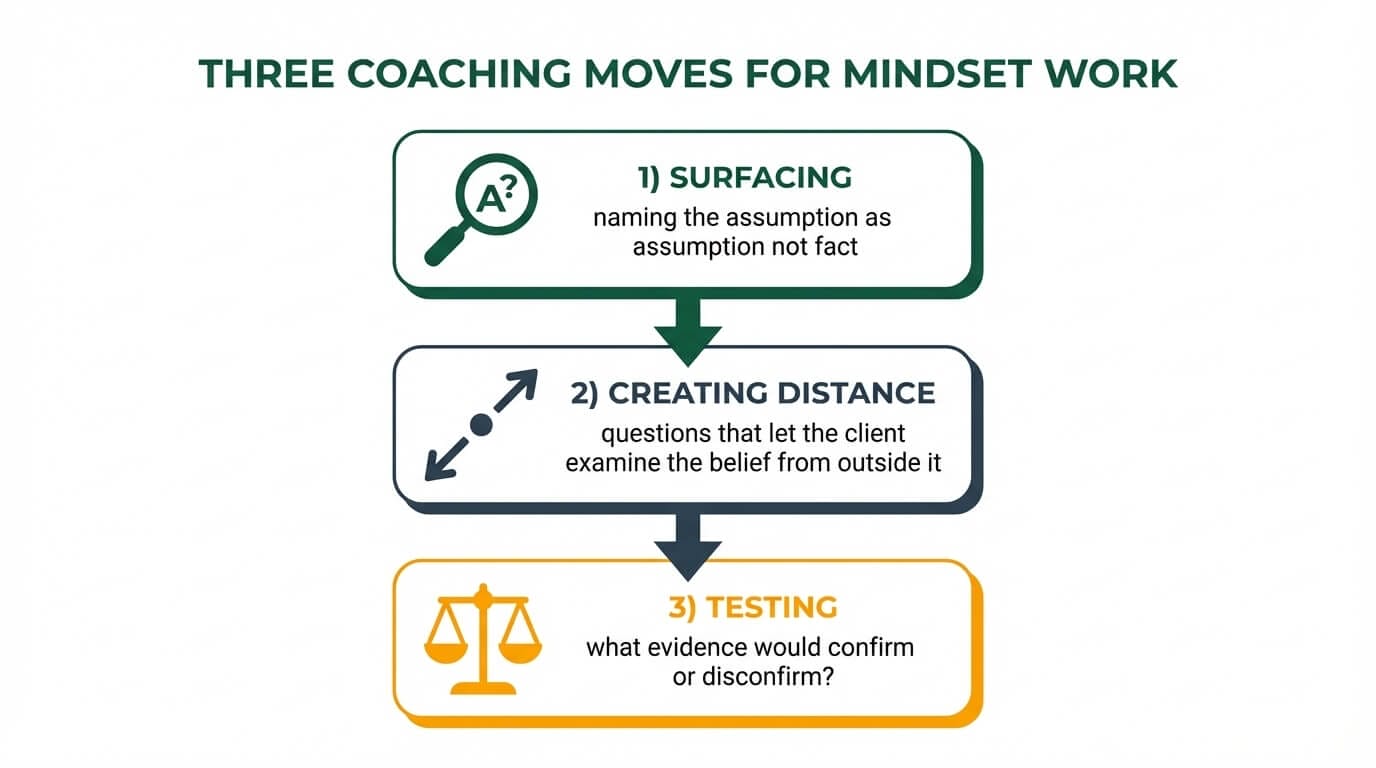
These three moves map directly to ICF Core Competencies, specifically Competency 7: Evokes Awareness. The competency asks coaches to use "questions that help the client explore beyond current thinking." Surfacing, creating distance, and testing are how that exploration happens when the current thinking is a limiting belief. Coaches trained through an ICF ACC program learn to recognize these moves as part of the competency framework, but knowing the competency and executing the moves in session are not the same skill.
Fixed and Growth Mindset in Coaching
Dweck's fixed and growth mindset distinction is useful in coaching not as a diagnostic label but as a listening filter. A coach trained to hear fixed mindset language picks up patterns that would otherwise pass as ordinary self-description.
Fixed mindset language sounds permanent and categorical. "I'm just not good at delegation." "That's not how I work." "I can't do public speaking." "I've always been this way." These statements share a structure: they describe a changeable capacity as a fixed trait. The client is not lying. They are reporting their experience accurately - from inside a belief system that makes the trait feel permanent.
Growth mindset language sounds conditional and developmental. "I haven't learned to delegate well yet." "That approach doesn't fit my current style." "I'm developing my presentation skills." "This is a pattern I can examine." The difference is not optimism versus pessimism. The difference is whether the person locates the characteristic as a permanent feature of identity or as a current pattern that can shift.
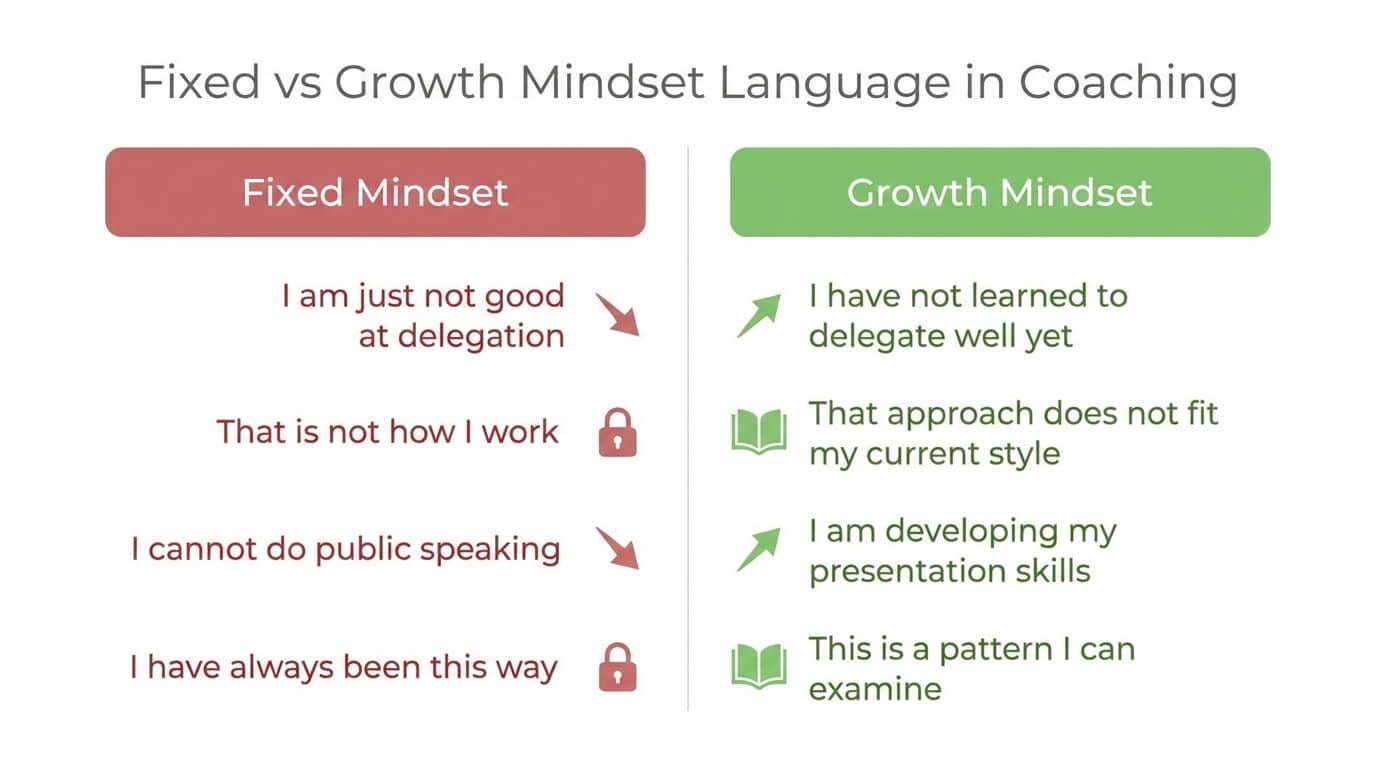
For coaches, the practical value of this distinction is in the listening, not the labeling. When a client uses fixed language, that is signal. It does not mean the coach should correct the language or teach the client about growth mindset. It means there is a belief operating as fact, and the three coaching moves apply. The coach surfaces the permanence claim, creates distance from it, and invites the client to test it. For more on growth mindset coaching as a specific application, the practical techniques go deeper than what Dweck's original framework covers.
What coaches observe in practice is that language shifts are often the first visible sign that mindset is moving. A client who began a coaching engagement saying "I'm not strategic" and six sessions later says "I haven't figured out my approach to strategic thinking yet" has made a shift that is audible before it becomes behavioral. The language does not cause the shift. It reflects it.
Questions That Surface Limiting Beliefs
The questions a coach uses in mindset work fall into four categories. Each category serves a different function, and knowing which type to use depends on where the client is in the process - whether the belief is still invisible, newly surfaced, being examined, or ready to test. These are the questions that surface limiting beliefs and create the conditions for the client to evaluate them.
Naming questions make the implicit explicit. "You said you can't lead a cross-functional team. Is that something you've tested, or something you've assumed?" These questions introduce a category - belief versus fact - and let the client sort their own statement into it.
Origin questions create distance by locating the belief in time. "When did you first start believing that about yourself?" "Who told you that, or did you decide it on your own?" A belief that has an origin story is a belief with boundaries. It started somewhere, which means it is not an immutable feature of reality.
Perspective questions create distance by shifting the vantage point. "If your closest colleague heard you say that, how would they respond?" "What would you say to a direct report who told you the same thing about themselves?" These questions let the client hear their own belief from outside.
Evidence questions move from examination to testing. "What evidence supports that belief? What evidence contradicts it?" Evidence questions work only after the client has enough distance to evaluate. Asking for evidence too early - before the belief has been surfaced and examined - produces rationalizations, not genuine evaluation.
The sequencing matters. Naming before origin. Origin before perspective. Perspective before evidence. Not every session moves through all four. But reversing the order tends to produce an argument rather than an exploration.
The Coach's Internal Discipline
The hardest part of mindset coaching is not the technique. It is what happens inside the coach when a client surfaces a core belief.
A client says, "I've always believed I'm not as capable as people think I am." The coach feels the pull immediately - toward reassurance, toward warmth, toward "That's not true, look at everything you've accomplished." The warmth is genuine. The coach cares about this person.
But reassurance is not coaching. The coach who responds with "You are absolutely capable" has provided something the client may need as a human being, but it is not what they need as a coachee. The reassurance redirects the session toward the coach's comfort with the client's discomfort. The belief goes back underground, unexamined.
Reassurance feels like care. In coaching, it is the exact moment you stop doing your job.
The coaching move is different. "You've been carrying that belief for a long time. What has it cost you?" That question does not reassure. It does not challenge. It invites the client to look at the belief's consequences, which is the work only the client can do.
This is what neutrality when clients surface core beliefs looks like in practice. Not detachment. Caring about the person without caring about which conclusion they reach. The coach who has an opinion about whether the client should keep or discard the belief has left the coaching stance.
What makes this discipline difficult is that it runs against social instinct. In normal conversation, when someone shares a painful belief about themselves, the appropriate response is reassurance. In coaching, the appropriate response is inquiry. That gap is where most mindset coaching breaks down. Not in the questions. Not in the framework. In the coach's willingness to sit with a client's discomfort without resolving it for them.
When Mindset Coaching Works and When It Doesn't
Mindset coaching works when the obstacle is a belief the client can examine. A leader who believes "I'm not strategic" and has never tested that assumption is a good candidate for mindset work. The belief is operating as a constraint, but once surfaced and tested, the client has the cognitive and emotional resources to evaluate it and choose differently.
Mindset coaching does not work when the belief is entrenched to clinical significance. A client whose "I'm not capable" belief is rooted in trauma, is accompanied by persistent anxiety, or triggers panic responses when examined directly is not in a coaching situation. That is therapy territory, and the ethical line is clear even when the presenting language sounds identical.
The distinction is not always obvious in session. A belief can look coachable in session one and reveal clinical depth in session four. The signs that a coach should watch for: the client becomes dysregulated when the belief is surfaced (not thoughtful, but distressed). The belief is connected to experiences the client cannot discuss without overwhelming emotion. The client has tried to change this belief repeatedly and the pattern is not shifting despite genuine effort and self-awareness.
When these signs appear, the coaching move is honest scope acknowledgment. "What we're touching on might benefit from a different kind of support. Have you considered working with a therapist alongside our coaching?" That is not a failure of coaching. It is a recognition that the client deserves the right kind of help, and that pretending coaching can do what therapy does serves no one.
ICF Competency 8 (Facilitates Client Growth) includes knowing when to refer. The competency does not describe this as a limitation. It describes it as part of the coach's professional responsibility. A coach who can name the boundary honestly builds more trust than one who pushes past it.
What Outcomes to Expect
Mindset coaching produces specific, observable changes, but they are not the changes most people expect. The outcome is not a new mindset. The outcome is self-awareness about the current one - and the capacity to choose differently when the old patterns appear.
The first change clients notice is in their language. The shift from "I can't" to "I haven't yet" is not a semantic trick. It reflects a real change in how the client relates to their own capabilities. Language shifts are early indicators. They show up before behavioral changes and signal that the underlying belief structure is loosening.
The second change is pattern recognition. Clients begin catching their own limiting beliefs in real time - in meetings, in conversations, in the moment of decision. A leader who used to avoid strategic conversations because "that's not my strength" starts noticing the avoidance as it happens. The noticing does not immediately change the behavior, but it creates a choice point that did not exist before.
The outcome of mindset coaching is not a new belief. It is a client who catches the old one in real time and chooses differently.
The third change is behavioral experimentation. Clients begin acting outside the belief's boundaries - tentatively at first. The leader who believed they could not delegate tries one project. The executive who assumed they were not creative suggests an unconventional approach in a strategy meeting. These experiments are small, deliberate, and they produce data the client can use to further evaluate the belief.
What makes these outcomes sustainable is that they are the client's own. The coach did not install a new belief. The client examined an old one, found it incomplete, and began operating differently. That process - because it is internally generated rather than externally prescribed - is what makes mindset shifts that make accountability sustainable over time rather than dependent on the coach's continued presence.
Frequently Asked Questions
How long does mindset coaching take to produce results?
Most clients begin noticing language and awareness shifts within 4-6 sessions. Behavioral changes - actually doing things differently based on examined beliefs - typically emerge between sessions 6 and 12. The timeline depends on how deeply embedded the limiting belief is and how willing the client is to test it in real situations between sessions.
Is mindset coaching the same as cognitive behavioral therapy?
No. Both work with beliefs and thought patterns, but they serve different purposes and operate within different scopes. CBT is a clinical intervention for diagnosable conditions, delivered by licensed therapists. Mindset coaching is a developmental conversation for functional individuals whose beliefs are constraining their professional growth. When a belief crosses into clinical territory - trauma responses, persistent anxiety, depression - the ethical move is referral to a therapist, not deeper coaching.
Can mindset coaching work in a group setting?
The surfacing and distance-creating moves can work in group coaching when the facilitator creates sufficient psychological safety. Group members hearing each other's limiting beliefs often recognize their own. Testing moves are more effective in individual sessions, where the coach can tailor evidence questions to the client's specific context without the social dynamics of a group shaping the responses.
What qualifications should a mindset coach have?
Look for a coach with ICF credentials (ACC, PCC, or MCC) and training that specifically covers Competency 7 (Evokes Awareness). The credential matters because it means the coach has been assessed on their ability to ask questions that help clients explore beyond current thinking - which is the core skill in mindset work. Be cautious of practitioners who promise specific mindset outcomes or use language about "reprogramming" beliefs. Coaching makes beliefs visible for the client to evaluate. It does not install new ones.
How do I know if my issue is a mindset problem or a skills gap?
A useful test: if you have received training or information on the topic and still cannot act on it, the obstacle is likely a belief, not a knowledge gap. A leader who has read five books on delegation and still does not delegate is not missing information. They are holding a belief - about trust, about control, about what good leadership looks like - that makes delegation feel unsafe regardless of what they know intellectually.
The next time a client says "I just can't" or "that's not how I work," notice the precision of the language. They have not said "I haven't figured out how yet" or "that approach doesn't fit my current context." They have made a permanent claim about a changeable thing. That gap - between what they said and what is actually true - is exactly where mindset coaching lives.
Learn the Methodology Behind Mindset Coaching
The three coaching moves in this article map directly to ICF Competency 7. Our ACC program trains you to execute them in live sessions with mentor coaching feedback from MCC-level instructors.
Learn About the ACC Program →