Life Coach Certification: What It Means, What It Costs, and How to Choose
In the United States, no government license is required to call yourself a life coach. No state board. No bar exam. No medical board equivalent. Anyone can declare themselves a certified life coach tomorrow morning and start taking clients by afternoon.
That absence of regulation creates a real problem for anyone trying to enter coaching professionally. Hundreds of life coach certification programs exist, ranging from rigorous year-long ICF-accredited programs to weekend courses that hand out certificates with no competency assessment at all. Both use the word “certified.” Both are legal. Only one signals professional competence to the people who matter: clients, employers, and the coaching profession itself—a distinction explored in depth in executive vs. life coaching differences.
The difference between an ICF-accredited program and a self-issued certificate is the difference between a degree from a university and a certificate you printed at home. The coaching industry chose voluntary accreditation over government regulation. That choice means the burden of distinguishing professional preparation from marketing falls on you.
ICF certification exists as the profession’s answer. The International Coaching Federation created a voluntary credentialing standard that has become the globally recognized benchmark for professional coaching. Over 50,000 coaches in more than 140 countries hold ICF credentials. This article is a neutral buyer’s guide: what life coach certification actually means, why it matters even though it is not required, how the credential ladder works, and how to evaluate any program against the professional standard.
Key Takeaways
- No government regulation: Life coach certification is voluntary in the U.S. ICF accreditation is the professional standard that distinguishes credentialed coaches from self-declared ones.
- Program certificate ≠ ICF credential: Completing a certification program and earning an ICF credential are two different things. The credential requires training hours, coaching experience, mentor coaching, and a competency exam.
- The credential is a tiebreaker, not a closer: Nobody hires a coach for their credential alone. They hire you for what you can do—for the benefits of executive coaching you can deliver. The credential confirms you have done the work to get there.
- Speed is the red flag: If a program treats the minimum training hours as the ceiling, it is optimizing for throughput, not coaching skill.
What Life Coach Certification Means
Life coach certification is a credential attesting that a coach has completed specific training, logged supervised coaching hours, and passed a competency assessment administered or recognized by an accrediting body. It is the coaching profession’s voluntary answer to a question other professions solved through government licensing: how does a client know this person is qualified? For clients, the answer lies in the benefits of leadership coaching that credentialed coaches demonstrably deliver.
Comparing Programs That All Say “Certified”?
We’ll help you evaluate any program against ICF accreditation, competencies, mentor coaching, and the credential pathway—so you don’t pay for a printable certificate.
The term “certified” is used loosely across the coaching industry, which is part of the confusion. Three distinct tiers exist:
- ICF-accredited certification with credential pathway. The program meets ICF education standards (Level 1 or Level 2), and graduates can apply for an ICF credential (ACC or PCC) after completing all requirements. This is the globally recognized professional standard.
- Self-issued program certificates. The program provides its own certificate upon completion. No external accrediting body has reviewed the curriculum, and the certificate carries no weight outside the program’s own community.
- Other accrediting bodies. Organizations like EMCC (European Mentoring and Coaching Council) and CCE (Center for Credentialing & Education) offer their own credentialing frameworks. ICF remains the most widely recognized globally, but depending on your geographic market or coaching niche, ICF versus other coaching certifications is a comparison worth understanding.
The practical difference shows up when a career changer is comparing two programs. One is a six-month ICF Level 1 program with 60-plus hours of training, required coaching practice, mentor coaching, and preparation for the credentialing exam. The other is a three-day online course at a fraction of the cost that issues its own certificate at the end. Both programs use the word “certified” in their marketing. What each delivers is fundamentally different.
The first program requires you to demonstrate coaching skill in live sessions, receive direct feedback from a credentialed mentor coach, and pass an exam that tests whether you can recognize competent coaching in realistic scenarios. The second program requires you to watch videos and complete a quiz. The word “certified” appears on both program websites, which is exactly why the distinction matters.
ICF accreditation means the program’s curriculum has been reviewed against a specific set of ICF core competencies and education standards. The accreditation is not permanent. Programs must demonstrate ongoing quality to maintain their status. That external accountability is what separates an ICF-accredited life coaching certification from a certificate with no outside verification. The distinction is whether anyone outside the program recognizes the credential as meaningful.
The word “certified” is not protected. The standard behind it is what matters.
Health and wellness coaching is one recognized specialty within this broader framework. Life coaches working in health-related niches face additional considerations around scope of practice, which makes understanding how coaching differs from therapy particularly relevant for anyone considering this niche.
Why Certification Matters
No U.S. state requires a license to practice life coaching. No federal body regulates it. That means the only thing standing between a client and an unqualified coach is the coach’s own preparation and ethical grounding. Certification exists to fill that gap voluntarily.
The most consequential reason certification matters has nothing to do with marketing or career advancement. It has to do with the coaching-therapy boundary.
Every coaching engagement eventually encounters it. A client starts talking about persistent anxiety, a pattern with clinical roots, or a traumatic experience that is shaping their current decisions. What happens next depends entirely on the coach’s training.
Consider a life coach working with a client who is processing grief. The client has been functional at work but is struggling with motivation and sleep. A coach without formal training might try to address the grief directly, using coaching tools for a problem that requires clinical expertise. That is not a hypothetical risk. It happens routinely when coaches lack training in recognizing the boundary.
The certified coach’s job at that point is not to diagnose, not to treat, and not to pretend the coaching toolbox covers it. The job is to name what you are observing and to hold the referral without judgment.
ICF-accredited programs teach this boundary explicitly. The ICF Code of Ethics requires coaches to recognize the limits of their competence and refer clients to other professionals when appropriate. A coach without that grounding may not even recognize when the line has been crossed. In the United States, with no mandatory licensing for coaches, the only thing protecting the client is the coach’s own ethical training and self-awareness.
ICF certification does not prevent scope creep. The ethical guidelines address it. The training teaches the boundary. But enforcement depends on the practitioner’s judgment in the moment. That is an honest limitation. It is also why the training matters more than the certificate itself.
Beyond the therapy boundary, certification signals three things to anyone evaluating a coach’s qualifications:
- Structured training. The coach completed an education program reviewed by an external accrediting body, not a self-paced course with no oversight.
- Supervised practice. The coach logged real coaching hours and received feedback from a credentialed mentor coach on their actual coaching, not just their knowledge of coaching theory.
- Ethical commitment. The coach agreed to abide by a professional code of ethics with an accountability mechanism. The ICF can investigate complaints and revoke credentials.
The honest answer to “do I need certification to be a life coach?” is: legally, no. Professionally, if you want clients, employers, and peers to take your coaching practice seriously, the answer changes. In most professional coaching contexts, clients or their organizations ask about ICF credentials before the first session. The credential does not make you a coach. What makes you a coach is what happens in the room with your client. The credential confirms that you have done the training, logged the hours, and passed the competency assessment.
For anyone considering coaching as a career, the certification question is not abstract. It shapes which clients you can access, which organizations will contract with you, and whether you belong to the profession or stand outside it. For a deeper analysis of the investment, see whether ICF certification is worth the investment.
The ICF Credential Ladder
ICF issues three credential levels, each defined by the ICF credentials and standards framework. For life coaches, two matter: ACC (Associate Certified Coach) and PCC (Professional Certified Coach). Each represents a different stage of professional development, and the requirements reflect that progression. Our complete ICF certification guide covers the full credentialing process in detail.
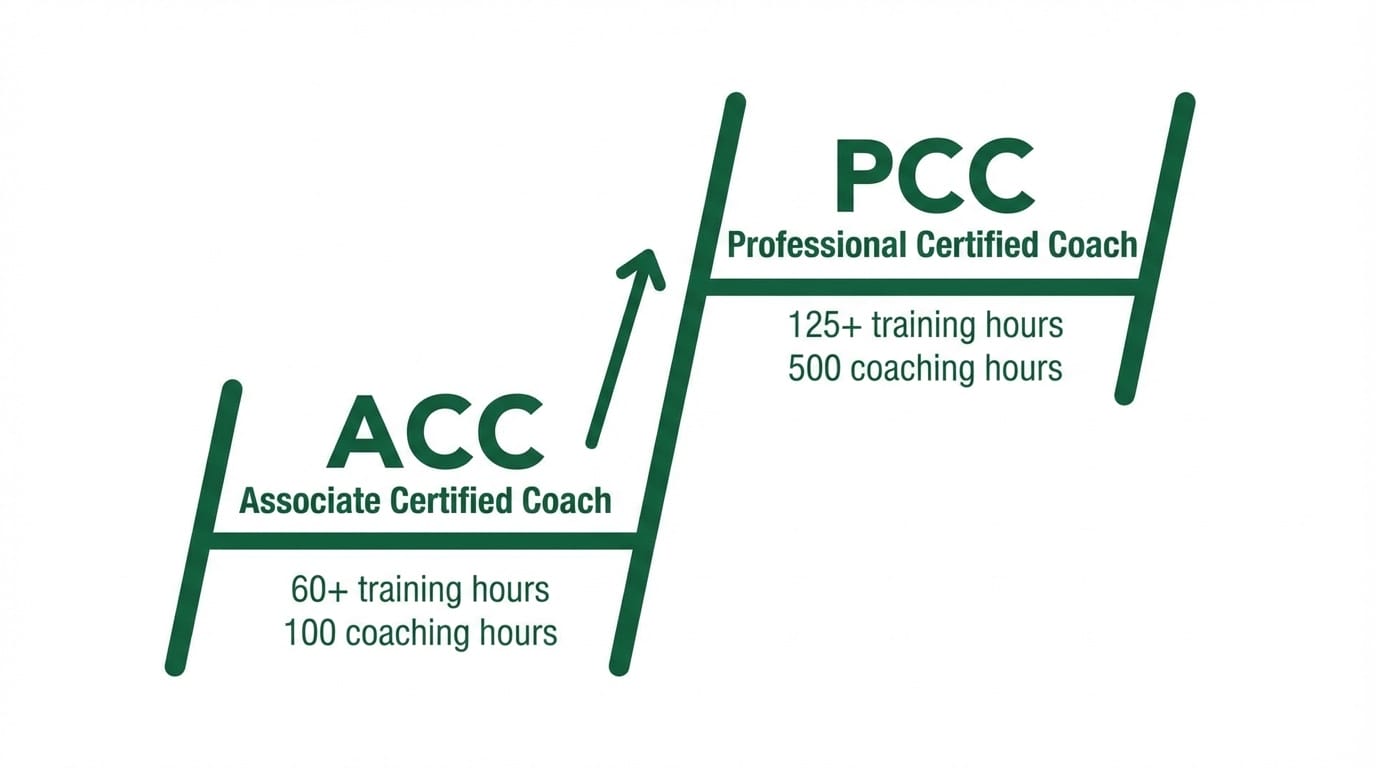
ACC (Associate Certified Coach) is the entry-level credential. Most life coaches start here. It documents that you have met a minimum competency standard: completed an ICF Level 1 program (60-plus hours of coach-specific education), logged 100 coaching hours, completed 10 hours of mentor coaching, and passed the Coach Knowledge Assessment (CKA). Full details on the ACC requirements are covered in a separate guide.
What candidates rarely expect is how the process actually works. Most arrive believing certification is a test they study for, the way a CPA or PMP works. The CKA exam exists, but it is a fraction of the total effort. The real weight falls on the coaching hours, the recorded sessions that get evaluated, and the mentor coaching where someone watches you coach and gives you direct feedback on what you are actually doing versus what you think you are doing. That shift from “I need to memorize material” to “I need to develop a skill and prove I can do it” is where the certification process begins in earnest.
The CKA itself tests recognition, not recall. It presents realistic coaching scenarios and asks whether a given response demonstrates or undermines a specific competency. Candidates who can define “Evokes Awareness” fluently often struggle to select the correct response in a situational question. The exam rewards the ability to evaluate coaching, not the ability to describe it in the abstract. That distinction changes how you prepare.
The exam does not ask whether you know what good coaching is. It asks whether you can spot it happening.
PCC (Professional Certified Coach) is the growth credential. It signals a serious practitioner. Requirements include completing an ICF Level 2 program (125-plus hours of training), 500 coaching hours, and a performance evaluation based on a recorded coaching session. The PCC certification requirements represent a meaningful step up from ACC, both in time investment and in the depth of coaching skill expected. You can explore the PCC certification pathway at Tandem for program specifics.
Consider a coach 18 months into their practice with ACC, deciding whether to pursue PCC. The 500-hour requirement is not just an administrative gate. Those are 400 additional hours of actual coaching practice beyond what ACC required, and they change how the coach works. Patterns that were invisible at hour 100 become obvious at hour 300. The performance evaluation at PCC level assesses whether the coaching has matured accordingly.
| Requirement | ACC (ICF Level 1) | PCC (ICF Level 2) |
|---|---|---|
| Training hours | 60+ hours | 125+ hours |
| Coaching hours | 100 hours (75 paid) | 500 hours (450 paid) |
| Recorded session evaluation | ACC markers | PCC markers |
| Typical timeline (working full-time) | 6–9 months | 2–3 years total |
For someone working full-time, the realistic timeline for ACC is six to nine months. The education runs about 60-plus hours spread across several months of weekend or evening sessions. Then you need 100 coaching hours. If you are starting from zero, that means finding practice clients, building a schedule, and logging hours consistently. For PCC, add substantially more time: accumulating 500 coaching hours while working full-time typically takes 18 to 24 months after completing the Level 2 education. Programs that promise faster timelines are usually quoting only the classroom portion and leaving the hours requirement for you to figure out on your own.
ICF also offers the ACTC (Advanced Certification in Team Coaching) for coaches who want to specialize in team coaching. It requires an existing individual coaching credential and separate team coaching training. It is not the typical path for life coaches, but it is worth knowing the credential exists. Both ACC and PCC require credential renewal every three years through continuing coaching education, so the commitment extends beyond the initial certification.
ICF replaced its older program accreditation categories (ACTP, ACSTH) with Level 1 and Level 2 designations. If a program still references ACTP or ACSTH, ask whether they have updated their accreditation under the current framework.
From the candidate side, 100 coaching hours feels like a mountain. From the mentor side, it is when coaching starts to become intuitive rather than mechanical. That shift, from following a technique to actually being present with a client, is the development the hours requirement is designed to produce. The credential does not make you a good coach. It documents that you have met a minimum standard. The two are related. They are not the same.
How to Choose a Certification Program
Choosing an ICF-accredited life coaching certification program comes down to five evaluation criteria. These apply whether you are looking at an online program, in-person training, or a hybrid format.
1. ICF accreditation status. Confirm the program holds current ICF Level 1 or Level 2 accreditation. This is verifiable on the ICF website. Programs that claim to be “ICF-aligned” or “based on ICF competencies” without holding actual accreditation are not the same thing. A list of ICF-accredited coaching programs can help you compare options.
2. Instructor credentials. Who is teaching? An MCC-led program exposes you to coaching skill that has been demonstrated at the highest credential level. That matters because you absorb how your instructor coaches, not just what they teach about coaching. A PCC-led program is solid for Level 1 training. A program where the lead instructor holds no ICF credential should raise questions about what standard they are teaching to and whether they have personally gone through the credentialing process they are preparing you for.
3. What is included. The best programs are all-inclusive: training hours, supervised practice sessions, mentor coaching, CKA exam preparation, and support through the ICF credential application process. When a program quotes a low price, ask what is not included. Mentor coaching and coaching supervision hours purchased separately can add thousands to the real cost.
4. Delivery format and live interaction. Online life coach certification programs vary widely in what “online” actually means. Some are fully asynchronous: self-paced video modules you complete on your own schedule with no live interaction. Others include scheduled live sessions with instructors, peer coaching practice labs, and real-time Q&A with credentialed faculty. Coaching skill develops through practice and feedback in real conversations, not through watching videos about coaching. Look for programs that build in live interaction as a core component, not as an optional add-on.
When a program promises speed over development, the question to ask is: what are they cutting? A program that treats the minimum training hours as the ceiling is optimizing for throughput, not for the development of coaching competence.
5. Red flags. Any program that cannot tell you exactly how many ICF-recognized training hours it provides, who your mentor coach will be, or what its ICF accreditation status is deserves scrutiny. Programs advertising “certified in 60 hours” or “credentialed in 8 weeks” are quoting minimums without accounting for the coaching hours, mentor coaching, and exam preparation required for the actual ICF credential. Coaching presence does not develop in a weekend intensive.
The most expensive program is not necessarily the best. The clearest indicators of program quality are instructor credential level, ICF accreditation status, and the structure built around actual coaching practice. Price is a factor, but it is a secondary one. For those ready to start, an online life coach certification path can give you a practical timeline.
Free life coaching certification programs are not ICF-accredited. They exist, they are legal, and they will not meet the standard that most employers, organizational buyers, and serious clients recognize. If you see “free certification,” understand what you are getting: a program-issued certificate, not a pathway to an ICF credential.
The Real ROI of Certification
Certification is not a client-generation machine. That is the honest starting point for any ROI conversation. No credential, from any accrediting body, guarantees clients, income, or career success. If a program implies otherwise, that is a selling point, not a fact.
What certification does deliver falls into two categories: the credential itself and the competency development behind it. Understanding both is necessary to make an informed decision about the investment.
The credential functions as a tiebreaker. When two coaches compete for the same opportunity, and one holds an ICF credential while the other does not, the credential matters at the margin. In procurement contexts especially, where HR or learning and development teams need to justify their vendor selection to internal stakeholders, the ICF credential removes a barrier. It is not the reason someone hires you. It is the reason they are allowed to hire you.
We had a student who struggled through the program. Session after session, the coaching was not clicking. He kept showing up. At some point it connected. The credential did not change his career overnight. What it did was give him something tangible to point to when organizations asked, “How do we know you can coach?” The hundreds of hours of practice made him a better coach. The credential gave decision-makers a reason to say yes. For a detailed look at what certification costs, the financial picture is covered separately.
The deeper ROI is in what the certification process forces you to develop. The 100 coaching hours required for ACC are not just a checkbox. They are 100 sessions where you practice the skill under mentor observation. By session 60, most coaches have moved past the mechanical application of techniques into something that looks more like actual coaching. The 500 hours required for PCC accelerate that development further. The highest ROI of certification is not the credential itself but the hundreds of hours of supervised coaching practice that change how you work with clients. If you want to understand how to become a certified life coach, the hours are where the real learning happens.
Nobody hires a coach because of a badge. They hire you because of what the preparation behind it made you capable of doing.
Who benefits most from life coach certification? The answer depends on where coaching sits in your career:
- Internal coaches and HR practitioners adding coaching skills to their existing professional role. The credential changes how they work and documents a formal competency to their organization.
- Career changers building a coaching practice as their primary income source. The credential signals professional commitment to prospective clients and coaching platforms.
- Managers and leaders using coaching approaches in their work. They may not pursue the full credential, but the training itself changes how they lead.
- Professionals already coaching informally who want to formalize what they do. They are already doing the work. Certification gives them a framework, a professional community, and a recognized credential.
The people who get the least return from certification are those who expect the credential to do the work for them. Certification confirms competence. It does not build a business. The practice-building is a separate challenge that the credential does not solve. The post-certification conversation happens more often than the certification industry acknowledges: a newly credentialed ACC asks, “Now how do I get clients?” The credential and the practice are two different things, and the gap between them is real.
If you are not yet sure coaching is your career path, investing several thousand dollars in an accredited program may be premature. There are lower-cost ways to explore whether coaching fits you before committing to the full credentialing arc. But if you have already decided, and if you are already doing coaching work informally, the certification process will formalize what you know, fill the gaps you did not know you had, and give you a credential that communicates professional commitment to anyone evaluating your qualifications. For more perspective on the investment question, read the ROI case for ICF certification.
Your Next Step
You now have a framework for evaluating any life coaching certification program: check the ICF accreditation, evaluate the instructors, understand what is included, look at the delivery format, and watch for red flags. The next decision is where to start.
For most people entering the coaching profession, ACC (ICF Level 1) is the right starting point. It builds the foundational coaching competencies, gets you to 100 hours of real coaching experience, and results in a credential that is recognized worldwide. The ACC certification program at Tandem is an ICF-accredited Level 1 program led by MCC-level instructors, with all-inclusive pricing that covers training, mentor coaching, and ICF application support.
For coaches who already hold ACC and are ready to advance, Tandem’s Systems Coach Program offers the ICF Level 2 education with the same all-inclusive structure. PCC marks the point where prospective professional coaching clients and organizational buyers start taking the credential seriously as a selection criterion. Coaches who want to combine PCC and ACTC alongside ACC can pursue the Professional Coach Program ($7,499)—ACC, PCC, and Advanced Certification in Team Coaching in one integrated pathway.
Both programs run online with live sessions, which means you can complete the education while working full-time. The coaching hours happen on your schedule, with your clients, as you build your practice alongside the training.
If you are still exploring whether coaching is the right career move, the investment in a full accredited program may be premature. But if the decision is made, and the question is simply where to train, the evaluation framework above will serve you well. Check the accreditation. Evaluate the instructors. Understand the full cost. Choose a program that develops your coaching skill, not one that just gets you through the minimum requirements.
The credential does not make you a coach. The work does. Certification confirms that you have done that work to a professional standard. If coaching is where your career is heading, the question is not whether to certify. It is when to start.
Frequently Asked Questions
How much does life coach certification cost?
ICF-accredited life coaching certification programs typically cost between $3,000 and $12,000 for Level 1 (ACC pathway). Total cost depends on whether the program includes mentor coaching, exam fees, and ICF application fees or charges for those separately. Free and low-cost programs exist but are not ICF-accredited. See the full ICF certification cost breakdown for a detailed comparison.
How long does it take to become a certified life coach?
For ACC (ICF Level 1), expect six to nine months working full-time. The education component is 60-plus hours spread over several months, plus 100 coaching hours that most candidates accumulate over three to six months. For PCC, add 18 to 24 months after completing Level 2 education to accumulate 500 coaching hours.
What is the best life coaching certification?
The best certification is one from an ICF-accredited program with credentialed instructors and a structure that includes supervised practice, not just classroom education. There is no single “best” program. Evaluate based on accreditation status, instructor credentials, what is included, and delivery format. The ICF credential itself (ACC, PCC) is the same regardless of which accredited program you attend.
Do you need a certification to be a life coach?
Legally, no. In the United States, no government license or certification is required to practice as a life coach. Professionally, certification from an ICF-accredited program is the clearest signal to clients, employers, and the coaching profession that you have met a recognized competency standard. Most serious coaching opportunities require or prefer ICF-credentialed coaches.
Is life coaching certification worth it?
Certification is worth it for professionals who are committed to coaching as a career or who need recognized credentials for their current role. The return comes from the competency development during training and the credential’s tiebreaker function in competitive situations. It is not worth it as a speculative investment before you know whether coaching is your career path. Read more on whether ICF certification is worth it.
Choose the Right ICF Path—Without Guesswork
Talk through ACC vs PCC, Level 1 vs Level 2, timelines, and red flags like “weekend certification.” Get a clear next step for your goals.
Book a Free Consultation →