Leadership Team Coaching: Why It’s Different and When Your Team Needs It
The leadership team met on Monday, agreed on Q3 priorities, and by Thursday every member was executing a different version of the plan. Engineering doubled down on platform stability. Sales chased a new market segment nobody had approved. Finance froze discretionary spending as a hedge. Each leader walked out of the same meeting and responded to the pressures their own function placed on them. Nobody was being insubordinate. They were each doing exactly what their own organization needed them to do.
This pattern is common in organizations where every senior leader performs well individually but the team itself cannot make a decision that sticks. The gap between individual leader development and collective team effectiveness is the space that leadership team coaching fills. It is a distinct discipline, not a group version of executive coaching, and it addresses problems that no amount of individual coaching, strategic offsites, or team-building exercises will solve.
This guide covers why leadership teams present unique dynamics, when coaching is the right intervention, what an engagement actually looks like month by month, and how to evaluate whether your leadership team is ready. It is written for the CHRO, CEO, or senior HR leader considering this investment, and for the professional coach who wants to understand what makes leadership team engagements different from other team coaching work.
Key Takeaways
- Leadership teams carry dynamics other teams lack: dual loyalty, constituency representation, and power asymmetries that make them the hardest teams to coach and the most consequential to get right.
- Individual executive coaching optimizes each leader. Leadership team coaching optimizes the relationship between leaders. One does not produce the other.
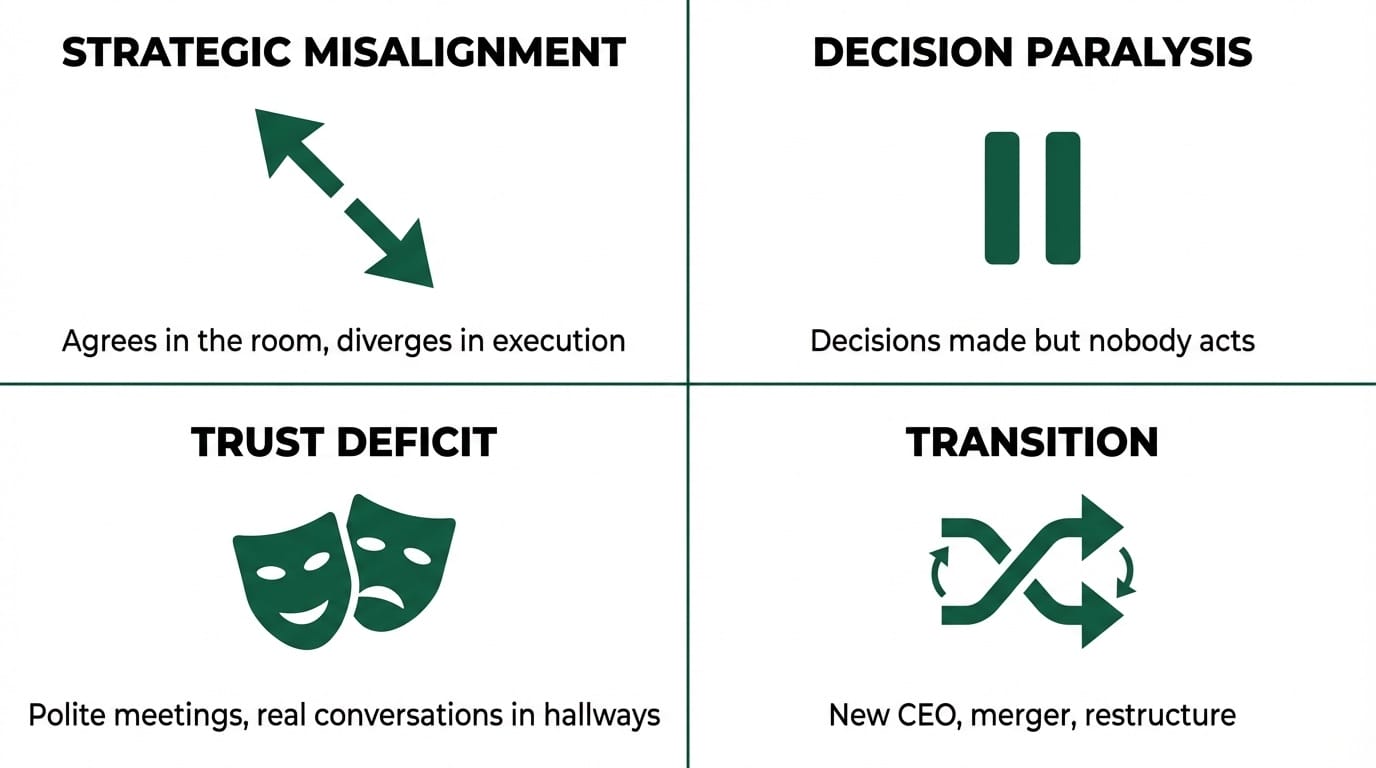
- Four trigger patterns signal when a leadership team needs coaching: strategic misalignment, decision paralysis, trust deficit, and organizational transition.
- The most overlooked readiness condition is whether the organizational environment (incentive structures, reporting lines, board expectations) will support the coaching outcomes rather than contradict them.
Why Leadership Teams Are Different
Leadership teams carry dynamics that other teams do not: dual loyalty, constituency representation, and power asymmetries that are difficult to surface and harder to address. These dynamics make leadership teams the hardest teams to coach and the most consequential to get right, because trust at the top cascades or poisons everything below.
Every member of a leadership team represents a constituency. The VP of Engineering answers to the leadership team but also to 200 engineers. The CFO answers to the team but also to the board. This creates dual loyalty: each leader's decisions in the room affect their standing outside the room. When the presenting problem is framed as "strategy and conflict resolution," the real problem is usually trust, decision-making authority, or misaligned incentives across the leadership team.
You see the result when the team agrees on a direction in the meeting and each member goes back to their function and executes something different. They are not being dishonest. They are responding to the structural reality that their individual survival depends on their functional results, not on the leadership team's collective outcomes. The organizational system rewards individual performance, and so the team coaching approach must name that structural tension before trying to resolve the interpersonal one.
Power dynamics compound the problem. A CEO who says "I want honest feedback" but visibly reacts to disagreement trains the rest of the team to perform agreement. A CFO who controls budget approval holds implicit veto power regardless of what the decision-making process claims. These dynamics exist on every team, but on a leadership team they carry organizational-level consequences. A trust deficit between two VPs does not stay between two VPs. It propagates into their departments, creating silos that show up as missed handoffs, duplicated work, and competing priorities at every level below.
The cascading effect is the reason leadership team dysfunction is so expensive. When the VP of Sales and the VP of Product have an unresolved disagreement about market direction, that disagreement does not stay in the leadership meeting. It becomes two sets of conflicting priorities, two sets of confused middle managers, and hundreds of employees pulling in different directions without understanding why.
David Clutterbuck draws a useful distinction between coaching a team of individuals and coaching the team as a single entity. On a leadership team, the entity is the decision-making culture at the top of the organization. That culture either enables execution or fragments it.
A trust deficit between two VPs does not stay between two VPs. It propagates into their departments, creating silos that show up as missed handoffs, duplicated work, and competing priorities at every level below.
Leadership Team Coaching vs. Individual Executive Coaching
Individual executive coaching develops a single leader's personal effectiveness: self-awareness, communication skills, decision-making, career growth. Leadership team coaching develops the team's collective effectiveness: how leaders make decisions together, resolve competing priorities, and hold shared commitments. These are not the same thing, and one does not produce the other.
A common pattern in organizations with mature coaching cultures: every C-suite member has their own executive coach, each one improving individually, and the leadership team as a whole gets worse at making decisions together. The individual coaches are optimizing each person. Nobody is coaching the relationship between them. This is the gap that executive team coaching addresses.
The distinction is structural. In individual coaching, the client is one person. In leadership team coaching, the client is the team or the relationship that makes those people a team. It is a multi-person single client. When a coach asks one leader a question, gets an answer, turns to the next leader, and asks another question, that is individual coaching performed in a group setting. Leadership team coaching requires the team to talk to each other, not to the coach. The coach stands on the outside of the conversation, not at the center.
Peter Hawkins describes this as the shift from coaching individuals who happen to share an organization to coaching the living system that connects them. For leadership teams, that system is where strategy either becomes execution or dies in the conference room.
The practical implication for buyers is direct. If your organization has invested in individual executive coaching for senior leaders and the leadership team still struggles to execute as a unit, the missing piece is not more individual training or development. It is coaching the space between leaders, the patterns of interaction, avoidance, and decision-making that no individual coach is positioned to see. The learning happens at the team level, not the individual level.
When Leadership Teams Need Coaching
Leadership teams need coaching when a pattern of dysfunction persists despite competent individual leaders. The triggers are structural, not personal. Four trigger patterns account for the majority of engagements, each presenting a surface symptom that obscures the actual structural problem underneath. Recognizing these patterns changes how you assess whether coaching is the right intervention.
| Trigger Pattern | What It Looks Like | What Is Actually Happening | Why Coaching |
|---|---|---|---|
| Strategic misalignment | The team agrees in the room, then each function executes a different version of the plan | Leaders perform agreement to avoid conflict, then default to functional loyalty once they leave | Coaching surfaces the undiscussed disagreements and builds the team's capacity to make decisions that hold |
| Decision paralysis | Decisions are made but nobody acts on them; the same issues recycle through meeting after meeting | Decisions are reached through consensus theater, not genuine commitment; leaders are hedging because accountability is unclear | Coaching works on the decision-making process itself: who decides, how dissent gets heard, and what commitment looks like |
| Trust deficit | Polite, efficient meetings. Real conversations happen in hallways, Slack DMs, or one-on-one lunches | The team has learned that candor carries risk; members protect themselves by keeping real opinions private | Coaching creates the conditions for candor by working on the relationship patterns, not by demanding honesty |
| Transition | New CEO, post-merger integration, major restructure. The team is technically assembled but not yet functioning | Legacy loyalties, competing cultures, or unresolved role ambiguity prevent the team from forming a shared identity | Coaching accelerates the forming process by making implicit assumptions explicit and building shared operating agreements |
None of these trigger patterns respond to consulting, which provides answers, or facilitation, which structures conversations. They respond to coaching because the problem is not what the team decides but how the team relates while deciding. The solutions already exist within the team. The barrier is the relational and structural patterns that keep those solutions buried.
The problem is not what the team decides but how the team relates while deciding. The solutions already exist within the team.
A fifth trigger worth noting: when a leadership team performs well operationally but cannot have the conversations required for strategic change. The meetings run on time, the quarterly numbers get reviewed, and nobody raises the question about whether the business model needs to change. Operational competence masks strategic avoidance.
When these patterns persist, the dysfunction rarely stays contained. It reaches into the wider system, showing up as execution failures, talent attrition, and cultural fragmentation at every level below the leadership team.
What a Leadership Team Coaching Engagement Looks Like
A leadership team coaching engagement typically spans 6 to 12 months with monthly or bi-weekly sessions, structured around six phases: sponsor conversation, team assessment, contracting, coaching sessions, stakeholder check-ins, and review. The length reflects the time required for relational patterns to shift and for new behaviors to produce measurable organizational results.
Learn to Coach Teams
Tandem’s ACTC program teaches the systemic lens for team coaching: intact teams, business partners, departments, and cross-functional cohorts.
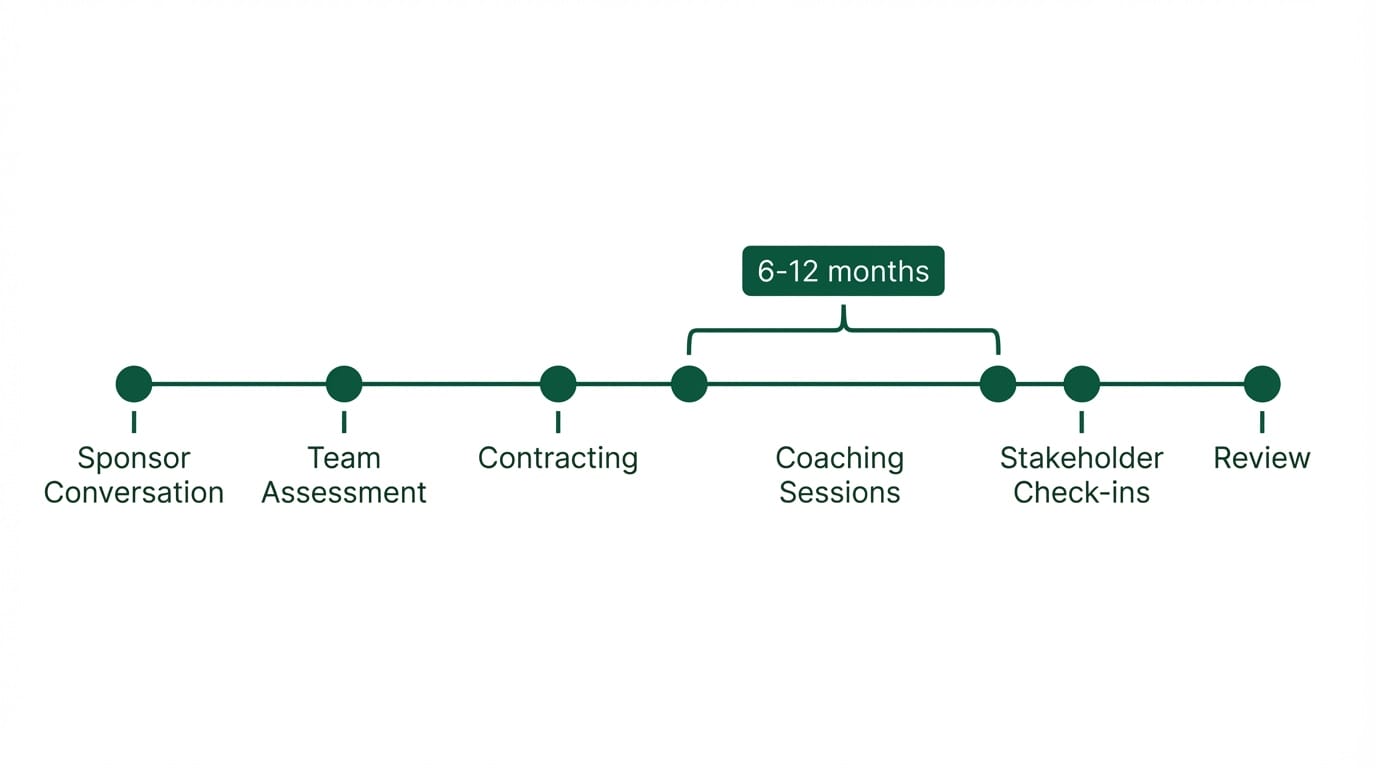
The engagement begins with a sponsor conversation, usually with the CEO, CHRO, or the executive who initiated the request. This conversation establishes what the organization hopes to achieve, what success looks like, and what constraints exist. It is also where the coach evaluates whether the organizational environment will support the coaching goals, a conversation that sometimes matters more than the sessions themselves.
Next comes a team-level assessment. This is not a set of individual 360-degree reviews compiled into a summary. It is an assessment of the team as a system: how it makes decisions, how it handles disagreement, how information flows, and where the gaps lie between stated values and actual behavior. The distinction matters. Individual assessments tell you about each leader. A team assessment tells you about the relationships between them.
Contracting with the team happens in the first session. The coach does not arrive with a plan the sponsor approved and impose it. The team co-creates the coaching agreement: what they want to work on, what they are willing to change, and how they will hold themselves accountable. The coach's position throughout the engagement is outside the power structure. The coach holds the team accountable to its own commitments, not to the coach's recommendations.
What the coach does not do is equally important. The coach does not provide strategic recommendations. The coach does not mediate individual conflicts between leaders. The coach does not serve as a communication channel between team members or between the team and the sponsor. The coach is there to help the team see its own patterns and build its own capacity, not to fix it.
During the coaching sessions, the team does the work. The coach observes patterns, asks questions that surface what the team is avoiding, and supports the team in designing its own experiments. Sometimes those experiments fail. A team may decide to revert to old working patterns. When that happens, the coach does not intervene. The team feels the consequences, learns from the experience, and builds genuine conviction for change rather than compliance with the coach's direction. This process of embedding coaching in the organization produces durable change because the team owns it.
Stakeholder check-ins at regular intervals (typically quarterly) keep the sponsor informed of progress without violating confidentiality. The coach shares themes, not specifics. The final review evaluates outcomes against the original coaching agreement and identifies what the team will continue developing independently.
Measuring Leadership Team Coaching Impact
Measuring leadership team coaching impact requires honesty about what can and cannot be quantified. Leading indicators show whether the coaching is working during the engagement. Lagging indicators show whether the change persisted. Neither can answer the question the executive buyer really wants answered: what would have happened without coaching?
Leading indicators are observable within the first three to six months. Decision velocity measures how quickly the team moves from discussion to action. Meeting effectiveness tracks whether decisions made in meetings hold through execution. Stakeholder satisfaction captures whether the leadership team's improved functioning is visible to the people who depend on it. Team member engagement scores show whether the leaders themselves experience the team differently.
Lagging indicators require 9 to 18 months to surface. Strategic execution rate measures whether priorities agreed upon by the leadership team are actually completed across the organization. Leadership bench strength indicates whether the improved team culture is developing the next tier of leaders. Retention of senior leaders signals whether the team is a place people want to stay.
The most practical approach is to establish baseline measurements before the engagement begins. Capture decision velocity, meeting effectiveness ratings, and stakeholder satisfaction scores in month one. Track changes at quarterly intervals. The numbers will not prove causation, but they create a credible narrative about what changed and when.
Qualitative indicators matter as much as quantitative ones. When a leadership team begins naming its own patterns without the coach prompting, when members hold each other accountable to commitments made in session, when the team can navigate a genuine disagreement without defaulting to avoidance or escalation, these are signals that the coaching has shifted the team's operating system, not just its behavior in the room.
Measurement is necessary, imperfect, and should be built into the engagement from the start. Claiming otherwise erodes credibility with sophisticated buyers.
The counterfactual problem is real. You cannot run a controlled experiment with a leadership team. You cannot measure what would have happened if the coaching had not occurred. Claiming otherwise erodes credibility with sophisticated buyers. The honest answer is that measurement is necessary, imperfect, and should be built into the engagement from the start. For a deeper treatment of return-on-investment frameworks specific to team coaching, see measuring development outcomes.
Evaluating Whether Your Leadership Team Is Ready
Three conditions determine whether a leadership team is ready for coaching: a shared goal worth pursuing together, willingness to be challenged, and an organizational environment that supports the outcomes. All three must be present. If any one is absent, the engagement will stall, and the most overlooked condition is the third.
First, the leadership team has a shared goal worth pursuing together. Not a collection of individual goals that happen to coexist. An actual shared outcome that requires collective effort. If every leader can achieve their own objectives without needing anything from the others, there is no team to coach.
Second, the team is willing to be challenged. Because a CEO says "go coach that team" does not mean the team is ready. If team members perceive coaching as punishment or performance management by another name, coaching cannot function. The team must have a reason and a desire to change.
Third, the organizational environment supports the outcomes. Individual incentive structures, board expectations, and reporting lines must not contradict what the coaching aims to build. Organizations that say they want collaboration while running individual bonus structures, competing management chains, and promotion systems that reward individual survival over team success are working against their own investment. When the environment contradicts the coaching, the coaching hits a ceiling no matter how skilled the coach or willing the team.
Ask the sponsor before the engagement starts: what incentive and reporting structures could work against this team's goals? If the answer reveals structural contradictions, that conversation is where the real work begins.
The third condition is where many coaching engagements fail. Coaches start the work, build momentum, and hit a wall three months in because the organizational system actively undermines the team's progress. Having the environment conversation before the first session, not after the coaching stalls, separates effective engagements from expensive ones.
If your leadership team meets all three conditions, the next step is a conversation about what the engagement could look like. If the third condition is uncertain, the next step is a conversation about the environment, before any coaching contract is signed. Tandem's leadership development approach begins with that assessment, matching the coaching structure to the team's specific dynamics and organizational context.
Build Your Team Coaching Practice
ACC, PCC, and ACTC programs with training, mentoring, and supervision included. The team coaching credential starts with the right foundation.
View Programs & Pricing →