Spot when career and money goals are crowding out the rest of life, using a proven Wheel of Life framework to set balanced priorities.
Free, print-ready PDF.
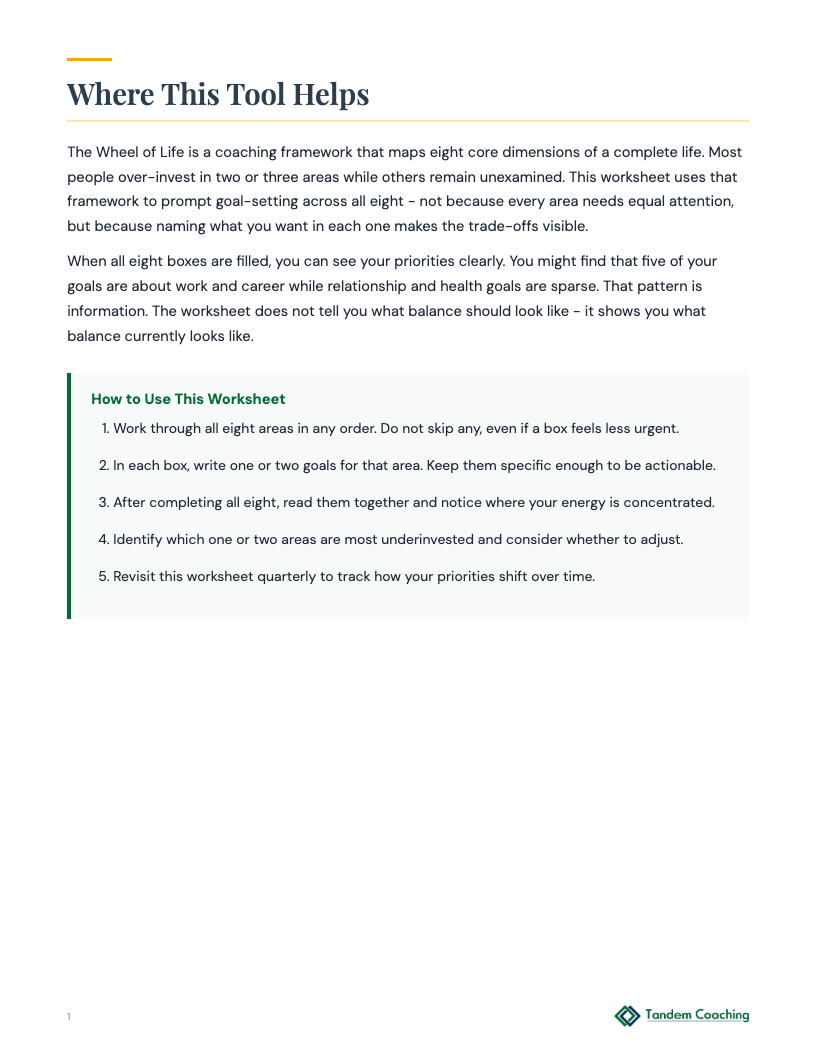
There's a worksheet that uses the eight Wheel of Life domains to prompt goal-setting across all areas of life — so when you're done, you can see exactly where your intention is concentrated and where it's absent. Would that be a useful starting point?
Client has no difficulty setting goals in career, business, and finances. When working through all eight areas, the remaining five — relationships, family and friends, recreation, growth, and spirituality — stay sparse or blank. The client is not neglecting those areas because they are unimportant. They have simply never built the habit of setting goals there. The eight-area structure makes this asymmetry visible in a way that a general goal-setting conversation does not: when all eight boxes are on the page, the empty ones are harder to overlook.
Frame the eight areas as a complete map with some areas drawn in detail and others left blank. 'You've got clear goals in career, business, and finances. What we're doing today is filling in the rest of the map — not because those areas need to have the same weight, but because knowing what you want in each one makes the trade-offs visible. An empty box is a choice, and choices are worth making consciously.' The resistance from goal-oriented professionals is that goal-setting in relationships or spirituality feels different in kind — softer, less tractable. Name it: 'A goal in the relationships box doesn't have to look like a career goal. It just has to name what you want there, specifically enough to do something about it.'
Watch the Recreation box carefully. High-performing clients often leave it blank because they associate recreation with waste or indulgence. When they do fill it, the entries tend to describe activities they are already doing rather than ones they want more of. Also watch for the Growth box being filled with professional development only — skills, certifications, career capabilities. The growth domain is broader than career growth, and conflating the two produces a box that looks complete but has not addressed personal development, intellectual curiosity, or anything outside of work.
After all eight boxes are filled, ask the client to look at the distribution: 'Which three boxes have the most specific and energized content?' Then: 'Which three have the least?' The contrast is usually obvious. Then: 'If the three underinvested areas looked as full as the three overinvested ones — what would have to be different about how you spend your time?' The question connects the visual pattern on the page to a real behavioral question about allocation.
Array
Client has reached a point where the accumulation of goals across career, relationships, health, and other areas feels unmanageable. They are not failing in any single area, but they do not have a clear sense of where to direct their limited attention. The eight-area framework provides a visual that the client can work with: once all eight boxes are filled, the pattern of where goals are clear and where they are absent tells a story about actual priorities versus stated ones.
Frame this as a prioritization exercise rather than a planning one. 'We're not trying to set goals in every area today — we're trying to see the full picture so we can make deliberate choices about where to focus. By the end, you'll have one or two areas where you're ready to invest intentionally and clarity about what you're consciously deprioritizing.' Some clients resist naming what they are deprioritizing because it feels like abandonment. Name it: 'Not setting a goal in Recreation this year is not the same as not valuing recreation. It is a conscious choice to invest elsewhere. Making that choice deliberately is different from letting it happen by default.'
Watch for the client spending most of the exercise on one box and treating the others as afterthoughts. That behavior is informative — it shows where their attention has been focused — but it produces a shallow picture in the other seven areas. Prompt them to return to underdeveloped boxes before drawing conclusions. Also watch for the Spirituality box being used to express general values ('I value integrity, connection, meaning') rather than a specific goal. Values are background; goals are foreground. The distinction matters for this exercise.
After all eight boxes are complete, ask the client to read them all in sequence and then identify: 'Which two or three areas have the most active goals — the ones that will require real attention this year?' Then: 'Which two or three are you consciously choosing to leave at maintenance level?' The distinction between active and maintenance gives the client a frame that is more honest than 'these matter and these don't,' because everything on the wheel matters. The question is about current season allocation, not permanent values.
Array
Client set goals three months ago and is mid-cycle. They have been tracking progress on their primary goals and want to check the rest of the picture. The eight-area wheel is useful at the quarterly mark because it shows whether progress in the focused areas has come at the expense of areas that were not tracked. High-performing clients often discover at this point that strong momentum in business and career has coincided with neglect of recreation, family and friends, and spirituality — areas that were not on any tracking system.
Frame the quarterly review as a pattern check, not a performance evaluation. 'We're going to look at all eight areas — not to measure progress against every goal, but to see whether the picture is balanced or whether some areas have been quietly losing ground while others got better. This takes about twenty minutes and usually surfaces something worth knowing.' The resistance here is from clients who are in motion and do not want to slow down to review. Name it: 'Quarterly reviews catch drift before it becomes a problem. Five minutes noticing that recreation has been at zero for three months is easier to address than six months of accumulated depletion.'
Watch for the client filling in current state rather than goal state — writing what is actually happening rather than what they want. The boxes should contain goals (what I want), not status updates (what is currently true). If the client mixes them, the exercise produces a confusing picture. Also watch for Recreation and Family & Friends being the boxes with the oldest or most generic goals — these tend to be the areas that get carried forward from previous quarters without revision.
After all eight boxes are reviewed, ask the client to compare the areas that received significant focus this quarter with the areas that received almost none. 'What do the boxes that received no attention look like compared to three months ago?' If the answer is 'worse,' the quarterly review has found the drift. Then: 'What is one specific thing you can do in the next two weeks in the most neglected area?' The debrief should produce a decision, not a plan for all eight areas — just one concrete action in the most neglected box.
Array
Client states their values with confidence but has not examined whether their behavior matches
LifeClient's annual goals focus entirely on achievement and acquisition without naming what to stop or change
LifeClient's goals are clustered in one or two areas and they haven't considered what's missing