Balance what you’ll achieve with what you’ll stop or change, using a coach-tested planner that turns yearly goals into realistic life shifts.
Free, print-ready PDF.
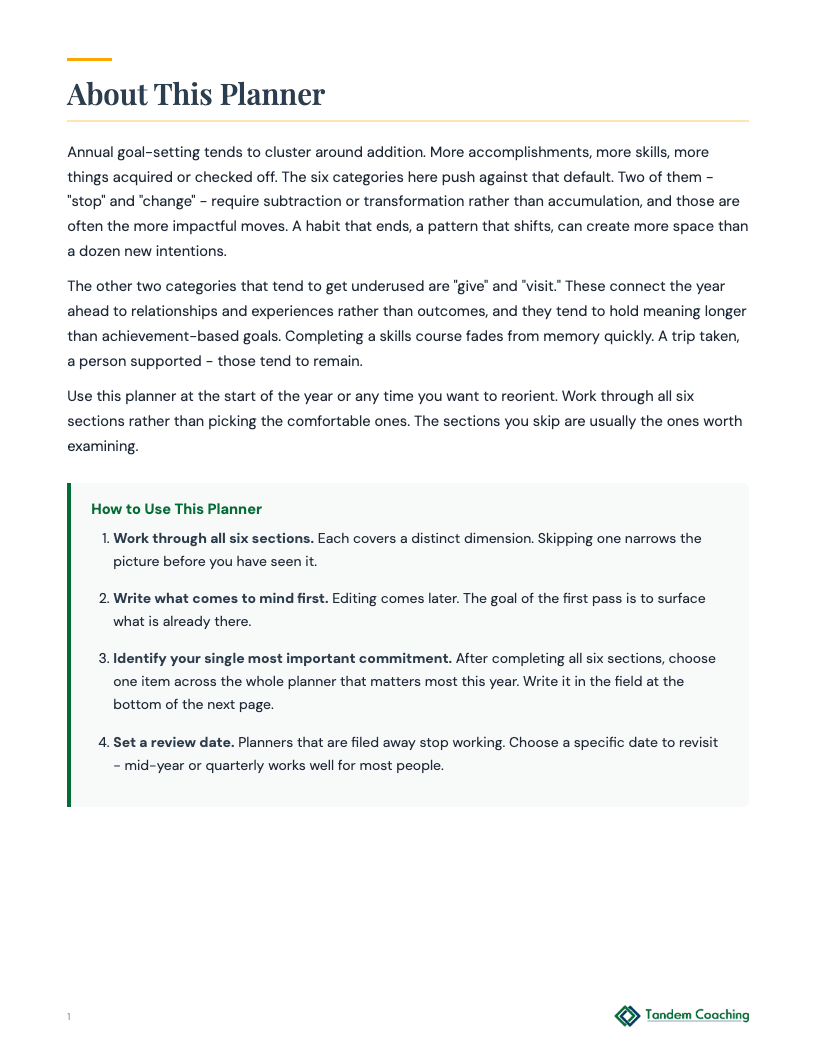
There's a six-category annual planner that includes not just what you'll start and learn, but what you'll stop and change — the subtraction and transformation categories are often where the most meaningful shifts live. Would that be a useful frame for the year ahead?
Client sets goals every year and follows through on most of them. The pattern is consistent: add skills, add projects, add responsibilities, add commitments. When asked what they are giving up to make space for any of it, the answer is vague — 'I'll find the time.' The year feels full before it begins because nothing is ever designated for removal. The Stop and Change categories have never been used intentionally.
Frame the Stop category as the enabling condition for everything in Start and Learn. 'Before we fill in what you want to add this year, let's look at what needs to come off the list. The Start column only has room if something leaves.' The resistance here is that high-performing clients associate stopping with quitting or failure. Name it: 'Stopping something by choice is different from stopping because it failed. What would you remove this year if removing it were considered a strength rather than a retreat?'
Watch for the Stop and Change categories being filled with vague intentions ('stop procrastinating,' 'change my mindset') rather than specific behaviors or commitments. A useful Stop entry names something concrete: a project, a relationship pattern, a recurring commitment. If both categories stay abstract while Start and Learn are filled with specific items, the client has not yet done the harder work. Also watch for the Give category being left blank — it often signals that the year is being planned entirely around the self.
After all six sections are complete, read the Stop and Change entries back to the client and ask: 'If you actually did these two things — stopped what you named and changed what you named — what would become possible that isn't possible now?' The answer usually reveals what the Start and Learn goals are actually in service of. Then: 'Which single item across the whole planner, if you accomplished only that, would make the year feel significant?' That item should be in the commitment field at the bottom.
Array
Client is organized and goal-directed. They arrive with a list of things to accomplish this year — skills to develop, career milestones to hit, health metrics to improve. The list is credible and achievable. What is absent is any goal that connects to relationship, experience, or contribution. The Visit and Give categories feel foreign to this client — not because those domains do not matter, but because the planning frame has always been productivity, not meaning. A year that ends with all boxes checked may still feel like something was missing.
Frame the six categories as a complete picture rather than a ranked list. 'Most annual planning focuses on Start and Learn — the achievement columns. The categories that tend to hold meaning longest are Visit and Give. Let's look at the whole frame before deciding where to put the energy.' The resistance from achievement-oriented clients is often a values argument: 'I can focus on experiences later — this year I need to hit specific milestones.' Name it: 'A year planned entirely around hitting milestones is one kind of year. The question is whether that's the kind of year you want this to be.'
Watch for Visit being filled with travel plans that are already scheduled — things that would happen regardless of this planner — rather than experiences the client is choosing intentionally. And watch for Give being filled with organizational contributions ('present at the company retreat') rather than personal ones. The distinction matters: organizational giving is often required; personal giving is chosen. If every entry in Give is something the client is already expected to do, the category has not been used.
After the full planner is complete, ask the client to identify one item from each of the six categories and read them in sequence. Then: 'If you described this year to someone important to you at the end of it — not what you accomplished but what the year was like — which of these six would you be most likely to mention?' The answer reveals which category carries the most meaning, regardless of which one received the most planning attention.
Array
Client is entering a new period — a new role, a significant life change, a year they have designated as different from the previous ones. They have a sense that this year should be different but have not organized that sense into anything specific. The full-picture structure of six categories is useful here not because all six are equally weighted but because the exercise of working through all of them surfaces what the transition actually touches. Clients in transition often have strong ideas in two or three areas and have not yet looked at the rest.
Frame this as mapping the transition rather than planning the year. 'You're in a real shift. Before we plan anything, let's look at what this transition touches — all six categories. That'll show us where the change is concentrated and where things can stay the same.' Some clients at transition points resist structure: 'I don't want to over-plan — I need to see how things unfold.' Name it: 'This isn't locking in a plan. It's naming your current intentions across all six areas so you can see what you're actually prioritizing versus what's running on autopilot.'
Watch for the six categories splitting sharply into two groups: the categories directly affected by the transition (fully populated) and the ones the client has not yet thought about in relation to it (sparse or empty). That split is useful data — the empty categories are often the ones the transition will affect most, because transitions tend to ripple. Also watch for the single most important commitment field at the bottom being answered with something from the loudest category rather than from genuine reflection across all six.
After the planner is complete, ask the client to look at which of the six categories changed the most in their thinking during the exercise — which one surprised them or felt different at the end than at the start. Then: 'Set a review date before we close. What's the right moment to come back to this — when enough has happened that the picture will have shifted, but early enough to adjust?' The review date is as important as the goals: a planner without a checkpoint is just a list.
Array
Client states their values with confidence but has not examined whether their behavior matches
LifeClient's goals are clustered in one or two areas and they haven't considered what's missing
LifeClient can state a goal but hasn't connected it to a personal reason that would sustain effort over time