Compare your stated values with how you actually spend your time, using a structured exercise that reveals real priorities and gaps.
Free, print-ready PDF.
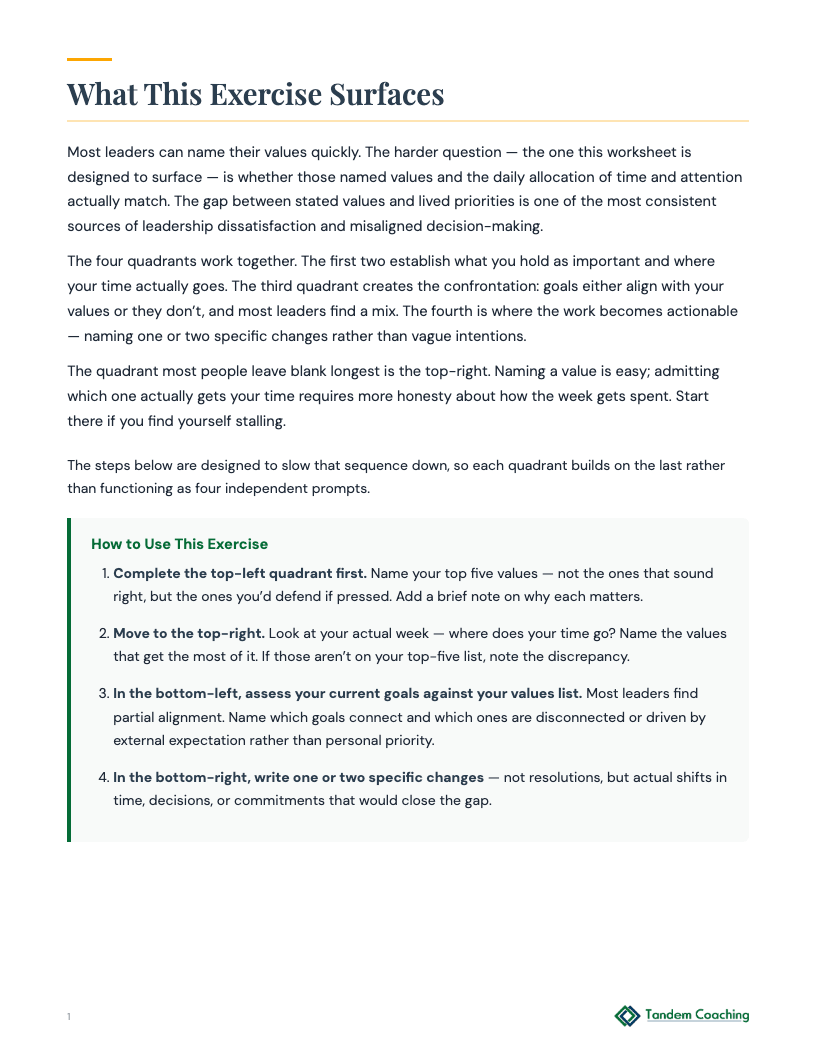
When you look at how you actually spend your time and energy — how well do those patterns match what you named as most important to you?
A 38-year-old marketing VP at a consumer goods company has built an impressive career track — promotions every two years, strong relationships, high performer ratings. She's been coaching for a month and opens each session well but stalls when asked what she actually wants. She can articulate what she's achieved but not what would make achievement feel meaningful. The quadrant format of this tool is specifically suited for this gap — she needs to separate values she's living from ones she's only endorsing.
Frame as a snapshot rather than an aspiration exercise. 'We're going to map four categories: what you do well and love, what you do well but don't love, what you love but don't do yet, and what you don't love and want to move away from. The last two quadrants are where we'll spend most of our time.' The predictable resistance: she may use the first quadrant as a performance summary rather than a values signal. Name it early: 'We're not listing achievements here — we're identifying what energizes you. The distinction matters.'
The second quadrant — things she does well but doesn't love — is diagnostic. If it's longer than the first, she has built a career on competence rather than alignment. If she initially refuses to populate it at all ('I love everything I do well'), that's a different kind of resistance. Watch for values that appear in the 'aspire to' quadrant (third) that she's never acted toward — those are wishes, not values in any active sense.
Start with the second quadrant. 'Read me everything in the 'does well, doesn't love' column.' Then: 'How much of your current week is that column running?' Don't move to the third quadrant until she's sat with the implication of the second. The question that typically opens things up: 'If you couldn't use your credentials as the reason to keep doing these things, what would you do with them?' That removes competence as justification and makes the choice visible.
Array
A senior data engineer at a tech firm has been offered a team lead position twice and declined both times. His manager has brought up a third offer and suggested that refusing again may limit his advancement. He's in coaching because he's conflicted — he knows the track he's on, doesn't know if he wants it, and feels pressure from multiple directions. He hasn't articulated what he actually values about his current role versus what he fears about the new one.
Position this as giving the decision a values foundation it currently lacks. 'Before we talk about whether to take this role, let's figure out what would be at stake if you did.' For technical professionals, the quadrant framing can feel more analytical and therefore safer than open-ended values conversations. That's useful — but watch for him populating the quadrants as a pros-and-cons list rather than a values map. The distinction: a pros-and-cons list evaluates options; a values map reveals what matters underneath the options.
If 'deep work,' 'autonomy,' or 'technical mastery' appear in the first quadrant (love and do well) and 'managing people' appears in either the second or fourth, the resistance to the leadership track has a values basis — not a fear-based one. That's a fundamentally different coaching conversation. Conversely, if what he loves most is the impact of his work rather than the technical act itself, the leadership track may align better than he thinks.
Start with the first quadrant. 'What on this list would you lose if you became team lead?' Then map the loss to actual job requirements, not assumptions. 'In this specific role, how much deep work would you actually lose?' The question that tends to open things up: 'If you took the role and it turned out you loved it, what would have to be true about it?' That question surfaces his unstated criteria for when leadership might feel like a values expression rather than a values cost.
Array
A 28-year-old account manager at a financial services firm is one year into her first post-MBA role. She chose the field for income and credential reasons and is now realizing she has no intrinsic interest in it. She describes herself as good at the work but disengaged. She's coaching because she doesn't want to waste the credential, but also doesn't want to spend another decade in work that feels like going through motions. She needs to separate what she values from what she's been trained to pursue.
This tool is particularly useful early in an engagement when the client doesn't yet have language for what she actually wants. 'Rather than talking about your career in the abstract, let's map what's alive for you across four specific quadrants.' For clients who are early in their careers and haven't built much evidence yet, the third quadrant — things she loves but doesn't do — is often the most generative. Name this: 'The things you haven't pursued yet but feel drawn to — those often contain the clearest signal.'
Watch for the fourth quadrant — things she doesn't love and wants to stop doing — to be significantly longer than the first. If she's twenty-eight and already has more in 'move away from' than in 'love and do well,' the misalignment is structural, not a rough patch. Also watch for the 'aspire to' quadrant containing items that are expensive to pursue (creative fields, non-profit work) — this is worth exploring without projecting whether cost should be the deciding factor.
Start with the first quadrant. 'What on this list could you imagine doing in ten years and still caring about?' Then compare that to her current role description. If the overlap is minimal, name it without directing: 'There's not much overlap between what energizes you and what you do most of every week. That's worth sitting with.' The question that opens things up: 'If the credential weren't something you needed to 'use,' what would you do next?' That removes sunk-cost logic and makes the actual preference visible.
Array
I feel stuck in the day-to-day and I've lost sight of what I actually want my life to look like
LifeClient is successful by external measures but cannot articulate why the work feels hollow
LifeClient is achieving goals but feels disconnected from any larger sense of meaning




![Why is Leadership Development Important? [Quick Answer]](https://cdn.tandemcoach.co/wp-content/uploads/2024/08/TC-215.jpg)