
Unique Value Proposition Builder
Craft a clear, differentiated elevator pitch for your coaching practice using a proven UVP framework and real client-focused prompts.
Get This Tool
Free, print-ready PDF.
When to Use This Tool
A coach whose elevator pitch sounds like every other coach's
Practice owner struggling to explain what makes them different
A coach who can describe what they do but not why someone would choose them
How to Introduce This Tool Plus
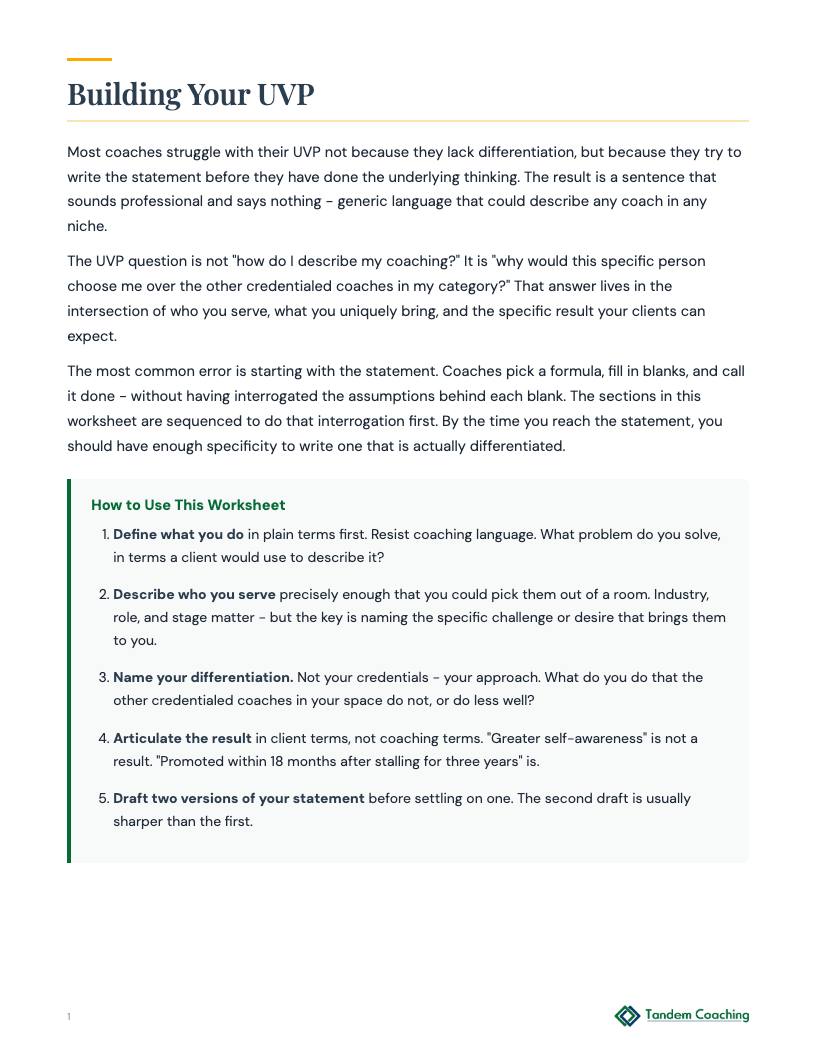
Most coaches can describe what they do. This worksheet is about a different question: why would your specific ideal client choose you over the other credentialed coaches in your space?
Browse All Pages
Tool Classification
Domain
Coach Practice
Type
Worksheet
Phase
Discovery
Goal Setting
Details
45+ min
Between sessions
Topics
Identity
Communication
Accountability
For the Coaching Practitioner
Plus
Coaching Scenarios
Plus
1 Coach differentiating from credential-equivalent peers in a saturated market ▶
Context
Your client holds the same ICF credential as dozens of coaches in their city and has similar training and experience. When they try to articulate why someone should choose them, they default to credential claims and years of practice - the same markers every other coach lists. They are not getting traction on their website or in discovery conversations.
How to Introduce
Frame this as an excavation, not a marketing exercise. 'The differentiation is almost certainly already there - it's in what you find yourself caring about in sessions, who you take on most readily, and what results show up repeatedly. We're finding it, not inventing it.' Resistance pattern to name: coaches with strong technical training often anchor on credential parity rather than distinctive approach. Name this directly before they start - 'Credential lists are necessary but not differentiating. We're looking for something that only you would have written.'
What to Watch For
Watch how long the client spends on the 'Who I serve best' section. If it fills in quickly with a demographic description (women in leadership, mid-career professionals), probe for specificity about the actual presenting problem those people bring. Demographic targeting without problem specificity produces a UVP that still sounds like everyone else. Also watch whether the 'proof' section is empty or vague - a UVP without evidence is a claim.
Debrief
Start with whatever section took longest to fill in - that is where the real material lives. Read the drafted UVP statement back to your client and ask: 'Could another coach with similar credentials have written this?' If the answer is yes, the worksheet has more work to do. Then ask: 'Which part of this, if you said it in a discovery conversation, would make someone lean forward?' That question usually surfaces the actual differentiator.
Flags
If your client cannot identify any aspect of their practice that feels genuinely distinctive - if every section of the UVP builder sounds generic even after working it - this may signal the practice needs more development before differentiation is possible, or that the client's self-awareness about their own work is limited. Severity: low. Response: continue, but suggest supplementing with feedback from past clients about what they experienced as distinctive.
2 Coach with a strong niche who cannot translate it into accessible language ▶
Context
Your client works almost exclusively with high-performing athletes transitioning into corporate leadership roles - a genuinely distinctive niche. When asked to explain their value in a conversation, they either go too narrow ('I work with former D1 athletes') or too conceptual ('I help people transfer peak performance mindsets'). Neither version lands. They know what they do; they cannot explain why it matters to someone who might hire them.
How to Introduce
Frame the UVP builder as a translation exercise, not a discovery one. 'You already know your differentiator - what we're building is the version of it that makes sense to someone outside the niche.' The work here is moving from internal fluency to external legibility. Clients with strong niches often resist simplification because the nuance feels essential. Name that upfront: 'The simplest version you can write while staying true is usually the right one.'
What to Watch For
Watch for jargon overload in the differentiation section - language that reads like shorthand for people already in the niche rather than an entry point for prospects outside it. Also watch whether the target client description matches what the client actually describes in sessions. Coaches with genuine niches sometimes write aspirational targets rather than actual ones.
Debrief
Start by asking your client to read the UVP statement as if encountering it for the first time with no context. 'If you did not know what you do, would this sentence make you want to know more?' Then focus on the proof section. Ask: 'What is the most concrete result a client of yours has achieved that you could point to?' If they can name it but it is not in the worksheet, that is the missing piece.
Flags
If your client's niche is so narrow that the pool of potential clients is genuinely small - and they have not mapped a business model around it - the UVP conversation may surface a viability concern rather than a messaging one. Severity: low. Response: name the distinction between having a clear UVP and having a sustainable practice, and explore whether the niche serves the business model.
3 Coach pivoting from one specialty to another mid-career ▶
Context
Your client spent 8 years coaching in organizational change management and is deliberately pivoting toward executive presence coaching. They have a strong track record in the old niche but feel like a newcomer in the new one. They are uncertain about how to represent their experience accurately without overstating expertise they are still building.
How to Introduce
Frame this as building a bridge UVP - one that is honest about the pivot while making the case for why the old experience is an asset in the new direction. 'Your eight years are not irrelevant to executive presence - they've given you an angle most executive presence coaches don't have. The question is how to make that explicit without making it the whole story.' Name the resistance pattern: pivot-stage coaches often either overclaim continuity or understate their background entirely. The worksheet holds both.
What to Watch For
Watch whether the differentiation section skips the transition entirely - treating the new niche as if the past never existed. Also watch whether your client writes two separate UVPs (one for each niche) and cannot synthesize them. That fragmentation is often a signal that the pivot is not yet resolved internally, not just in the messaging.
Debrief
Start with the 'Who I serve best' section. Ask: 'Which past clients from your organizational change work have shown up in the executive presence work?' If there is overlap, that is the connective tissue for the UVP. Then read the differentiator section aloud and ask: 'Does this sound like someone who has earned the right to say this, or someone who is still figuring it out?' Your client can usually hear the difference.
Flags
If your client is actively taking on executive presence clients before they feel confident in the specialty - and the UVP feels premature to them - explore whether the pivot timeline is too compressed. Severity: low. Response: the UVP builder can still be completed as a working draft; frame it as the aspiration the practice is building toward rather than a current-state claim.
Tool Flow
Plus
Requires
- None - standalone tool
→
Produces
- finalized UVP statement
- differentiation map approach result client
- two-draft UVP iterations with rationale
Pairs Well With
Coach Business
Optional Client Feedback and Use-Consent Notes
Use this checklist to review communication and accountability without assuming every item applies.
Why it pairsYour UVP names what sets you apart; this collects client words that prove it to prospects who haven't met you yet.
Coach BusinessCoaching Introduction Builder
Use this worksheet to explore communication and identity and turn the client’s observations into one optional next step.
Why it pairsYour UVP statement gives this tool the raw differentiation it needs to produce a spoken pitch that doesn't ramble.
Coach BusinessColor Context and Accessibility Notes
Use this framework to structure a conversation about identity and creativity while keeping interpretation with the client.
Why it pairsAfter naming your verbal differentiation, use this to choose brand colors that signal the same positioning without words.
Related Articles


Unlocking Your Potential as an Agile Coach: Exploring Different Paths for Professional Development
Read article →
Life Coach Certification: What It Means, What It Costs, and How to Choose
Read article →
Reflective Practice in Coaching Supervision for Growth
Read article →
The Technology Formation: The Builder Who Cannot Stop Building
Read article →