

Thought Holding Reflection
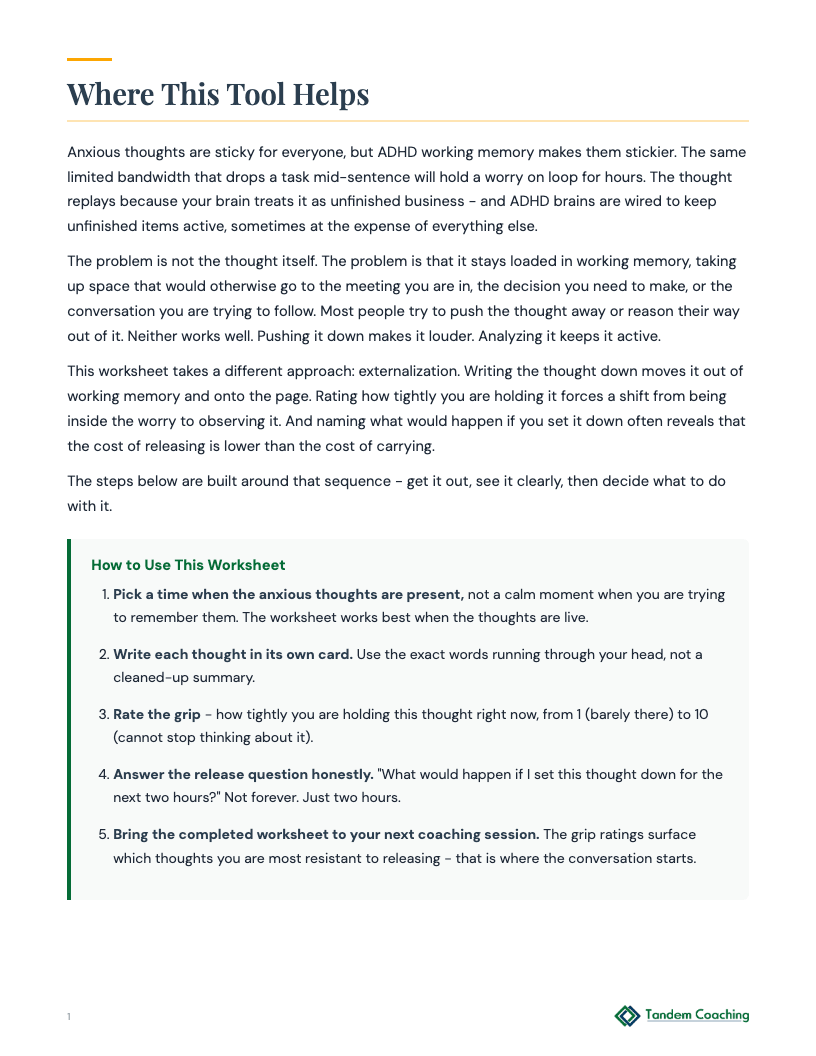
Record how much attention a thought holds and what might happen if you set it aside briefly, without forcing release.
Get This Tool
Free, print-ready PDF.
When to Use This Tool
A client wants to record a recurring thought without forcing it away
A client wants to compare personal attention ratings with likely consequences
A client wants to prepare a practical question for coaching or qualified support
How to Introduce This Tool Plus
Which thought is holding attention right now, and what might happen if you set it aside briefly without forcing it away?
Coaching Tool Disclaimer
This tool is designed for coaching contexts, not clinical use. If you or your client is in crisis, contact the 988 Suicide and Crisis Lifeline (call or text 988) or Crisis Text Line (text HOME to 741741).
Browse All Pages
Tool Classification
Domain
ADHD
Type
Worksheet
Phase
Action
Reflection
Details
15 min
Between sessions
As-needed
Topics
Mindset
Emotions
Executive Function
For the Coaching Practitioner
Plus
Coaching Scenarios
Plus
1 Product manager recording recurring stakeholder-feedback thoughts ▶
Context
A product manager notices that thoughts about recent stakeholder feedback are competing with current sprint-planning attention and wants to record what is present without inferring why it recurs.
How to Introduce
Offer the worksheet as an optional way to record a recurring thought and a personal attention rating. The client controls what is written and may pause, skip, or stop.
What to Watch For
Keep every description client-owned. Do not infer anxiety, ADHD mechanisms, emotional dysregulation, control patterns, hidden beliefs, or the meaning of a rating.
Debrief
Ask what the client recorded, what consequence they expect from setting the thought aside briefly, what remains uncertain, and whether a practical next step or qualified support is useful.
Flags
Coaching scope: not diagnosis, medical care, treatment, or a validated instrument. Adapt or stop for distress and use licensed health or emergency support when appropriate.
2 New director deciding what feels safe to write ▶
Context
A recently promoted director has one recurring work concern but is unsure what they want to record. The worksheet is optional, and privacy, pacing, and leaving prompts blank are explicit choices.
How to Introduce
Offer the worksheet as an optional way to record a recurring thought and a personal attention rating. The client controls what is written and may pause, skip, or stop.
What to Watch For
Keep every description client-owned. Do not infer anxiety, ADHD mechanisms, emotional dysregulation, control patterns, hidden beliefs, or the meaning of a rating.
Debrief
Ask what the client recorded, what consequence they expect from setting the thought aside briefly, what remains uncertain, and whether a practical next step or qualified support is useful.
Flags
Coaching scope: not diagnosis, medical care, treatment, or a validated instrument. Adapt or stop for distress and use licensed health or emergency support when appropriate.
3 Engineering manager comparing attention across work concerns ▶
Context
An engineering manager wants to compare how much attention several work concerns hold and what practical consequences they expect if each concern is set aside briefly.
How to Introduce
Offer the worksheet as an optional way to record a recurring thought and a personal attention rating. The client controls what is written and may pause, skip, or stop.
What to Watch For
Keep every description client-owned. Do not infer anxiety, ADHD mechanisms, emotional dysregulation, control patterns, hidden beliefs, or the meaning of a rating.
Debrief
Ask what the client recorded, what consequence they expect from setting the thought aside briefly, what remains uncertain, and whether a practical next step or qualified support is useful.
Flags
Coaching scope: not diagnosis, medical care, treatment, or a validated instrument. Adapt or stop for distress and use licensed health or emergency support when appropriate.
4 Sales leader recording work and financial concerns under pressure ▶
Context
A sales leader wants to separate several recurring work and financial concerns, record likely consequences, and decide which question belongs in coaching or with another qualified professional.
How to Introduce
Offer the worksheet as an optional way to record a recurring thought and a personal attention rating. The client controls what is written and may pause, skip, or stop.
What to Watch For
Keep every description client-owned. Do not infer anxiety, ADHD mechanisms, emotional dysregulation, control patterns, hidden beliefs, or the meaning of a rating.
Debrief
Ask what the client recorded, what consequence they expect from setting the thought aside briefly, what remains uncertain, and whether a practical next step or qualified support is useful.
Flags
Coaching scope: not diagnosis, medical care, treatment, or a validated instrument. Adapt or stop for distress and use licensed health or emergency support when appropriate.
Tool Flow
Plus
Requires
- None - standalone tool
→
Produces
- client-owned thought notes
- personal attention ratings
- likely-consequence and uncertainty notes
Pairs Well With
ADHD
Environment Context Log
Use this tracker to notice patterns in executive function and habits over time before drawing conclusions.
Why it pairsUse only when the client finds the next tool relevant; confirm scope and avoid treating personal observations as diagnostic or causal evidence.
ADHDDaily Mood and Energy Log
ADHD adult who can't see patterns in their emotional or energy fluctuations across the week
Why it pairsUse only when the client finds the next tool relevant; confirm scope and avoid treating personal observations as diagnostic or causal evidence.
ADHDPaced Breathing Option
A client wants to use Paced Breathing Option as an optional reflection
Why it pairsUse only when the client finds the next tool relevant; confirm scope and avoid treating personal observations as diagnostic or causal evidence.
Related Articles


Executive Function Strategies for ADHD Leaders: Working Memory, Impulse Control & Flexibility
Read article →
Organize Your Success – ADHD Coaching to Master Organizational Skills
Read article →
ADHD Mentorship: Support Networks That Work
Read article →
ADHD Coaching Certification: Which Path Actually Counts
Read article →