Turn one clear goal into three concrete targets you can act on, using a coaching-tested breakdown that makes progress measurable.
Free, print-ready PDF.
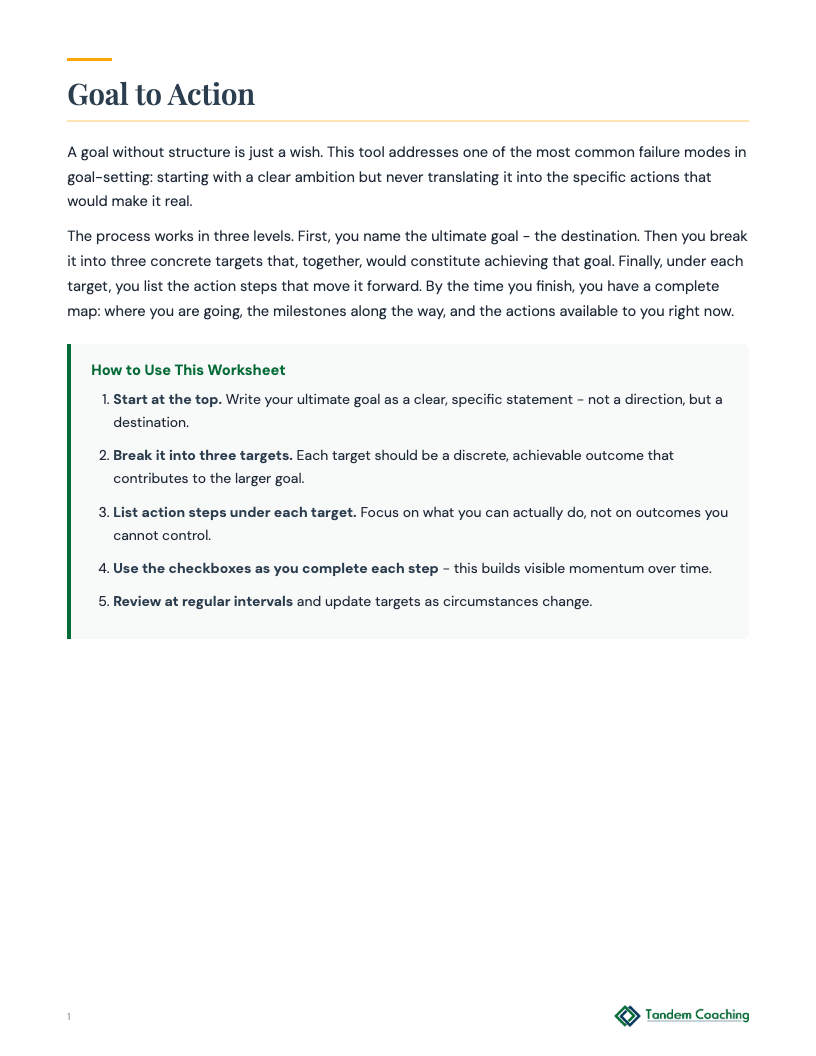
There's a three-level breakdown that moves from your ultimate goal to three concrete targets, then to the action steps under each — by the end you have a complete map from destination to immediate next move. Would it be useful to build that out together?
Client has named a clear, genuine goal — a promotion, a business milestone, a personal achievement — and has been working toward it in a general way for some time. Progress is inconsistent. The problem is not motivation or clarity about the destination; it is that the goal has never been broken into the three discrete targets that together would constitute achieving it. The client is trying to pursue a destination without a map of the terrain.
Frame the three-target structure as translation work, not additional planning. 'You know where you're going. What this does is break the journey into three legs — three outcomes that, together, mean you've arrived. By the end, you'll have a complete map from the goal to the first step you can take today.' The resistance here is from clients who find decomposition tedious when they already feel clear about the goal. Name it: 'The point of the three targets is not to plan more — it is to find the next move. Without targets, there is no clear next move, only the goal, which is too large to act on directly.'
Watch for three targets that are not discrete outcomes but milestones on the same path — 'get 25% of the way there, get 50%, get 75%.' Those are progress markers, not targets. A target should be something that would feel like an achievement in its own right. Also watch for action steps that are actually outcomes rather than actions — 'have a better relationship with my manager' under a target is an outcome, not an action step. Action steps should be things the client can physically do.
After the three targets and action steps are complete, ask: 'If you only completed Target 1 and stopped — just that target — would you have made meaningful progress?' If the answer is no, Target 1 is not discrete enough. Then: 'Which action step in the whole grid is most important to do first?' The client's answer reveals where they think the leverage is, which is usually more accurate than where they are currently spending their time.
Array
Client has filled in the three targets and the action steps beneath each. When read top to bottom, the chain does not hold together: the action steps address real tasks but it is not clear how completing them produces the target, or how the target leads to the ultimate goal. The actions are real activities but they are not the right activities for this goal. The client has been busy without being strategic.
Frame this as tracing the chain. 'We have the goal, the targets, and the steps. What I want to do is read them as a chain and check whether each link actually connects to the next.' Some clients resist this because they are confident they have been working on the right things. Name it: 'This is not a critique of your activity — it is checking whether the activity leads where you intend. If the chain holds, we know. If it breaks, we find the break and fix it.'
Test each target by asking: 'If all the action steps under this target were completed, would the target be achieved?' If the answer is 'probably not' or 'that would help but there's more,' the action steps are incomplete or the wrong ones. Also watch for action steps that produce a related benefit but not the specific target — they improve something adjacent to the goal without addressing it directly. That pattern often signals that the client is working around a more difficult action they have not yet named.
After the chain has been reviewed, ask: 'Are there any action steps on this list that you would be genuinely uncomfortable doing — the kind you have been putting off?' The discomfort test reveals which actions are the real leverage points. Then: 'If you removed all the action steps from this list that you are already doing anyway — things you would do regardless of this goal — what is left?' What remains is the actual behavioral change the goal requires.
Array
Client is beginning something new — a project, a role change, a personal commitment. They have energy and genuine intention. What they do not have is a structure that translates the intention into immediate action. The energy of starting tends to carry the first few days, then dissipates when the next move is not obvious. This tool creates the bridge between 'I want to do this' and 'here is what I am doing tomorrow morning.'
Frame this as converting intention into architecture. 'You have the goal. What we are building today is the structure underneath it — the three milestones and the first moves under each. By the end of this session, the goal will have a map attached to it.' Some clients find this unnecessary when their energy is high: 'I know what I need to do.' Name it: 'High motivation in week one is not a plan. A plan is what you use in week four when the motivation has leveled off and you need to know what to do next.'
Watch for action steps that are front-loaded under Target 1 with decreasing specificity under Targets 2 and 3. That pattern reveals that the client has planned the beginning but not the middle and end. The checkboxes under Targets 2 and 3 should be as specific as the ones under Target 1 — if they are not, the client has not yet thought through what happens after the initial momentum.
After the grid is complete, look at the first action step under Target 1 — the one that can be done first. Ask: 'Is this actually the first thing you will do, or is there a setup step that needs to happen before it?' The question often reveals a prerequisite that has not been named, which is frequently the reason initial momentum stalls. Then: 'When specifically will you complete this first step?' A commitment to a day and time is more reliable than a commitment to 'soon.'
Array
I read a lot but I never retain or apply what I learned
LifeClient knows the goal but hasn't mapped what daily behaviors will actually carry them there
LifeCoach wants structured session feedback but a free-form debrief produces inconsistent and hard-to-compare responses