Turn vague life dreams into clear goals and next steps with a guided, coach-tested vision board framework you can act on.
Free PDF - professionally formatted, ready to print or fill digitally
Download Free PDF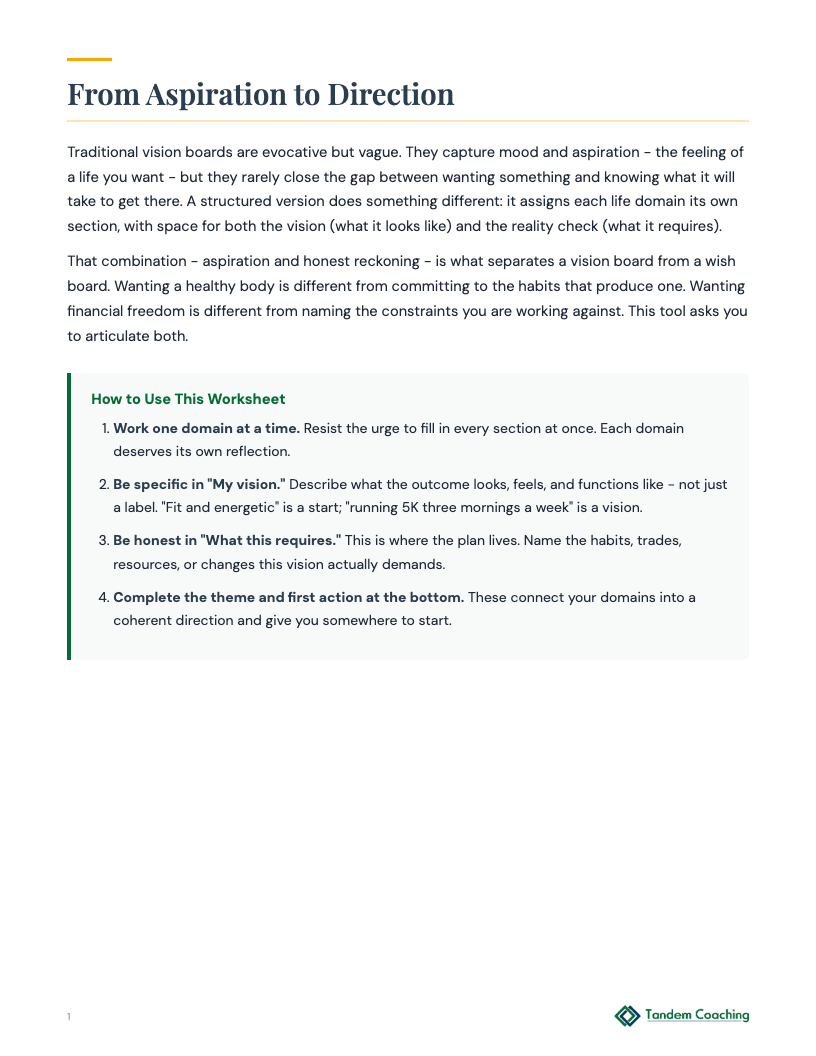
Some clients find it useful to describe where they want to be across several life areas at once and then check whether that vision is realistic given where they are now - would exploring that combination be helpful?
Client can describe their dream life in vivid terms. Health, relationships, finances, career — they have images for all of it. What they have not done is name what each domain actually requires. They want the outcome without the cost, or they have not yet confronted the cost. The 'What this requires' field in each domain is the critical one — it is where the vision either becomes a plan or remains a fantasy.
Frame the tool's two-field design as the difference between wishing and planning. 'Most vision exercises ask what you want. This one asks what you want AND what it requires. The second field is where most people slow down — because naming what it requires means looking directly at what you are not yet doing.' The resistance pattern is avoidance of the requirements field. Clients will fill in the vision side fluently and leave the requirements sparse. Name it: 'If the requirements field is hard to fill, that is information — it means the vision is not yet grounded in what it actually takes.'
Watch for a completed vision side and an empty or vague requirements side — particularly in the domains the client has the most energy about. If the vision for health is specific ('running four mornings a week, weight stable, energy sustained through the day') but the requirements field says 'make better choices,' the client has not looked at what this actually demands. Also watch for requirements that are so demanding in aggregate that they cannot all be honored simultaneously — that tension is the conversation.
After all six domains are complete, read the requirements side as a list: 'Health requires this. Career requires this. Relationships require this.' Then: 'Looking at this list of requirements together, which three are you already meeting and which three are you furthest from?' The second question focuses the coaching work on the actual gap, not the aspirational picture. Close with the theme and first action fields — the theme should name what connects the domains, and the first action should be something the client can do in the next 30 days.
Array
Client had a clear vision at an earlier point in their life. That vision was coherent, energizing, and meaningful. In the years since, circumstances have changed significantly — a relationship has ended or deepened, a career has taken an unexpected direction, health has imposed new realities, values have shifted. The client is still operating from the old vision because they have not stopped to rebuild it. The gap between the current vision and the current reality is producing a low-grade friction they cannot fully explain.
Frame this as a rebuild rather than a review. 'Sometimes a vision needs to be built from scratch because who you are now is different enough from who built the last one that the old picture no longer fits. This is that exercise.' The resistance here is from clients who have invested significant energy in a previous vision and feel that abandoning it represents a kind of failure. Name it: 'Updating a vision as you change is not inconsistency — it is accuracy. A vision that fits your life ten years ago may be working against you now.'
Watch for language in the vision fields that sounds like nostalgia — describing a previous version of the client's life rather than a forward-looking picture. 'Get back to feeling the way I used to about my work' is not a vision; it is a desire to reverse a loss. Also watch for the connecting theme field at the bottom: if the client cannot name a theme that feels current and alive, the vision may have been generated from habit or obligation rather than genuine desire.
After completing all six domains, ask: 'How much of what you wrote here is new and how much is from a previous version of your life?' The question surfaces whether the rebuild has happened or whether the old vision has reasserted itself. Then: 'Which domain feels most different from where you would have placed it five years ago?' That domain is usually where the most meaningful change has occurred and where the coaching work has the most traction.
Array
Client can describe their career trajectory in precise terms: the role they are building toward, the skills they are developing, the reputation they are cultivating. When asked about health, relationships, personal growth, or experiences, the answers are sparse — not because those domains do not matter, but because the client has not built the habit of thinking about them intentionally. The vision for the non-career domains exists only as a vague background preference, never examined or named.
Frame this as a first articulation, not a final one. 'You have a clear picture of your professional direction. What we are going to do today is build the same kind of picture for the other areas — not because they need to be as specific as your career goals, but because having nothing there means those areas are running on autopilot.' The resistance here is often a values argument: 'relationships shouldn't be goals, health is just something you manage.' Name it: 'This isn't about turning everything into a project. It's about noticing what you want in each area so you can make conscious choices rather than just filling gaps when they get too large.'
Watch the Career and Finances domains being filled quickly with strong, specific language, while Health, Relationships, and Personal Growth have vague or minimal entries. That asymmetry is not a problem to fix in the session — it is data about where the client's intentional thinking has been concentrated. Also watch for the requirements field revealing, in some non-career domain, a requirement that the client is already meeting but has not been crediting themselves for.
After all six domains are complete, ask: 'If you could make only one of these six visions significantly more real in the next year — just one — which would you choose?' The answer is usually not career. Most clients who arrive with only a professional vision choose a relational or health domain when given permission to think about it directly. That choice is the beginning of a different kind of planning conversation.
Array
My client feels like life is passing by without them living it intentionally
LifeA client feels pulled in a direction they haven't fully articulated yet
LifeA client who's overwhelmed by complexity and needs a visual way to see the whole picture