Clarifies your genuine strengths versus what you think you should be good at, using structured reflection and evidence from real-life examples.
Free, print-ready PDF.
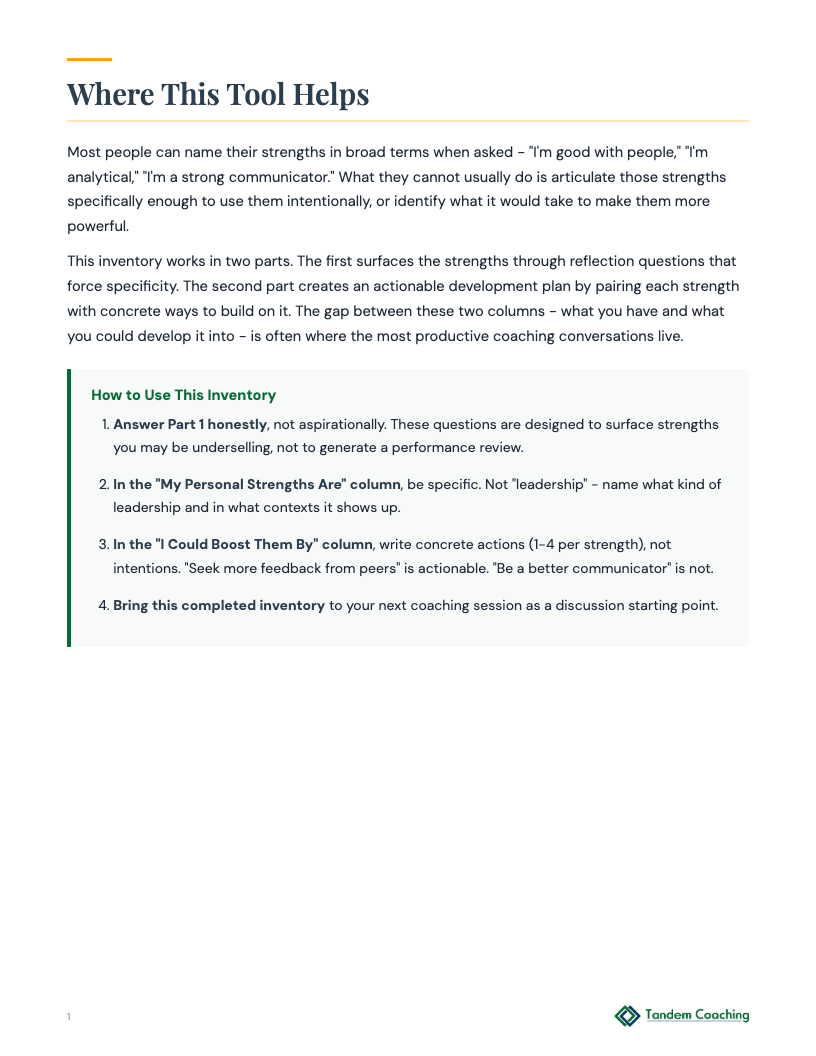
When you filled in the 'I Could Boost Them By' column, which strength had the most concrete actions — and which one did you struggle to go beyond a vague intention?
A senior manager preparing for a promotion discussion who can describe their team's accomplishments in detail but struggles to articulate their own strengths in first person. When asked directly, they pivot to results and team performance. They know they're capable but can't make the move from knowing to claiming. The promotion conversation requires them to speak specifically about what they bring that others don't.
Frame Part 1 as reconnaissance before Part 2 is designed. 'Before we build a development plan, we need to know what you're actually building from. The questions in Part 1 are designed to surface evidence you already have but haven't organized.' The standout strengths question in Part 1 is where clients often stall: 'standout' implies comparison, and clients who resist self-promotion read the question as asking them to declare superiority. Reframe it as 'what do people reliably come to you for that they don't go to others for?'
Watch Part 1's specificity. If a client fills it in with category labels - 'strategic thinking,' 'communication,' 'leadership' - they're listing common vocabulary, not naming actual strengths. The signal is in the specificity: 'I can see the second-order consequences of a decision before most people in the room' is a strength. 'Strategic thinking' is a label. If the client resists writing specifics, probe with: 'Give me a specific example of a time when this quality showed up.' The example, not the category, is the data.
Start with the Part 2 table's 'I Could Boost Them By' column, not the strengths column itself. Clients are more willing to discuss development than to claim strengths. 'What's the most interesting development action you wrote?' often opens the conversation better than 'what did you identify as your top strength?' Once the client is engaged with development, return to Part 1: 'Which of the qualities you identified in Part 1 feels most true to who you actually are, not who you think you should be?' That distinction often produces the most honest answer.
If the client's Part 1 responses describe strengths that are entirely relational - listening, supporting others, making people feel heard - with no task or strategic strengths, explore whether the client is underselling their intellectual or technical contribution out of a belief that relational strengths are less valued. Severity: low. If the client fills Part 2's action lines with development activities that are designed to fix weaknesses rather than amplify stated strengths, the exercise has been inverted - they're using a strengths tool to build a deficit remediation plan. Severity: low. Name the pattern.
A capable professional in their mid-30s who has never been through a formal strengths assessment, received developmental feedback focused on what's working, or had a coaching conversation oriented toward their assets. Every performance conversation in their career has been about what to improve. They arrive not knowing what their strengths are in any organized way - the information hasn't been absent from their life, it just has never been named or structured.
Open by explaining what the tool does and what it doesn't do. 'This isn't an assessment that scores you against norms. It's a set of questions that help you surface patterns from your own experience - things you already know but haven't necessarily said out loud.' The personal qualities question in Part 1 is the entry point: it's less threatening than 'what are your standout strengths' because it asks about qualities, not performance. Give the client permission to write things that feel obvious or too basic. The obvious ones are often the most load-bearing.
Watch for clients who write the same strength in multiple forms throughout Part 1 rather than diversifying. If every answer circles back to a version of 'I work hard' or 'I'm reliable,' the client may be defaulting to virtues rather than capabilities. Probe gently: 'When you think about a problem or challenge you're especially good at handling, what kind of problem is it?' This question surfaces domain-specific strengths that don't appear in the virtue vocabulary. Also watch for clients who complete Part 2 before Part 1 is adequately populated - the development plan can't be better than the inventory it's built from.
Start with what surprised the client. 'Looking at what you wrote in Part 1, what did you write that you've never actually said about yourself before?' This question surfaces the underowned strengths - the ones the client knows but doesn't claim publicly. Move to Part 2: 'Which of the development actions you listed would feel most like expanding something real, rather than fixing something broken?' That framing reveals which development direction the client is actually motivated to pursue. Close by asking which strength they'd want their closest colleague to confirm or challenge.
If the client fills Part 1 primarily with skills from their current job description rather than personal qualities that exist across roles and contexts, they may be conflating strengths with job competencies. Severity: low. This matters because job competencies change when roles change; underlying strengths don't. If the client reports having taken formal strengths assessments before and describes those results very differently from what they wrote in Part 1, explore the discrepancy. Severity: low. The gap between assessed strengths and self-named strengths is often the most interesting coaching data.
A client who was laid off or managed out of a role, regardless of the business circumstances behind it, and has internalized the event as evidence of personal inadequacy. They intellectually understand that layoffs are often structural, but emotionally the departure has become a referendum on their capability. They're approaching a job search or next-role conversation from a deficit position that will show in how they present themselves.
Frame this as evidence retrieval, not confidence building. 'You have a track record. We're going to inventory it so you can see it laid out as a set of capabilities, not just as a list of job titles.' Part 1's reflection questions are the most important section for this client: the personal qualities and standout strengths questions are asking them to look at what crossed organizational boundaries - what they brought to every role, not just the one that ended. The qualities they identify here are not what the last employer valued or didn't value; they're what the client actually has.
Watch for the client writing Part 1 responses in the past tense: 'I used to be good at...' or 'before this happened, I was known for...' The tense shift signals that the client is locating their strengths in a self that ended with the role. If the responses are in past tense, pause and ask: 'Is that quality still true of you today, independent of what happened at [company]?' Most clients, when asked directly, confirm the quality still exists. But without that prompt, the past tense framing goes unexamined. Part 2's development actions may feel irrelevant to a client who believes their strengths no longer apply.
Start with the distinction between what the client wrote and what they believe. 'You wrote that you're good at X. Do you believe that right now?' The gap between what they can write and what they can claim is the coaching work. This is a client who may need several rounds of the tool before the self-concept catches up to the evidence. The Part 1 responses are not the end point; they're the starting argument in an ongoing case the client needs to build for themselves. Close by asking: 'If the person described in Part 1 were interviewing for their next role, what would you tell them to lead with?'
If the client cannot write anything in Part 1 after 20+ minutes of attempting, the departure event may have created more significant disruption to their self-concept than the coaching container alone can address. Severity: moderate. Continue working with the tool over several sessions rather than in one sitting. If the client describes the layoff or departure in terms that suggest they were treated unjustly, with significant unresolved anger toward the organization, the tool may surface distress rather than insight. Severity: moderate. The strengths inventory can wait; the emotional processing may need to come first.
My client says they know what they value but their choices don't reflect it
LifeA client feels successful but unfulfilled and wants to understand why
LifeA client wants to track which daily activities feel aligned with what matters most to them