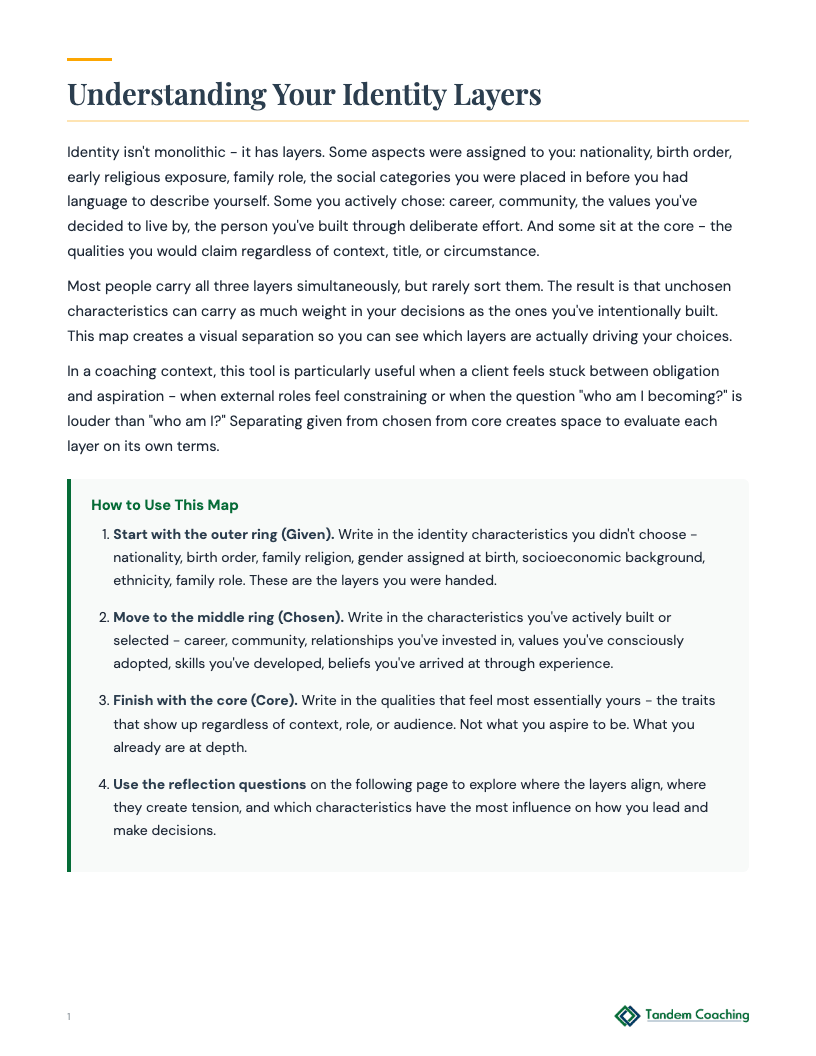
Social Identity Map

Pathway Builder 🔒
Domain
Life Coaching
Type
Worksheet
Phase
Discovery
Details
30 min Mid session
Topics
Identity Values

Coaching tools for personal clarity and intentional living.

When to Use This Tool
I've built my identity around my job and I'm not sure who I am outside of it
I want to understand which parts of myself I chose versus inherited
I'm going through a major life transition and I'm questioning who I really am
How to Introduce This Tool

Some clients find it valuable to map out which aspects of their identity were given to them versus which ones they've consciously chosen - would exploring that distinction be useful for where you are right now?

Download This Tool

Free PDF - print-ready, professionally formatted

Download Free PDF
Preview Worksheet · 30 min

For the Coaching Practitioner

Coaching Scenarios Plus
1 When Professional Identity Has Crowded Out Everything Else
Context

A client who is a managing partner at a law firm is facing a forced reduction in practice hours due to health reasons and describes feeling 'like I don't know who I am without the work.' He has built his identity around his professional role for twenty years and cannot name who he is outside it. The three-ring map - given identities, chosen identities, and core self - creates a visual structure for examining what exists in the outer rings that has been suppressed or ignored, and identifies what in the core self has been present across roles even when the professional identity is removed.

How to Introduce

Frame the diagram as a way to see what's there, not what should be: 'This three-ring map separates the identities you were born into from the ones you chose and the core self that exists regardless of either. Most of us, if we've been high-performing for long enough, find that the chosen ring has crowded out a lot. Completing this map isn't about redesigning yourself - it's about taking an accurate inventory of what's actually there.' Introduce it in session for the first ring (given identities), then assign the remaining rings as between-session work so he has time to sit with the core self ring.

What to Watch For

Watch for the given identities ring being completed dismissively - 'son, husband, American' - without examining whether those identities still hold meaning or have been dormant. The question the map asks about given identities is: do these still serve you? If he has never examined his given identities as potentially meaningful or potentially outgrown, the map is not yet working. Also watch for the core self ring being populated with professional attributes: 'strategic thinker,' 'problem solver,' 'rainmaker.' If the core self is described in professional terms, ask: 'If you had never become a lawyer, what would still be true about who you are?'

Debrief

Start with the given-identity question: 'Which of these given identities still feel like part of who you are, and which feel like they were assigned to you and you've been carrying them?' That question often surfaces long-held identity constraints that the client has never examined. Then look at the gap between the chosen identities ring and the current-life reality: 'The things you wrote in chosen identities - how many of them are actively present in your life right now?' The gap between chosen identity and lived experience is the coaching territory for the engagement's next phase.

Flags

Array

2 Chosen vs. Inherited Identity Before a Major Career Transition
Context

A client who is a senior director of product management at a financial services firm is considering leaving to start her own company. She has been in financial services for fifteen years because her family expected stability and professional prestige. She describes herself as 'not sure whether I want this transition or whether I'm finally allowed to want it.' The social identity map creates a structured way to examine which of her current professional identities were chosen and which were inherited from family and cultural expectations - a distinction that is foundational to making the transition decision from a place of clarity rather than permission-seeking.

How to Introduce

Name the specific question the map is designed for: 'The distinction between what we were given and what we chose is often invisible until we look at it directly. This map externalizes that distinction - it asks you to sort your identities by whether you chose them or inherited them, and then to identify what's true about you regardless of either. For someone making a major decision about direction, that sorting process is foundational. Before we talk about the transition, let's understand which parts of your current path were chosen and which were assigned.' Assign it with enough time to complete it thoughtfully.

What to Watch For

Watch for the client sorting her professional identity into 'chosen' when the history she has described suggests it was largely given. If she writes 'financial services professional' in the chosen ring, ask: 'When did you choose financial services - what was the moment?' The answer often reveals that the choice was made under constraint rather than from preference. Also watch for the core self ring producing qualities that support the transition (creative, entrepreneurial, risk-tolerant) while the client is simultaneously expressing uncertainty about whether she 'really' wants to leave - the map output and the stated uncertainty are data for the same coaching conversation.

Debrief

After reviewing all three rings together: 'How many of the identities in your given ring are you still actively maintaining? What would it cost you to let go of the ones that no longer fit?' Then turn to the chosen ring: 'Of the identities here, which ones would you choose again if you were choosing today, and which ones would you not?' The 'would choose again' question makes visible the distinction between active choice and inertia. Close by asking: 'What does the core ring tell you about whether your proposed direction fits who you actually are?'

Flags

Array

3 Finding the Consistent Core Across Conflicting Role Demands
Context

A client who is a chief operating officer at a healthcare nonprofit describes feeling fragmented across her roles: she is different with her board, her direct reports, her external partners, and her family. She is not sure which version of herself is real and worries that the version her board sees is a performance. The three-ring map's core self section addresses this directly - the core qualities that appear across all roles regardless of context are the 'real' self, and mapping them explicitly reduces the experience of fragmentation by revealing the thread that has always been present.

How to Introduce

Frame the core ring as the destination of the exercise: 'The outer two rings are context-dependent - they shift based on role and relationship. The core ring is what doesn't shift. We're using this map to find that thread - the quality that's been present whether you're in a board meeting, a difficult conversation with a direct report, or at home. Most people who feel fragmented have more consistency in their core than they realize; they just haven't named it. Complete all three rings and bring it in - we'll look at the core ring together.'

What to Watch For

Watch for the core ring containing context-dependent qualities rather than fundamental ones - 'listener,' 'leader,' 'strategic thinker' are roles, not core qualities. Ask: 'Is that something that's true of you in every context, or something that appears in certain roles?' The core ring qualities should be describable at any age and in any setting. Also watch for the client being reluctant to claim the core ring qualities as genuinely hers - 'I think I'm caring but I'm not sure others would say that.' The qualifier often indicates that the core quality has been underexpressed or suppressed in the dominant context (often the professional one).

Debrief

Read the core ring qualities aloud and ask: 'Where do you see these appearing in the version of yourself your board sees? Your direct reports? Your family?' If the core qualities appear across all contexts, the fragmentation is a perception rather than a reality - and naming that is itself the intervention. If specific core qualities are completely absent in certain contexts, ask: 'What would it look like for this quality to show up in that context?' The suppressed core quality in a specific role becomes a coaching target for behavioral change.

Flags

Array

Tool Flow
Requires
  • None - standalone tool
Produces
  • three-ring identity map given chosen and core
  • written answers to which given identities still serve
  • named core quality visible across all roles
  • identified tension between given and chosen layers

Pairs Well With

Life

Ikigai

Client is successful by external measures but cannot articulate why the work feels hollow

30 min Framework
Life

Life Purpose Discovery

Client is achieving goals but feels disconnected from any larger sense of meaning

45+ min Framework
Life

Dream Life Visualization

Client articulates dissatisfaction with their current situation but cannot describe what they actually want

30 min Framework

Related Articles

Executive Job Automation Risk: The PURPOSE AUDIT™ Framework

Executive Job Automation Risk: The PURPOSE AUDIT™ Framework

Read article →
Transformational Coaching Skills: Powerful Coaching Questions to Ask Clients

Transformational Coaching Skills: Powerful Coaching Questions to Ask Clients

Read article →
Executive Transition Runway Calculator | How Long Can You Really Last?

Executive Transition Runway Calculator | How Long Can You Really Last?

Read article →
Benefits of Leadership Development Programs - Unveiled for Corporates

Benefits of Leadership Development Programs - Unveiled for Corporates

Read article →
Chief AI Officer Career Path: Is CAIO Right for You?

Chief AI Officer Career Path: Is CAIO Right for You?

Read article →
Exploring Different Types of Coaching: Finding the Right Fit for Your Needs

Exploring Different Types of Coaching: Finding the Right Fit for Your Needs

Read article →