Skills and Strengths Inventory (Professional)

Get a clear, evidence-based snapshot of your professional strengths and gaps to guide career decisions, development priorities, and next steps.

Assessment · 30 min · Print-ready PDF · Free download

Get This Tool

Free PDF - professionally formatted, ready to print or fill digitally

Preview Assessment · 30 min
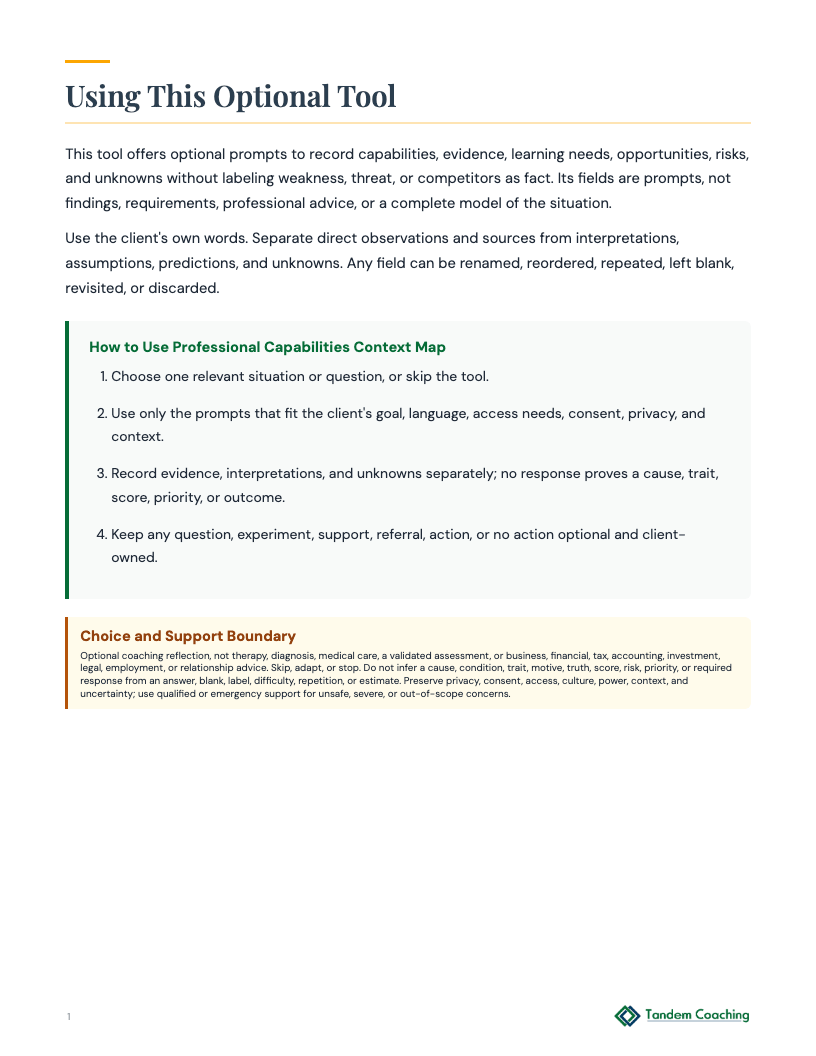
Skills and Strengths Inventory (Professional) - preview
When to Use This Tool
A client needs a clear-eyed picture of where they're strong and where they're exposed professionally
Someone filling four SWOT quadrants with specific capabilities, gaps, opportunities, and competitive threats
Identifying the one strength-opportunity pairing worth pressing and the one weakness-threat pairing to address
How to Introduce This Tool Plus

Where does one of your real strengths intersect with an opportunity you haven't moved on yet — and what's been getting in the way?

Browse All Pages
Interactive Preview Assessment · 30 min
Tool Classification
Domain
Career
Type
Assessment
Phase
Discovery
Details
30 min Between sessions As-needed
Topics
Career Transition Leadership

For the Coaching Practitioner

Plus
Coaching Scenarios Plus
1 Engineering director moved to general management three months ago
Context

A director of engineering was promoted to VP of Product & Engineering, a role that requires cross-functional leadership across design, marketing, and customer success. The client requested coaching because they feel like they're 'losing their edge' - the technical depth that earned the promotion isn't what the role demands. They think the problem is time management. The actual gap is that they haven't identified what they bring to non-technical conversations.

How to Introduce

Frame this as a positioning exercise, not a self-assessment. 'You keep saying you're losing your edge. Before we accept that, let's map what you actually bring and where the gaps are - with the new role as the frame, not the old one.' The resistance here is that technical leaders often fill Strengths with technical capabilities and leave the quadrant feeling complete. Name that upfront: 'Write what you bring to a room where nobody cares about the architecture. If you can only list technical skills, that's the data we need.' This tool works here because it forces the comparison between what the client values in themselves and what the role actually requires.

What to Watch For

Count how many Strengths entries reference technical skill versus influence, judgment, or relationship capital. If all six or eight items are technical, the client is describing who they were, not who they need to be. In the Opportunities quadrant, look for whether entries reference projects or relationships. A client writing 'the new product launch' is thinking about tasks. A client writing 'the CMO has no technical counterpart in her planning meetings' is thinking about positioning. The Threats quadrant is where compliance shows up in this scenario - generic items like 'AI disruption' or 'market downturn' instead of 'my peer in Sales has stronger executive presence with the CEO.'

Debrief

Start with the Strengths quadrant. Read the entries back and ask: 'Which of these matter to your CFO? Which ones does your head of design care about?' This reframes strengths from intrinsic qualities to contextual assets. Then move to the gap between Opportunities and Threats. The question that tends to open this up: 'You listed five technical strengths and one influence-related strength. If the ratio were reversed, which Threats would disappear?' This connects the inventory to specific developmental action rather than leaving it as a snapshot.

Flags

If the Weaknesses quadrant is empty or contains only one item framed as a humble-brag ('I'm too detail-oriented'), the client may not be ready to examine their gaps in this role. Severity: low. Response: don't push the Weaknesses quadrant directly. Instead, ask 'What would your head of design say is missing from this list?' External attribution is easier than self-assessment for clients protecting their professional identity during a transition.

2 Senior executive who has 'already done SWOT' resists the exercise
Context

A C-suite executive with 20+ years of experience was nudged into coaching by the board after a failed acquisition integration. The client sees coaching as a formality and approaches every tool as something they've already mastered. They completed a personal SWOT in an MBA program and see this as a repeat. The presenting issue is the integration failure; the actual issue is that the client's self-assessment hasn't been updated since they were last genuinely challenged.

How to Introduce

Don't argue with the objection. Use it. 'You've done SWOT before - good. Do it again, but with one constraint: every entry has to be from the last 12 months. Nothing from before the acquisition.' This neutralizes the 'already done it' resistance by changing the time horizon. The client will discover that their mental model of their strengths is years old. If they push back further, try: 'Think of it as a balance sheet. A balance sheet from 2019 doesn't tell you where you are today. Neither does a SWOT from your MBA.' The tool works here because the gap between the client's stored self-image and their current reality is itself the coaching material.

What to Watch For

Speed and polish are the tells. If the client fills all four quadrants in under 10 minutes with articulate, well-formed entries, they're retrieving cached answers rather than thinking in real time. Look for language that sounds like it came from a presentation: 'strong stakeholder management' or 'proven track record in M&A.' These are resume lines, not honest inventory. Genuine engagement looks like hesitation in the Threats quadrant, crossing things out, or adding items after they thought they were done. If the Weaknesses quadrant reads like a polished development plan ('working on delegation'), the client is managing their image, not doing the exercise.

Debrief

Start with the Threats quadrant - it's where cached answers break down fastest. Ask: 'Which of these existed before the acquisition, and which are new?' Then move to Strengths and ask the same question. The pattern that typically emerges is that the client's Strengths haven't changed in years while the Threats are all recent, which means the client is facing new challenges with an outdated toolkit. The question that creates movement: 'If the board were filling out your Threats quadrant, what would they write that isn't on this page?'

Flags

If the client produces a polished, internally consistent SWOT with no contradictions or tensions between quadrants, and resists any question that challenges it, the coaching relationship itself may be at risk. This client is performing compliance rather than engaging. Severity: moderate. Response: name the pattern directly in session rather than continuing to work with the tool's output. 'This reads like a document prepared for someone else. I need the version you wouldn't show the board.'

3 Mid-career finance leader whose Threats quadrant reveals an unacknowledged rival
Context

A VP of Finance at a mid-size company hired a coach to prepare for a CFO succession. The outgoing CFO retires in 18 months, and the client believes they're the natural successor. They framed the coaching engagement as 'polishing leadership presence.' They haven't acknowledged that a recently hired SVP of Strategy - with board-level relationships and a broader mandate - is positioning for the same role.

How to Introduce

Frame the tool around succession readiness, which aligns with the client's stated goal. 'Before we work on presence, let's get specific about where you're strong and where you're exposed in the succession conversation. Not generally - specifically for this role, in this organization, in the next 18 months.' The Threats quadrant is where this scenario gets real, but don't signal that upfront. Let the tool do the work. If the client writes only market-level threats ('economic uncertainty,' 'regulatory changes'), prompt once: 'Include people, not just conditions. Who else could be in this conversation?'

What to Watch For

Whether the SVP of Strategy appears anywhere in the tool. If the Threats quadrant has no mention of internal competitors, there are two possibilities: the client genuinely hasn't registered the threat (blind spot), or they've registered it but won't write it down (avoidance). The distinction matters. A blind spot shows up as surprise when you name it. Avoidance shows up as quick deflection - 'Oh, she's in a completely different track.' Also watch the Opportunities quadrant: if it's heavy on operational improvements and light on relationship-building with the board, the client is playing to their existing strengths rather than the ones the role requires.

Debrief

Start with Opportunities. 'Walk me through these - which ones move you closer to the CFO role specifically?' This grounds the conversation in succession without being confrontational. Then move to Threats. If the internal competitor is absent, ask directly: 'Who else in the organization could be considered for this role?' Don't soften it. The client needs to name it out loud because the succession strategy changes entirely depending on whether they're the only candidate or one of two. The question that opens the real conversation: 'If the board is choosing between you and someone else, which of your Strengths would they weigh, and which would they discount?'

Flags

If the client names the internal competitor but dismisses them as 'not a real contender' without evidence, the client may be protecting a narrative rather than assessing reality. Severity: moderate. Response: don't argue the point in this session. Instead, assign between-session work: 'Map what the SVP of Strategy brings to the table using the same four quadrants. We'll compare next session.' This externalizes the competitive analysis and removes the emotional charge.

4 Recently laid-off director with a near-empty Opportunities quadrant
Context

A director of operations was laid off in a restructuring after 14 years at the same company. They've been job-searching for four months with minimal traction and were referred to coaching by a former colleague. The client frames the problem as 'the market is bad.' The actual pattern is that 14 years in one organization atrophied their external network and their ability to see themselves as someone with portable, marketable capabilities.

How to Introduce

Position this as an inventory before strategy. 'Before we change your job search approach, let's figure out exactly what you're working with. What you bring, what's missing, what's available, and what's working against you.' Don't use the word 'SWOT' - for someone in a demoralized state, framework jargon feels academic. The resistance pattern here is premature deflection to the Threats quadrant. Clients in prolonged job searches have a well-rehearsed narrative about market conditions, industry trends, and age bias. If they start there, redirect: 'We'll get to the headwinds. Start with what you actually know how to do, in specific terms.'

What to Watch For

The Strengths-to-Opportunities ratio is the primary signal. If Strengths has 8 entries and Opportunities has 1 or 2, the client can articulate what they bring but can't see where to take it. This isn't a skills problem - it's a visibility problem. They've lost the ability to scan for openings because their last 14 years were spent inside one system. Also watch for how Strengths are framed: 'I managed the APAC supply chain transformation' is company-specific. 'I restructure underperforming operations across geographies' is portable. If every Strength references the former employer by name or project, the client hasn't translated their experience into transferable capability yet.

Debrief

Start with the Opportunities quadrant. Not 'what did you write' but 'how did it feel to fill this in?' The emotional response reveals whether the scarcity is informational (they genuinely don't know what's available) or psychological (they've stopped believing opportunities exist for them). Then take each Strength and ask: 'Where else does someone need this - outside your former industry?' Widen the frame one entry at a time. The question that tends to create movement: 'If a recruiter were reading your Strengths column, which item would make them pick up the phone?'

Flags

If the Threats quadrant is extensive, detailed, and emotionally charged while the Strengths quadrant is sparse or dismissive ('nothing special'), the imbalance may reflect depression or identity erosion, not just a tough job market. Severity: high. Response: note the pattern but don't diagnose. Continue one more session to see if the imbalance shifts with coaching. If the pattern persists - the client consistently can't name what they're good at despite external evidence to the contrary - explore whether therapy or career counseling alongside coaching would be appropriate.

5 COO preparing a board presentation discovers strategic blind spots
Context

A COO at a Series C startup was asked by the CEO to present a self-assessment to the board as part of a leadership review. The client wants to use this tool to prepare 'talking points' for the presentation. They see it as a rehearsal exercise. The coaching opportunity is that the client hasn't done honest self-assessment in years - they've been too busy executing to examine where they're actually strong versus where they're coasting on organizational momentum.

How to Introduce

Reframe the purpose. 'Use this to prepare, but do two versions. The first is the real one - just for us. The second is what you'd show the board. The gap between them is where the interesting coaching lives.' This framing gives the client permission to be honest because the tool output itself won't be exposed. The resistance in this scenario is instrumentalizing the exercise - treating it as content generation for a presentation rather than self-examination. If every entry reads like a slide bullet, pause: 'This reads like it's written for an audience. Write it for yourself first.'

What to Watch For

Two signals matter. First, whether the Strengths quadrant describes what the client does versus what the organization does. 'We scaled from 200 to 800 employees' is an organizational achievement. 'I built the operational infrastructure that allowed us to triple headcount without breaking' is a personal strength. COOs blur this line because their role is so intertwined with company performance. Second, look at the Weaknesses quadrant for what's absent. If a COO lists no strategic weaknesses - nothing about board communication, fundraising instincts, or market vision - they may be defining the role narrowly around execution and missing the parts that matter for their next career step.

Debrief

Start with the Strengths quadrant and ask: 'Which of these would still be true if you moved to a different company tomorrow?' This separates personal capability from organizational context. Then look at the gap between Strengths and Opportunities. COOs at growth-stage companies often have strong Strengths and weak Opportunities because they haven't looked up from execution long enough to see what's next. The question: 'You've listed seven things you're strong at operationally. Which one positions you for a CEO role, and which ones keep you in a COO role?' This reframes the inventory from backward-looking to forward-looking.

Flags

If the 'board version' and the 'real version' are identical - the client claims there's no gap between what they'd present publicly and what's actually true - probe gently. Either the client is unusually self-aware and comfortable with vulnerability (rare at C-suite), or they haven't separated the performer from the person. Severity: low. Response: test with a specific question: 'What would the CTO say is missing from your Weaknesses quadrant?' If the client can answer immediately, they're aware of the gap but chose not to write it. If they can't, the lack of gap is genuine blind spot territory.

Tool Flow Plus
Requires
  • None - standalone tool
Produces
  • SWOT with specific capabilities and competitive threats
  • prioritized strength-opportunity pairing to press
  • identified weakness-threat pairing requiring attention

Pairs Well With

Career

Performance and Development Planner

A client wants to take ownership of their own development rather than waiting for a manager to drive it

45+ min Planner
Career

Professional Development Plan

A client plans one year at a time and never builds toward a long-term direction

30 min Planner
Executive

Competitive Landscape Analysis

I know my competitors exist but I've never systematically mapped where I sit relative to them

45+ min Framework

Related Articles

AI Opportunity Evaluation Framework for Executives | 3 Filters

AI Opportunity Evaluation Framework for Executives | 3 Filters

Read article →
AI Career Disruption by Industry: Executive Impact Guide | 2026

AI Career Disruption by Industry: Executive Impact Guide | 2026

Read article →
5 Signs Your Executive Role Is Changing Due to AI

5 Signs Your Executive Role Is Changing Due to AI

Read article →
Chief AI Officer Career Path: Is CAIO Right for You?

Chief AI Officer Career Path: Is CAIO Right for You?

Read article →
Executive Transition Runway Calculator | How Long Can You Really Last?

Executive Transition Runway Calculator | How Long Can You Really Last?

Read article →
4 Executive Career Paths in the AI Era | TRANSITION BRIDGE™ Framework

4 Executive Career Paths in the AI Era | TRANSITION BRIDGE™ Framework

Read article →