Performance and Development Planner

Plan and track your career development with a clear, self-led framework grounded in proven goal-setting and performance review practices.

Planner · 45+ min · Print-ready PDF · Free download

Get This Tool

Free PDF - professionally formatted, ready to print or fill digitally

Preview Planner · 45+ min
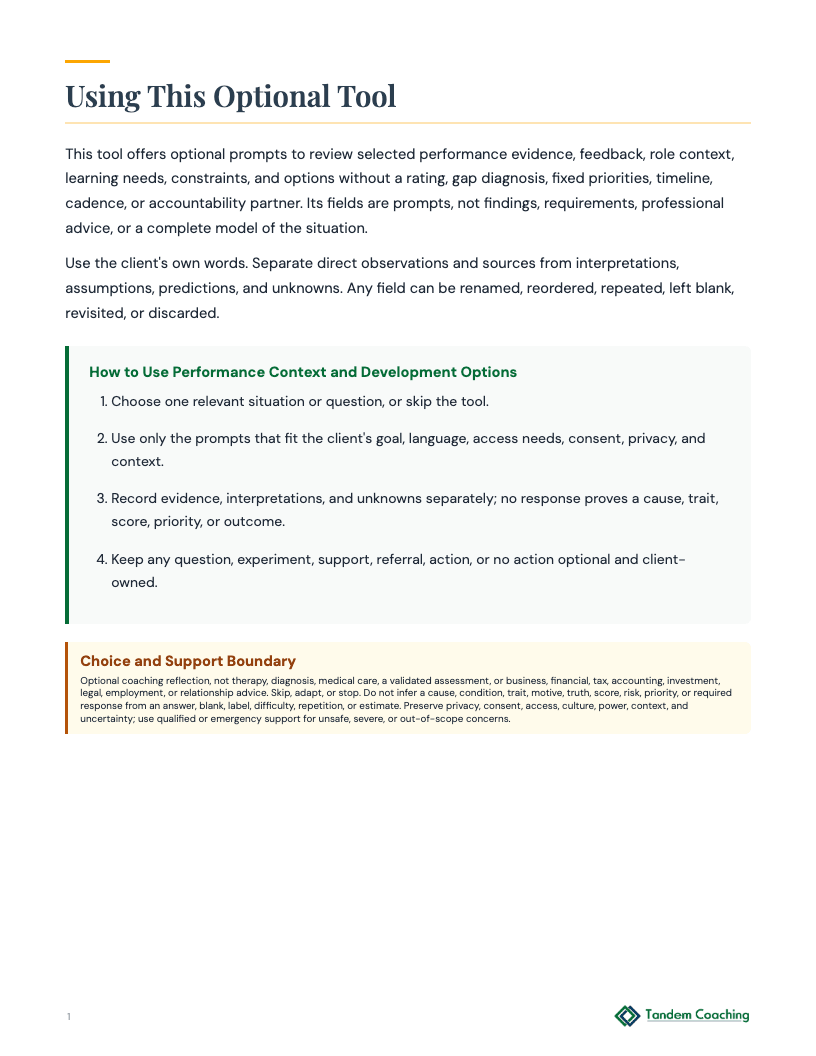
Performance and Development Planner - preview
When to Use This Tool
A client wants to take ownership of their own development rather than waiting for a manager to drive it
A client is preparing for a performance review and wants a structured self-assessment
A client is building a 90-day development plan for a new role or promotion
How to Introduce This Tool Plus

When you set your 90-day action plan, which development priority do you feel most motivated to work on — and which one do you suspect will slip first without accountability?

Browse All Pages
Interactive Preview Planner · 45+ min
Tool Classification
Domain
Career
Type
Planner
Phase
Discovery Goal Setting
Details
45+ min Between sessions Monthly
Topics
Leadership Accountability Career Transition

For the Coaching Practitioner

Plus
Coaching Scenarios Plus
1 The high performer who has never been given a formal development plan and doesn't know where to start
Context

A 34-year-old senior analyst at a financial services firm has received strong performance ratings for three consecutive years. Her manager has never created a development plan with her. She has a vague sense she should be 'growing toward something' but has no framework for identifying what that is or how to get there. She came to coaching to work on career direction. The Performance and Development Plan is introduced after she names a role she wants to move into — it converts that direction into a self-assessment against current competencies, identifies the top three skill gaps, and produces a 90-day action plan she can own independently of her manager.

How to Introduce

Frame this as building the plan her manager hasn't built for her. 'You've been waiting for your organization to hand you a development plan. That's not coming — at least not at the level of specificity that's actually useful. The planner puts you in the driver's seat: you assess your own performance against your current role, identify the top three gaps between where you are and the role you're moving toward, and build a 90-day action plan with success metrics you can track yourself. When you bring this to your manager, you're no longer asking for development — you're showing them you've already started.' The skill gap section is the most important: 'I want specific gaps, not general improvement areas. Not 'communication' — what specifically about how you communicate needs to change, in what context, by how much?'

What to Watch For

Watch for the self-assessment to skew high across the board — clients with strong performance records often rate themselves at the top of every competency because their current role confirms competence, not because they've assessed against the target role. The assessment is most useful when it's calibrated against where she's trying to go, not where she is. Push her to assess each competency relative to the demands of the next role, not the current one. Also watch for the 90-day action plan to be composed entirely of learning activities — courses, books, certifications — with no behavioral experiments in real work situations. Development at this level requires doing something differently, not just learning more.

Debrief

Start with the self-assessment: 'You rated yourself on [competency] as [score]. What would a hiring manager for the role you're targeting say if they saw you in action on that competency today?' That question usually surfaces the gap between self-perception and how she'd be evaluated externally. Then go to the top three gaps: 'Which of these three gaps would have the most impact on your ability to get the next role — and why is it the right one to start with?' Then go to the 90-day plan: 'Which of these action steps happens at your desk in a course, and which one requires you to do something differently in a real conversation or meeting?' Close with the session starter: 'Which development priority do you feel most motivated to work on — and which one do you suspect will slip first without accountability?'

Flags

Array

2 The manager who received critical feedback in his performance review and is treating it as an attack rather than data
Context

A 41-year-old director of operations at a manufacturing company received his annual performance review two weeks ago. His manager flagged three development areas: delegation, managing up, and emotional reactivity under pressure. He is angry about the feedback, convinced two of the three items are politically motivated, and has spent his coaching sessions processing the injustice rather than responding to the content. He came to coaching to 'work on leadership.' The Performance and Development Plan is introduced not as a compliance exercise but as a way to separate the feedback he can use from the grievance he's been carrying — and to put him back in control of his own development story.

How to Introduce

Frame this as taking ownership of the narrative. 'You've had two weeks to be angry about the feedback. That's reasonable — some of it may genuinely be unfair. But here's what's happening in the meantime: your manager has named three development areas, and you have no documented response to any of them. The performance plan lets you build your own account of where you are and where you're going — so the story of your development isn't being written by the person who wrote that review, but by you. We're not accepting every item uncritically. We're choosing which ones to work on and building a 90-day plan that you control.' The self-assessment section matters here: 'Rate yourself honestly on each area they named. Not to validate the feedback — to find the one or two items where you can see what they saw, even if you'd describe it differently.'

What to Watch For

Watch for the skill gap section to exclude the emotional reactivity item entirely — clients who are actively defending against feedback often concede the technical or structural gaps (delegation, managing up) while refusing to examine the interpersonal pattern (reactivity) that underlies both. If reactivity is absent from the plan, name it. Also watch for the 90-day action plan to produce goals that are entirely self-directed and internal — reading, reflection, journaling — with no accountability partner named and no behavioral target in a real work situation. A plan built entirely inside his own head cannot be verified, which is exactly the problem the feedback was pointing to.

Debrief

Start with the self-assessment: 'Of the three items your manager named, which one — even if you think the characterization was unfair — did you recognize something real in?' Let him answer without pushback. Then: 'You gave yourself [score] on emotional reactivity. What would your two direct reports say if asked the same question?' That question creates distance from the grievance and opens the behavioral data. Then go to the 90-day plan: 'You have an accountability partner listed here. Does that person know they're on this plan, and will they tell you when they see the gap versus when they don't?' Close with: 'In three months, how will your manager know the plan worked? Not that you completed it — that it worked?'

Flags

Array

3 The newly promoted manager who doesn't know what good performance looks like at her new level
Context

A 36-year-old team lead at a technology company was promoted to engineering manager three months ago. She was the strongest individual contributor on her team. She has received no formal onboarding into the management role, her manager has given her no performance criteria for the new position, and she is evaluating herself against her old job description because it's the only reference she has. She's been coaching herself on instinct and has a growing sense that something is off — her team seems fine, her deliverables are going out, but she doesn't feel like she's doing management, she's doing project coordination with a title change. The Performance and Development Plan is introduced to help her define what engineering management actually requires at her company and to build a self-assessment against that definition rather than against individual contribution benchmarks.

How to Introduce

Frame this as defining the job before trying to do it well. 'You were promoted into a role that nobody described to you. You've been evaluating yourself against the wrong criteria — your old individual contributor benchmarks — because those are the only ones you have. The planner starts by asking you to define what the role requires: not what your company said in a generic job description, but what it specifically requires of you in your context, with your team, in this quarter. The self-assessment section only makes sense once you've named what you're assessing against.' The skill gap section matters most for this client: 'The gaps I want to see aren't 'things I need to learn' — they're behaviors the role requires that you aren't doing yet because nobody told you to do them.'

What to Watch For

Watch for the self-assessment to remain at the individual-contribution level — rating herself on technical output, code quality, delivery speed — rather than on management behaviors: team development, one-on-one effectiveness, delegation clarity, creating conditions for others' performance. The tool is most useful when the performance criteria she rates herself against are appropriate to the role she now holds. Also watch for the 90-day action plan to focus exclusively on learning more about management rather than practicing it. She needs behavioral commitments — specific conversations she will have, specific decisions she will make, specific feedback she will solicit — not a reading list.

Debrief

Start with the self-assessment criteria she wrote: 'Read me the performance criteria you defined for yourself at the top of this section. These are the benchmarks you're assessing against — do they describe an engineering manager, or do they describe a lead engineer?' That question often surfaces the mismatch without requiring the coach to name it. Then go to the top three gaps: 'Which gap, if you closed it, would most change how your team experiences you as a manager — not as a contributor?' Then go to the 90-day plan: 'Walk me through week one. Not what you'll learn — what you'll do differently in your first one-on-one this week.' Close with: 'Which development priority do you feel most motivated to work on — and which one do you suspect will slip first without accountability?'

Flags

Array

Tool Flow Plus
Requires
  • recent performance feedback or manager input
  • identified skills needed for next role
Produces
  • performance self-assessment against current role
  • skill gap ratings for top 3 development priorities
  • 90-day action plan with success metrics and accountability partners
  • quarterly review checkpoint for progress and adjustments

Pairs Well With

Executive

Competitive Landscape Analysis

I know my competitors exist but I've never systematically mapped where I sit relative to them

45+ min Framework
Executive

Business Structure Chart

A client is building or reorganizing their business and needs to map reporting lines and departmental structure visually

30 min Framework
Executive

Business Process Overview

A client needs to document their core business processes so they can identify inefficiencies or hand off responsibilities

30 min Framework

Related Articles

Leadership Development Goals That Actually Work: Framework and Examples

Leadership Development Goals That Actually Work: Framework and Examples

Read article →
5 Top Employee Development Plan Examples - Learn to Make Your Own

5 Top Employee Development Plan Examples - Learn to Make Your Own

Read article →
Chief AI Officer Career Path: Is CAIO Right for You?

Chief AI Officer Career Path: Is CAIO Right for You?

Read article →
Need a Career Transition Coach? Read This Guide First

Need a Career Transition Coach? Read This Guide First

Read article →
Executive Psychological Readiness Assessment for Career Change

Executive Psychological Readiness Assessment for Career Change

Read article →
Executive AI Vulnerability Assessment | Know Where You Stand

Executive AI Vulnerability Assessment | Know Where You Stand

Read article →