Session Rating Template

Pathway Builder 🔒
Domain
Life Coaching
Type
Assessment
Phase
Reflection Review
Details
5 min Closing Weekly
Topics
Accountability Mindset Habits

Coaching tools for personal clarity and intentional living.

When to Use This Tool
Coach wants structured session feedback but a free-form debrief produces inconsistent and hard-to-compare responses
Client's session reflections stay at a surface level without a rating scale to anchor the conversation
Coach is tracking client progress across sessions and needs consistent measurement points
How to Introduce This Tool

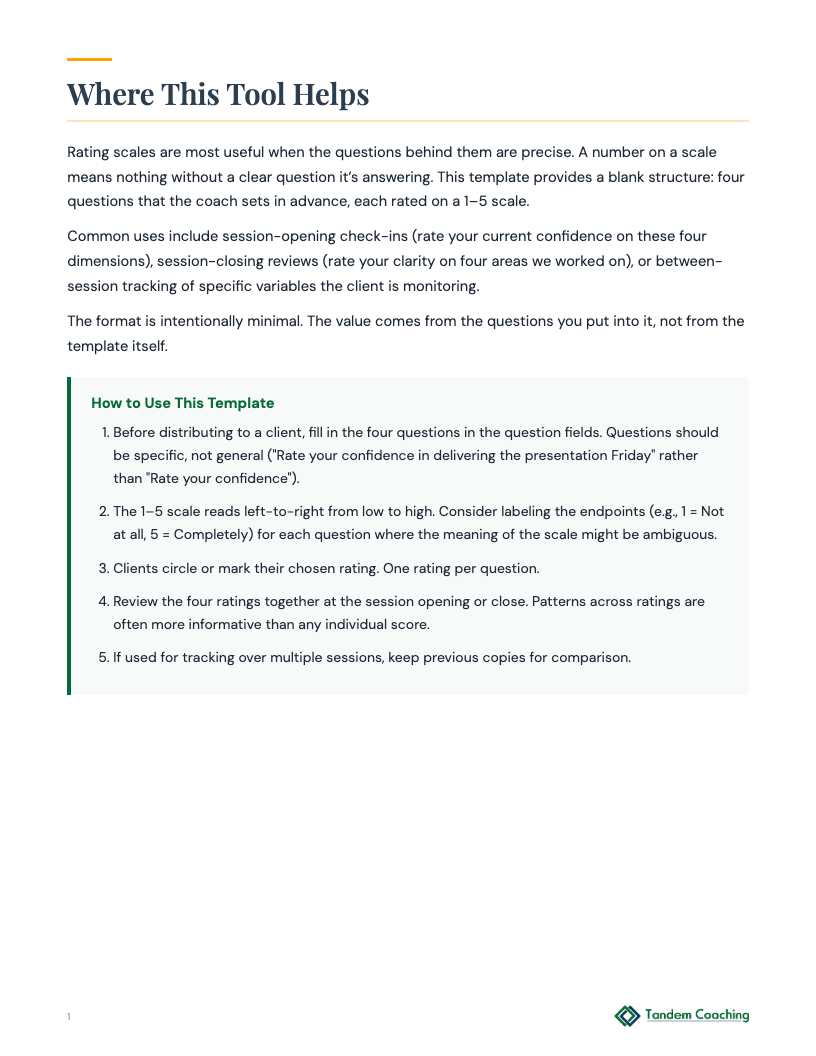
This is a four-question rating template that closes each session with consistent reflection - would using it at the end of today give us a snapshot to compare over time?

Download This Tool

Free PDF - print-ready, professionally formatted

Download Free PDF
Preview Assessment · 5 min

For the Coaching Practitioner

Coaching Scenarios Plus
1 Coach whose clients feel heard in sessions but can't articulate what changed
Context

Your client - the coach - has strong relationships with their clients. Sessions are warm, generative, and well-paced. When those clients are asked what has shifted, they say things like 'my coach really gets me' and 'I always feel better after.' They cannot point to specific progress. The coach doesn't have a systematic way to check whether sessions are producing movement or just producing positive affect. The Session Rating Template, used at session close, generates data that distinguishes between sessions where clients feel understood and sessions where clients name something that shifted.

How to Introduce

Frame this as adding a feedback mechanism, not auditing quality. 'What this adds to your sessions is a structured close that separates how the client felt from what moved. Most coaches have a reliable read on the first; very few have consistent data on the second.' The resistance pattern: coaches with strong rapport sometimes resist structured session feedback because it feels clinical or like it disrupts the relational flow they've built. Name that the four questions can be delivered conversationally - the structure is in the questions, not in the format the client receives them.

What to Watch For

Watch how the coach sets the four questions for the first use. If all four questions assess emotional experience - 'Did you feel heard?', 'Was the session what you needed?', 'Did you feel safe?' - the template will collect comfort data, not movement data. At least one question should be outcome-facing: 'What is one thing that is clearer now than when we started?' or 'What do you know now that you didn't at the start of this session?' Also watch whether the coach intends to share the ratings with clients or only use them internally. The debrief conversation is where the useful data often surfaces.

Debrief

After the first use, ask the coach: 'What did the client's rating tell you that you didn't already know from the conversation itself?' If the answer is 'nothing' - if the template only confirmed what the coach sensed - the questions may need recalibration. Then ask: 'If a client gave you a 2 out of 5 on the outcome question, what would you do with that?' That question surfaces whether the feedback mechanism has a response protocol or whether it is only data collection.

Flags

If the coach's clients are consistently rating sessions highly on rapport questions and low on progress questions, and if the coach has not been tracking this, the pattern has been present for some time. Severity: low. Response: the template is the right intervention; note that two to three sessions of data will be needed before a pattern is visible, and that interpreting a single session rating in isolation is less useful than comparing across four or five sessions.

2 Client whose session summaries consistently omit what was hardest to say
Context

Your client tends to review sessions by reporting the practical output: 'We talked about the promotion conversation, I have three things to do before next week.' The emotional or relational content of the session - the moment where they hesitated, the thing they almost didn't say, the realization that landed quietly - is not in their summary and is rarely revisited. Over time this produces a coaching relationship with a lot of action tracking and relatively little integration of what is actually shifting. The Session Rating Template, used at session close, creates a structured moment that names what shifted rather than only what was assigned.

How to Introduce

Frame this as building a closing ritual, not adding paperwork. 'Right now sessions end with a list of next steps. The rating template adds a closing question that captures something different - what shifted inside the session, not just what was agreed outside it. The two or three minutes at the end changes what gets carried forward.' The resistance pattern: action-oriented clients sometimes experience a reflective close as soft or unnecessary. Name that the data from the ratings is what makes the next session more targeted - it is not reflection for its own sake.

What to Watch For

Watch question 3 or 4 carefully - whichever question asks about insight or shift. If the client's written response is a summary of the action they agreed to ('I realized I need to have the conversation with my manager'), the question has been answered with the action output, not with the internal shift. The internal shift is the harder sentence: 'I realized I've been avoiding this because I'm afraid of what she'll say, not because the timing is wrong.' If the responses stay at the action level, the question may need rewording for this client.

Debrief

Start the following session by reading the client's rating response aloud - specifically the insight or shift question - and asking: 'Did that hold? Is that still how it felt when you looked at it a few days later?' That question checks whether the session landing was durable or whether it faded between sessions. Then ask: 'Is there anything on this rating that looks different now than it did when you wrote it?' The gap between immediate rating and one-week reflection is useful coaching material.

Flags

If the client's session reflections consistently stay at the surface - action outputs, practical summaries, no named internal movement - and if this is true across multiple sessions, the coaching may be producing compliance without integration. Severity: low. Response: the template is appropriate; note whether the pattern warrants a direct conversation about what the client is looking for from coaching and whether the current mode is producing what they came for.

3 Coach who doesn't know which of their standard questions are actually landing
Context

Your client - the coach - has developed a set of signature questions they return to across clients: their opening question, their challenge question, their forward-movement question. These questions feel effective. The coach has used them for three years and has not formally tested whether they produce the response the coach hopes for. Some clients respond to these questions with depth. Others give brief, surface answers and move on. The coach has not been able to distinguish whether the difference is the question or the client. The Session Rating Template, built around the coach's own questions, generates client-specific data on which questions are doing the work.

How to Introduce

Frame this as a calibration experiment, not a critique of the coach's practice. 'You have questions you believe in. What this gives you is a way to test them - to find out whether they work the same way for different clients or whether they need to be adapted.' The resistance pattern: experienced coaches sometimes feel that structured client feedback on their methods is a competence challenge. Name that the template is framed as session experience, not coach evaluation - and that the data belongs to the coach, not to any external assessor.

What to Watch For

Watch how the coach designs the four questions. If all four are about the session experience broadly ('Was this session valuable?', 'Did we cover the right things?') rather than about specific moments or specific questions, the data will be general. For this use case, at least one question should be tied to the coach's specific method: 'Was there a question today that produced something you weren't expecting?' or 'Was there a moment where the conversation shifted?' Also watch whether the coach debrief is designed - whether they have a plan for what to do if a client's rating on a specific element is consistently lower.

Debrief

After two or three sessions using the template, ask: 'Which of your questions is getting the most response in the ratings - and which is getting the least?' That question produces a ranking the coach did not have before. Then ask: 'For the question that's landing least consistently - what do you think is happening when it doesn't work?' That question usually surfaces whether the problem is the question, the timing, or the client type it's being used with. The adjustment follows from the diagnosis.

Flags

If the coach's examination of their own question repertoire surfaces a question they have been relying on that consistently produces surface responses - and if they have been using that question with clients in vulnerable or high-stakes moments - the template finding has clinical implications, not just quality-improvement ones. Severity: low. Response: name the finding directly and explore what clients may have been not-saying in those moments.

Tool Flow
Requires
  • coach-defined rating questions for session dimensions
Produces
  • four-dimension session ratings on 1-5 scale
  • cross-session progress tracking data point

Pairs Well With

Life

Productivity Commitment Worksheet

I know what's holding me back but I haven't made a clear commitment to change it

15 min Worksheet
Life

Reading Log

I read a lot but I never retain or apply what I learned

5 min Tracker
Life

Goal Achievement Planner

Client knows the goal but hasn't mapped what daily behaviors will actually carry them there

15 min Planner

Related Articles

ICF Core Competencies: Managing Client Focus, Session Time, and Relationship Completion

ICF Core Competencies: Managing Client Focus, Session Time, and Relationship Completion

Read article →
Getting to 85 - Agile Metrics with ActionableAgile Part 3

Getting to 85 - Agile Metrics with ActionableAgile Part 3

Read article →
Information Radiator - Gut Check

Information Radiator - Gut Check

Read article →
How to Provide Leadership Feedback (Examples Included)

How to Provide Leadership Feedback (Examples Included)

Read article →
Change Management Certification: Compare Credentials and Choose

Change Management Certification: Compare Credentials and Choose

Read article →
How to Prepare for Coaching Supervision Sessions

How to Prepare for Coaching Supervision Sessions

Read article →