Resilience Strengths Assessment
Identify the strengths you’ve already proven under stress, so you can respond with confidence. Grounded in your real-life examples, not theory.
Get This Tool
Free, print-ready PDF.
When to Use This Tool
A client under pressure needs to reconnect with what they've already shown they can do
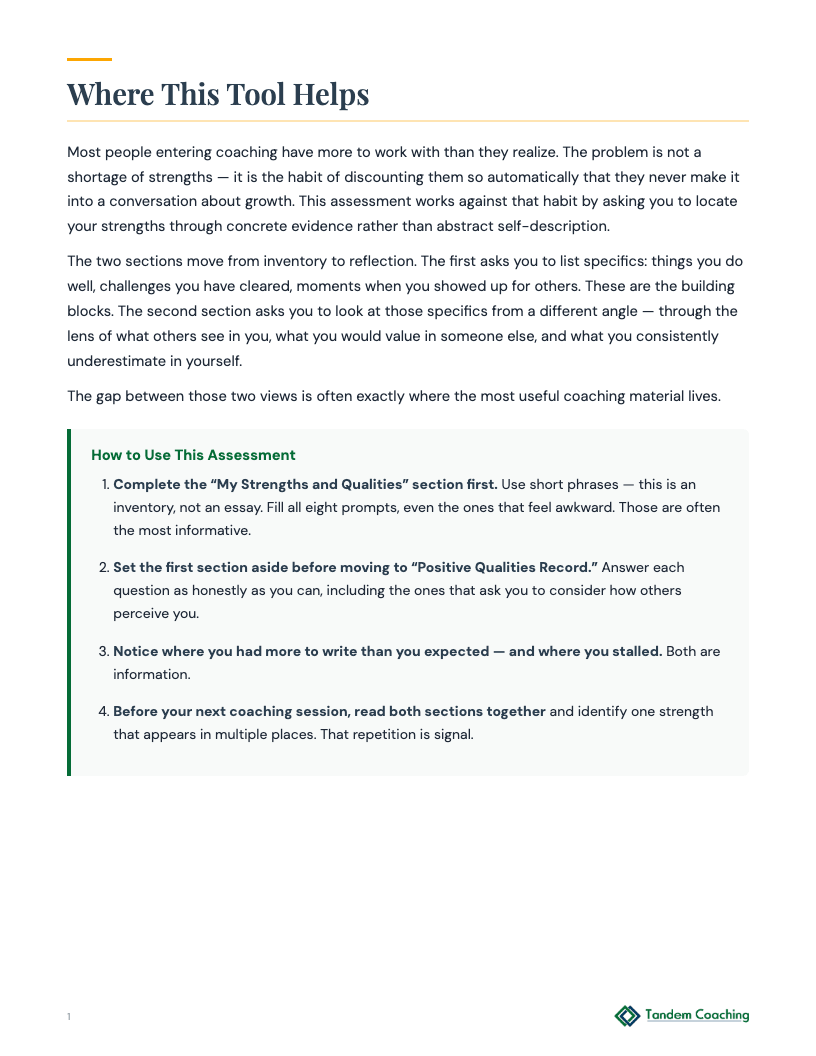
Someone building a strengths inventory through eight guided prompts from multiple vantage points
Using a dual-lens record to name positive qualities from both self-view and external feedback
How to Introduce This Tool Plus
When you've faced something genuinely hard in the past — what have you drawn on that you don't always remember you have?
Browse All Pages
Tool Classification
Domain
Life Coaching
Type
Assessment
Phase
Discovery
Details
30 min
Between sessions
Topics
Resilience
Identity
For the Coaching Practitioner
Plus
Coaching Scenarios
Plus
1 Senior engineer promoted to team lead struggles with imposter syndrome ▶
Context
A principal software engineer just promoted to engineering manager at a tech startup. Excellent technical contributor but convinced they lack leadership qualities. Came to coaching because they're second-guessing every decision and their team is starting to notice the hesitation.
How to Introduce
Frame this as evidence collection, not confidence building. 'Before we work on leadership skills, let's map what you're already working with. You got promoted for reasons beyond technical ability - this helps us find what those reasons were.' Expect resistance to the appearance and happiness prompts - engineers often dismiss 'soft' data as irrelevant.
What to Watch For
Technical achievers often fill the skills section quickly but struggle with the relational prompts. If 'helped others' and 'made others happy' sections are sparse while 'good at' is detailed, they're not seeing their interpersonal impact. Speed through 'compliments received' suggests they discount positive feedback.
Debrief
Start with the 'helped others' section. Ask: 'Read me what you wrote here.' Then: 'What did you have to be good at to help in those ways?' This connects their existing interpersonal skills to leadership requirements. The question that opens it up: 'What would your former teammates say you brought to projects beyond code?'
Flags
If both sections focus exclusively on technical achievements with no mention of collaboration, influence, or interpersonal moments, the client may have significant blind spots about leadership requirements. Severity: moderate. Continue coaching but assess whether they understand what management actually involves.
2 Mid-career professional returning from extended medical leave doubts their capabilities ▶
Context
A marketing director returning after six months of medical leave for cancer treatment. Physically recovered but convinced they've lost their edge and questioning whether they can handle their previous responsibilities. Company has been supportive but client feels like they're starting over.
How to Introduce
Position this as a baseline assessment, not therapy. 'Medical challenges don't erase professional capabilities, but they can make them harder to see. This maps what's still there.' Many clients in this situation will resist the 'challenges overcome' section because they don't want to relive the medical experience. Acknowledge that upfront.
What to Watch For
Clients post-medical trauma often minimize pre-illness achievements or describe them in past tense as if they no longer apply. Watch for language like 'I used to be good at' versus 'I am good at.' If the challenges section focuses only on the medical experience, they may be stuck in patient identity rather than professional identity.
Debrief
Start with 'things that make me unique' - this often captures resilience qualities they developed during treatment. Then move to 'what others value in you' and ask: 'Which of these changed during your leave?' Usually the answer is none of them changed. The opening question: 'What strengths did you use to get through treatment that you also use at work?'
Flags
If the client cannot identify any current strengths or describes all achievements in past tense, they may be experiencing depression or trauma responses beyond coaching scope. Severity: moderate to high depending on pervasiveness. Consider referral to therapy while continuing coaching focused on practical re-entry.
3 High-performing consultant who deflects praise and minimizes accomplishments ▶
Context
A senior management consultant at a top-tier firm who consistently delivers excellent client results but deflects all positive feedback. Recently passed over for partner track and told they need to 'own their value proposition.' Believes their success is mostly luck and good project assignments.
How to Introduce
Frame as a business exercise, not self-help. 'Partnership requires you to articulate your value to clients and colleagues. This isn't about feeling better about yourself - it's about having accurate data for business conversations.' Expect them to fill sections with generic consulting skills rather than specific personal qualities.
What to Watch For
High achievers often complete this tool with consulting buzzwords rather than personal qualities. Look for generic entries like 'problem-solving' versus specific ones like 'I stay calm when clients panic.' If the 'appreciate in another person' section is much more generous than the self-assessment sections, they have different standards for themselves.
Debrief
Start with the gap between 'compliments received' and 'what I like about myself.' Ask them to read both sections aloud. Then: 'Your clients and colleagues see something you're not seeing. What would have to be true about you for them to give you this feedback consistently?' The key question: 'If you hired someone with your exact track record, what would you expect them to be good at?'
Flags
If the client cannot identify any personal qualities that contribute to their success and attributes everything to external factors, this may indicate deeper self-worth issues. Severity: low to moderate. Continue coaching but monitor whether the pattern extends beyond professional contexts.
4 Nonprofit executive director overwhelmed by scope creep and boundary issues ▶
Context
Executive director of a mid-size nonprofit who has grown the organization significantly but now feels stretched beyond capacity. Board keeps adding initiatives, staff brings every problem to them, and they can't say no. Came to coaching to work on delegation but suspects the real issue is deeper.
How to Introduce
Present this as organizational diagnosis, not personal development. 'Before we work on boundaries, let's understand what you're protecting. Organizations grow around founder strengths - this maps what those are so we can see what's sustainable to delegate and what isn't.' Nonprofit leaders often struggle with the 'what makes me unique' prompt because mission-driven work feels selfless.
What to Watch For
Nonprofit leaders typically overload the 'helped others' and 'made others happy' sections while leaving 'what I like about myself' sparse. This pattern suggests they derive identity from service but don't see their own needs as legitimate. If 'challenges overcome' focuses only on organizational challenges, they may not differentiate personal resilience from professional problem-solving.
Debrief
Start with 'what others value in you' and ask: 'Which of these can only you provide to the organization?' Then move to 'what I value most' and explore the connection. The opening question is: 'If you took a six-month sabbatical, what would the organization lose that they couldn't replace by redistributing your tasks?'
Flags
If the client cannot identify any personal needs, preferences, or qualities separate from organizational mission, they may have boundary issues that extend beyond delegation. Severity: moderate. This pattern often correlates with burnout risk and difficulty sustaining leadership long-term.
Tool Flow
Plus
Requires
- None - standalone tool
→
Produces
- dual-lens strengths inventory from self and others
- written evidence of challenges overcome
- identified strength repeated across both lenses
Pairs Well With
Life
Wins and Learning Evidence Log
Use this tracker to notice patterns in resilience and accountability over time before drawing conclusions.
Why it pairsOnce you've named their strengths through two lenses, this adds a dated proof log that shows the same capability in completed action.
ExecutiveControl, Influence, and Context Notes
Use this framework to structure a conversation about leadership and mindset while keeping interpretation with the client.
Why it pairsAfter the assessment names what they've already shown they can do, this channels those strengths toward controllable action in the current situation.
LifeConfidence Evidence and Learning Notes
Use this worksheet to explore identity and mindset and turn the client’s observations into one optional next step.
Why it pairsUse this to move the repeated strength from the assessment into a domain map with one concrete action the client commits to.
Related Articles

Human Performance Under Pressure: What Organizational Coaching Addresses
Read article →
The Product Leader's Identity Crisis: Builder, Business Person, or Both?
Read article →
Natural Time Horizon: The Temporal Lens Your Client's Formation Installed
Read article →
The Strength That Got You Promoted Is the One Holding You Back
Read article →