Resilience Building Plan
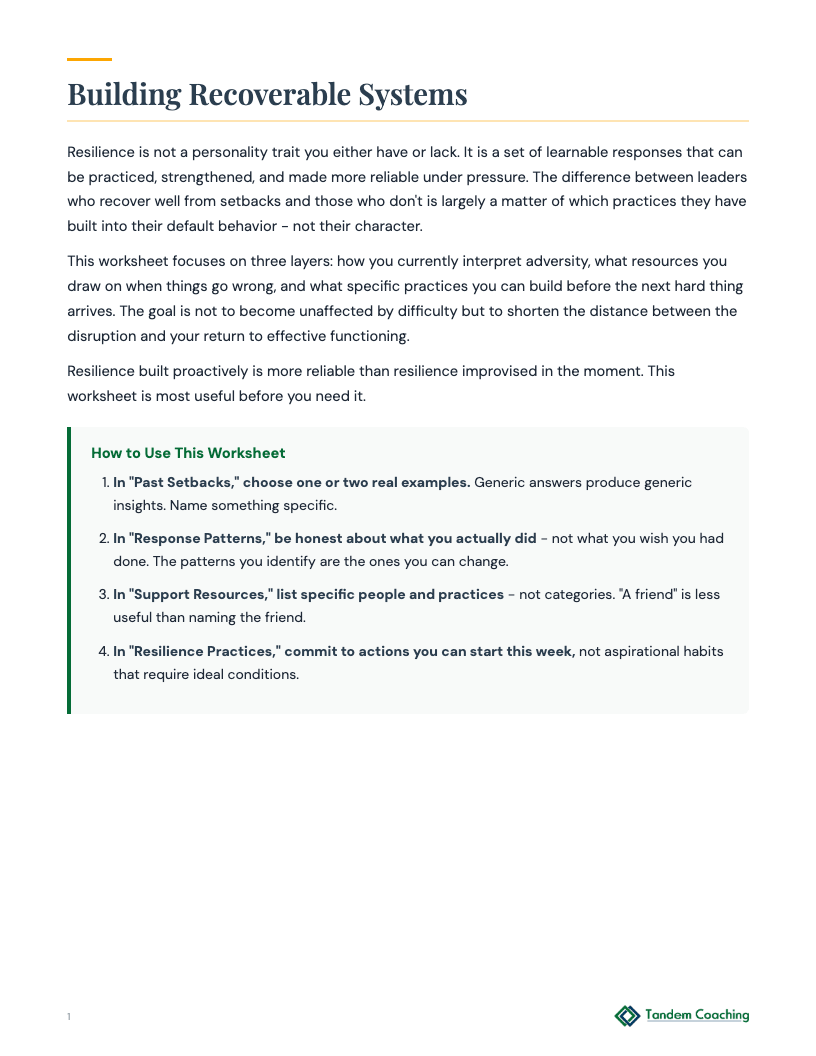
Identify what’s draining you and what truly restores you, then build a realistic weekly plan grounded in your current habits and energy levels.
Get This Tool
Free, print-ready PDF.
When to Use This Tool
Client describes burnout or depletion but has not examined what practices are actually sustaining them
Client knows they need to build resilience but treats it as abstract rather than a set of specific practices
Client's current recovery practices are not matching the demands being placed on them
How to Introduce This Tool Plus
This maps your current physical, mental, and spiritual practices side by side and asks what you're committing to add - would that structured inventory be a useful place to start?
Browse All Pages
Tool Classification
Domain
Life Coaching
Type
Worksheet
Phase
Discovery
Action
Details
30 min
Between sessions
As-needed
Topics
Resilience
Self-Care
Habits
For the Coaching Practitioner
Plus
Coaching Scenarios
Plus
1 Leader returning to high capacity after a significant organizational restructuring ▶
Context
A director who led their team through a major layoff cycle six months ago describes feeling 'back to normal' at work but privately acknowledges they haven't recovered. They're sleeping less, skipping exercise, and filling downtime with work. The depletion is real but they frame it as temporary and haven't examined what sustained them before and what has since stopped.
How to Introduce
Position this as a practice inventory, not a wellness plan. 'This looks at three dimensions - physical, mental, and spiritual - and asks what you're currently doing in each, what's missing, and what two or three specific things you'd commit to in the next 90 days.' Some leaders in this situation resist the spiritual column because it sounds soft. Name it directly: 'Spiritual here means purpose and meaning - not religion. What connects you to why you do this work?'
What to Watch For
The 'what's missing' rows are more diagnostic than 'what I'm currently doing.' Watch whether entries in the missing rows are specific or vague - 'more sleep' is a category, not a practice. If all three dimensions show depletion and the 'Things to Commit To' entries are aspirational rather than specific, the client may be completing the form to satisfy the exercise rather than to build a plan. Also watch whether the physical column is full and the mental and spiritual columns are nearly empty - that pattern often means the client is managing their body and ignoring everything else.
Debrief
Start with the 'what's missing' rows. Ask the client to read them aloud and identify which gap is costing them the most in terms of their current performance. Then move to the commitment section: 'Which of these two or three commitments has the best chance of actually happening this month, and what would need to be true for it to stick?' Close by asking about the Notes section - patterns across all three columns often surface the most important insight of the exercise.
Flags
If the client cannot name a single current practice in any of the three dimensions, the depletion may be more significant than a resilience planning exercise can address. Severity: moderate. Surface what you see and assess whether the client has the baseline capacity to take on new practices, or whether something needs to stop before something can start.
2 High-achieving manager who performs under pressure but crashes between sprints ▶
Context
A manager describes being highly functional during intense project cycles but experiencing significant depletion in the weeks following. They don't know how to recover because recovery has never been a priority - they've always used the next project to reset. They're starting a new high-stakes initiative and the pattern is becoming visible to their team.
How to Introduce
Frame this as a performance maintenance exercise, not self-care. 'The leaders who sustain high output through multiple cycles aren't harder workers - they're more deliberate about what they do when they're not in sprint mode. This maps out what actually sustains you, by dimension, and asks what you'd commit to building before the next cycle starts.' Clients who identify with performance respond to the framing of resilience as infrastructure, not softness.
What to Watch For
Watch the physical column carefully - clients in this pattern often have physical practices they use during sprints (coffee, adrenaline, short sleep) that they call sustaining but are actually depleting over time. If the physical column describes coping rather than recovery, name the distinction. Also watch whether the 90-day commitment section contains practices that are available during a sprint, or only during low-demand periods - sustainability requires practices that can be maintained under load.
Debrief
Start with the cross-column pattern: 'Where do all three dimensions show up as depleted at the same time?' That convergence is the vulnerability point. Then ask: 'Of your three commitments, which one could you actually do during the next high-pressure cycle, not just between them?' Close by asking them to identify which commitment has the most evidence from their past - something they've done before that worked, even briefly.
Flags
If the client has no examples of recovery practices that worked in the past and cannot articulate what rest actually feels like, the pattern may be older and more entrenched than a 90-day commitment will address. Severity: low. Note the pattern and explore whether the difficulty naming what sustains them is informative about the relationship to depletion.
3 Executive who identifies the missing dimension as spiritual and resists that framing entirely ▶
Context
An executive completes the physical and mental columns readily but dismisses the spiritual dimension as irrelevant to their work. They describe themselves as motivated by performance and results, not meaning. When pressed, they acknowledge feeling disconnected from why they're doing this work but resist the word 'spiritual' as the frame for that gap.
How to Introduce
Don't debate the category label. Reframe it in session before they complete the worksheet: 'In this context, spiritual means connection to purpose - what makes the work feel worth doing. You mentioned feeling disconnected lately. That column is about that.' If the resistance persists, let them leave it blank and use the gap itself as material. 'You left the third column empty. What's that about?'
What to Watch For
Watch whether the spiritual column stays blank or gets filled with proxy content - 'my team,' 'results,' 'client outcomes.' Proxy content is useful: it tells you what the client counts as meaningful even when they won't use that language. Also watch the Notes section - clients who resist the spiritual framing sometimes write their most honest observations there because it feels like less of a commitment.
Debrief
Start with the Notes section if it contains anything. Then return to the spiritual column. 'You left this blank - or you wrote [X]. What would change if you had a practice here?' The goal isn't to fill the column; it's to examine why it's empty. Close by asking: 'Of the three dimensions, which one do you think has the most influence on how you show up on a difficult day?'
Flags
Persistent disconnection from purpose paired with high performance metrics and difficulty naming what makes the work meaningful is worth exploring more broadly. Severity: low. The worksheet will not resolve this - it surfaces it. Note whether the disconnection appears across multiple sessions and topics or is isolated to this exercise.
4 Professional re-entering work after a health crisis or extended medical leave ▶
Context
A professional returning from three months of medical leave is managing a return that is more demanding than expected. They had prior routines that sustained them but those were disrupted during treatment. They describe wanting to rebuild but feeling uncertain about what their capacity actually is now, which makes it difficult to commit to anything.
How to Introduce
Position this as a calibration exercise, not a recovery plan. 'The point isn't to get back to where you were - it's to find out what actually works given where you are right now. This maps what you're currently doing, where you feel the gaps, and asks for small commitments, not ambitious ones.' Some clients post-medical leave have difficulty distinguishing between what they used to do and what is actually available to them now. Name that distinction: 'We're not filling in what you used to do here - we're filling in what you're actually doing this week.'
What to Watch For
Watch whether the current practices column reflects current reality or aspirational recovery. If the client writes practices they're 'working toward' rather than currently doing, they've skipped the honest first step. Also watch the commitment section for scope creep - three months out from a health crisis, commitments that require significant time or energy are unlikely to hold. Specific, small, and sustainable is more important than comprehensive.
Debrief
Start with the 'what's missing' rows and ask which gap is creating the most friction in their actual daily functioning right now. Then look at the commitment section together: 'Is any of this too big for where you are this month?' Help them scale the commitment to their current capacity, not the capacity they expect to have in three months. Close by asking: 'What would tell you, in 30 days, that your resilience is actually building?'
Flags
If the client's capacity concerns extend to basic functioning - sleep disruption, inability to concentrate, significant mood changes - the coaching focus on resilience practices may be premature. Severity: moderate. Explore whether a medical or mental health referral is appropriate before designing a resilience plan.
Tool Flow
Plus
Requires
- None - standalone tool
→
Produces
- three-dimension practice inventory (physical, mental, spiritual)
- resilience gap map showing depleted areas
- 90-day commitment list per dimension
Pairs Well With
Wellness
Optional Wellbeing Intentions
Use this worksheet to explore self care and values and turn the client’s observations into one optional next step.
Why it pairsOnce you've built the 90-day commitment list, this tracker gives ADHD clients daily structure to execute each practice without losing momentum.
WellnessDaily Gratitude Reflection
A client wants to use Daily Gratitude Reflection as an optional reflection
Why it pairsOnce you've named mental or spiritual practices in the plan, this daily tracker makes those commitments concrete and reviewable each session.
WellnessSelf-Care Practices Inventory
A client feels depleted and isn't sure which area of their life needs attention most
Why it pairsAfter mapping physical, mental, and spiritual resilience, this five-domain inventory surfaces self-care gaps the plan's three dimensions may have missed.
Related Articles


Definition of Done – More Than a Checklist
Read article →Master the Art of Building Trust in Coaching Relationships - Expert Insights from Tandem Coaching Partners
Read article →
AI Skills for Executives: The 5 Competencies That Actually Matter
Read article →