Apply goal-setting habits from your career to your relationships with a guided, coach-designed worksheet that clarifies priorities and next steps.
Free, print-ready PDF.
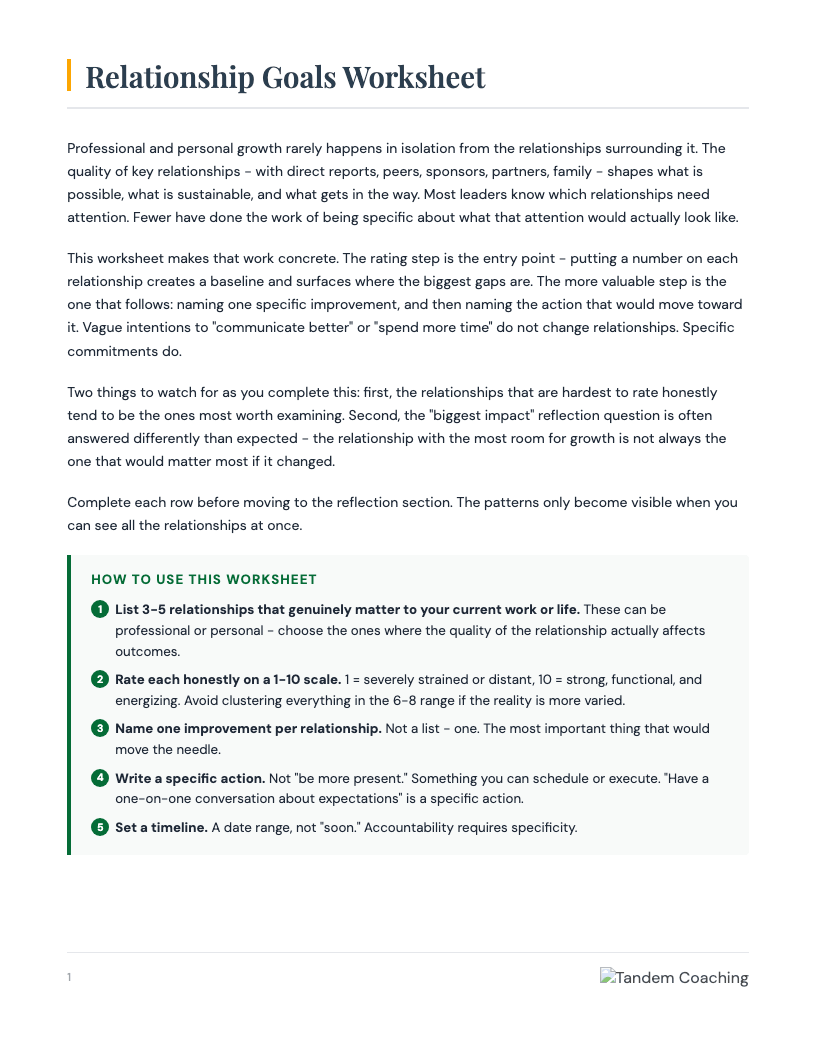
When you think about the relationships in your life that matter most, which ones are in good shape — and which ones are you neglecting more than you want to be?
Client's professional life is managed with intention, specificity, and accountability. Their relationships are not. They maintain connections reactively — responding when someone reaches out, showing up for major events — without setting any intentional direction for how those relationships develop. The relationship quality ratings often plateau or decline precisely because they are being maintained rather than invested in.
Frame this as applying the same deliberateness they use professionally to a domain they have been managing reactively. 'You run your career with goals and metrics. You don't apply that same structure to relationships — which may be why some of them have plateaued. This worksheet asks you to be intentional about specific relationships the same way you are intentional about your work.' The resistance is usually conceptual: relationships shouldn't be managed, they should be authentic. Name it: 'Setting an intention for a relationship is not manipulation — it is deciding what you want to put in rather than waiting to see what comes out.'
Watch the quality rating column closely. Ratings of 5-6 across all relationships warrant examination — this is the maintenance plateau. Either the client genuinely has no strong relationships, or they have relationships they have rated as adequate without examining what adequate means. Also watch the improvement column: if all entries are generic ('spend more time together,' 'be more present'), the client has not identified a specific change they are willing to make. Generic improvements never happen.
Start with the relationship that has the lowest quality rating. Ask: 'What has the quality of this relationship been doing over the last year — stable, improving, or declining?' Then: 'Who is most responsible for the current quality — you, them, or circumstances?' The ownership question separates relationships the client can affect from ones they cannot. Focus the action and timeline columns on relationships where the client has genuine agency.
Array
Client has achieved significant professional recognition — promotion, business growth, public visibility — during a period when several close relationships have deteriorated. They are not unaware of the deterioration; they have been managing the discomfort by attributing it to the temporary nature of the busy period. The busy period has now lasted long enough that 'temporary' is no longer accurate.
Frame this as a relationship audit at a specific inflection point. 'You've been building something significant professionally. Let's look at what that has cost relationally — not to create guilt, but to make sure you're making a choice rather than an oversight.' The guilt pattern is worth naming: clients who have allowed relationships to erode during a professional push often feel ashamed of it and manage that shame by avoiding looking directly at it. Name the dynamic: 'I'm not asking you to feel bad about the priorities you've had. I'm asking you to decide if they're still the right ones.'
In the relationship table, watch for relationships that the client rates high in quality but describes improvement entries that suggest significant unmet need from the other person — 'she needs more of my time,' 'he's mentioned feeling disconnected.' The discrepancy between the client's quality rating and the relationship partner's described experience is diagnostic. Also watch the reflection section: clients who feel the weight of neglect in close relationships often write their most honest content there.
Start with the reflection section rather than the table. 'You wrote [specific language from reflection]. What's behind that?' Then return to the table and ask: 'Which of these relationships could not survive another year of the same level of investment?' That question cuts through the abstract and makes the risk concrete.
Array
Client thinks of goals as belonging to professional and personal achievement domains — career, fitness, finances — and has never applied goal structure to relationships. The concept that you can set an intention for how a relationship develops, with an improvement focus and a timeline, is genuinely new to them. The tool introduces a framework that has simply not been part of their thinking.
Frame this as extending existing goal orientation to a new domain. 'You apply goal-thinking to your career and probably your health. This tool asks you to apply the same kind of intention to specific relationships — not by managing them, but by deciding what you want to put in.' Some clients find this framing immediately useful; others find it counterintuitive. For the counterintuitive cases: 'Think of it as less about the relationship and more about your behavior within it. You're not setting goals for the other person — you're setting goals for yourself as a participant.'
First-time users of this tool often leave the improvement and action columns empty because they have not thought in terms of intentional relational behavior before. A long quality rating column with empty improvement entries is normal for this scenario and is not resistance — it is unfamiliarity. The coaching work is helping the client move from 'the relationship is [quality]' to 'I could do [specific thing] to affect that.' Also watch the reflection section for genuine insight that the structured table did not capture.
After completing the table, ask the client which relationship surprised them most — which one looked different when they wrote down a specific quality number and a specific improvement. That relationship is usually the one where the coaching work will be most productive. Then: 'Pick one action from the table that you would commit to this week without telling me about it afterward — something that would just be different.' That reframe removes the accountability-performance dynamic and makes the behavior about the relationship, not the coaching.
Array
ADHD adult living with others where household responsibilities are unclear or contested
ExecutiveA coach or business owner wants to map every touchpoint a client experiences from first awareness through offboarding
RelationshipsI have a conflict I keep circling without resolving and I want a way to think through it clearly
Step 1 of 6 in A client who has professional goals but has never applied the same intentionality to their personal relationships
Next: Relationship Boundaries Worksheet → Explore all pathways →