Present, Goals & Ideal Day
Link how life feels now to the goals you set, using a coach-tested method to turn vague aims into a grounded ideal day.
Get This Tool
Free, print-ready PDF.
When to Use This Tool
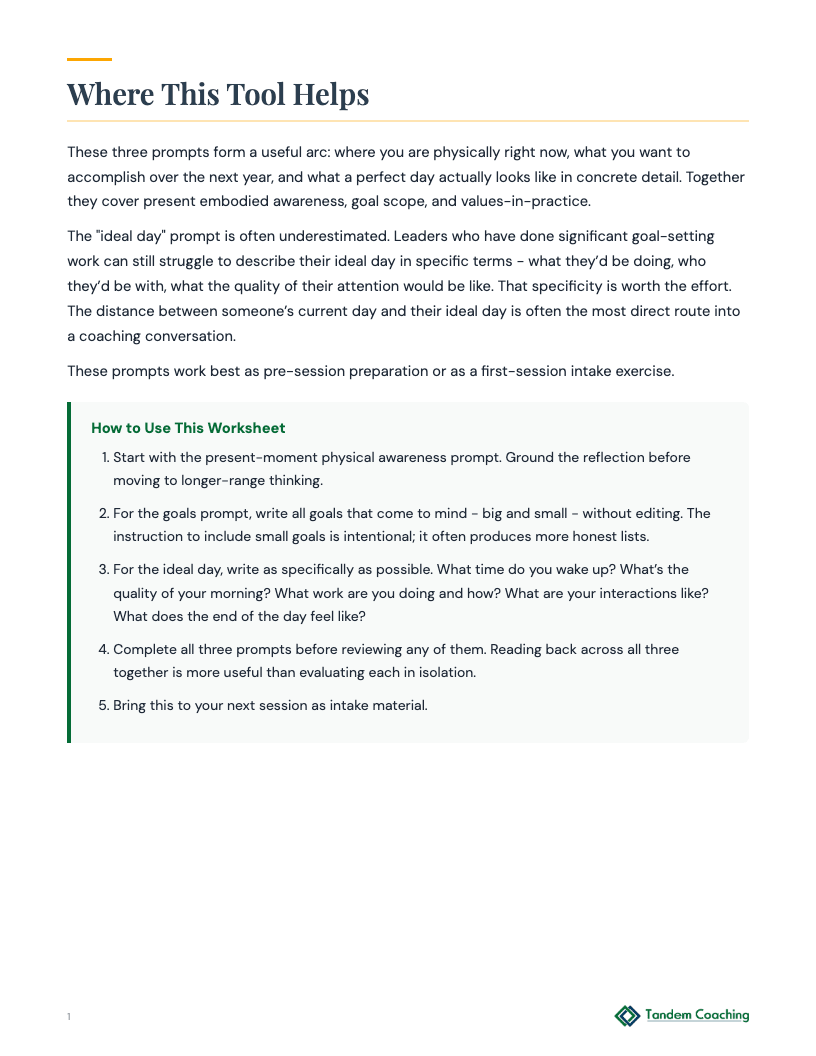
Client has not connected their physical experience of their current situation to the goals they are setting
Client's year-ahead goals exist in abstraction without a felt sense of what they actually want
Client has never described in sensory detail what their ideal day would look like
How to Introduce This Tool Plus
This moves from physical awareness in your current situation through what you want for the year ahead to a detailed description of your ideal day - would working through that sequence together give us a clearer picture of what you're actually building toward?
Browse All Pages
Tool Classification
Domain
Life Coaching
Type
Worksheet
Phase
Discovery
Details
15 min
Opener
As-needed
Topics
Identity
Values
Mindset
For the Coaching Practitioner
Plus
Coaching Scenarios
Plus
1 New coaching client struggling to articulate what they actually want ▶
Context
A director-level client arrives for a first session with vague goals - 'I want to feel more balanced' and 'I want to be more effective.' They've never done formal coaching and don't know what to bring. The session is about to become 50 minutes of you drawing out information that could have arrived pre-written.
How to Introduce
Frame this as intake prep, not homework. 'Before we meet, I want you to take 15 minutes with three prompts - where you are physically and emotionally right now, what you want to accomplish this year, and what a perfect day actually looks like in specific detail. Don't edit. Just write.' Clients who resist journaling often accept this because it's bounded - three prompts, not an open page.
What to Watch For
The ideal day section is diagnostic. If the client writes abstract states ('feeling calm,' 'having more impact') rather than specific scenes (waking time, work type, who they're with), their goals are still in aspiration mode. The gap between vague ideal day and concrete goals tells you how much grounding work the early sessions need to do.
Debrief
Start with the ideal day, not the goals list. Ask the client to read one detail from it - any detail. Then: 'What does that detail tell you about what's actually missing right now?' The physical awareness prompt can surface somatic data that pure goal-talk misses. If the client wrote that they feel tight or exhausted, that's the first real data point of the engagement.
Flags
If the ideal day section is blank or one sentence while the goals list is long and specific, the client is living in their head and has disconnected from felt experience. Severity: low. Adjust pacing to slow down and ground before moving into goal work.
2 Experienced leader whose goals are performance-driven but feel hollow ▶
Context
A VP who has hit every career milestone they planned is starting coaching because something feels off. They can list goals fluently - revenue targets, team metrics, promotion timelines - but struggle to say what they actually want. The goals section of this tool fills in quickly; the ideal day section reveals the real problem.
How to Introduce
Don't frame this as a new kind of goal-setting - they'll dismiss it as redundant. Frame it as calibration: 'You've done a lot of goal work. This checks whether the goals you're working toward are connected to what you actually want your life to feel like. The ideal day prompt is the one worth sitting with.' Give it as between-session prep.
What to Watch For
If the goals list includes nothing personal - no relationships, physical health, or time structure - and the ideal day is populated with work content only, the client's identity may be fused with their professional role. Also notice if the ideal day description is aspirational but structurally identical to their current day. That gap is often where coaching work begins.
Debrief
Start with: 'Read me one thing from the ideal day that isn't in your current day.' Then: 'What would have to be true for that to be present?' This sequence moves from wishful description to structural diagnosis. The physical awareness prompt at the top - whatever the client wrote there - is worth returning to at the end of the session as a check on whether they've moved.
Flags
If the ideal day is literally blank - client says they don't know what a perfect day would look like - that's not a blank page problem. It may indicate disconnection from self-knowledge that pre-dates the coaching engagement. Severity: moderate. Explore whether there's been a period of chronic overwork or loss that preceded this. Consider whether the work needs to slow down before it moves forward.
3 Client preparing for a significant life or career transition ▶
Context
A senior professional leaving corporate employment to start a consulting practice. They know what they're moving away from; they haven't defined what they're moving toward. The goals section typically lists practical tasks (set up LLC, build website). The ideal day prompt can surface what they actually want the new life to feel like.
How to Introduce
Present it as a grounding exercise before the planning begins: 'Before we map out the logistics, I want you to answer three prompts in writing - what you're experiencing right now, what you want from the next 12 months, and what a perfect day in this new chapter would look like. We'll use that as our starting point.' Clients in transition often feel like they should be further along in knowing what they want - this legitimizes the exploration.
What to Watch For
Watch for goals that are all execution tasks (websites, proposals, outreach) with no vision-level content about the kind of work, relationships, or lifestyle they're building toward. If the ideal day and the goals list don't connect to each other, the client may be running the old performance pattern in a new container.
Debrief
Compare the goals list to the ideal day. Ask: 'If you completed every goal on this list, would you end up living this ideal day?' That question often reveals misalignment between the tasks they're executing and the life they're designing. The physical awareness prompt - how they felt when they sat down to write - is useful data about whether the transition is energizing or depleting.
Flags
If the physical awareness section describes exhaustion, anxiety, or numbness in combination with a goals list full of urgent action items, the client may be using activity to avoid processing the emotional weight of the transition. Severity: low to moderate. Slow the action planning and create space to examine what the transition actually means for them before adding more to the list.
Tool Flow
Plus
Requires
- None - standalone tool
→
Produces
- written physical awareness snapshot
- one-year goal inventory
- specific ideal day description
- pre-session intake material
Pairs Well With
Life
Life Purpose Discovery
A client wants to use Life Purpose Discovery as an optional reflection
Why it pairsUse the goal inventory as testable raw material for checking whether those aims connect to what your client actually values.
LifeGROW Coaching Reflection
A client wants to use GROW Coaching Reflection as an optional reflection
Why it pairsOnce your client has described their ideal day, GROW structure converts that felt sense into specific options and committed timelines.
LifeOptional Future Perspective Letter
Use this worksheet to explore identity and values and turn the client’s observations into one optional next step.
Why it pairsThe goal inventory gives your client the articulated vision this tool needs to write a letter that speaks to real present choices.
Related Articles

How to Structure a Coaching Conversation That Actually Moves
Read article →
Leadership Development Goals That Actually Work: Framework and Examples
Read article →
Agile Manifesto - What it means to me
Read article →
What Coaches Miss Without Formation Awareness
Read article →