Letter from Your Future Self

Make short-term decisions that align with who you want to be long term, guided by a structured letter-writing exercise used in coaching.

Worksheet · 30 min · Print-ready PDF · Free download

Get This Tool

Free PDF - professionally formatted, ready to print or fill digitally

Preview Worksheet · 30 min
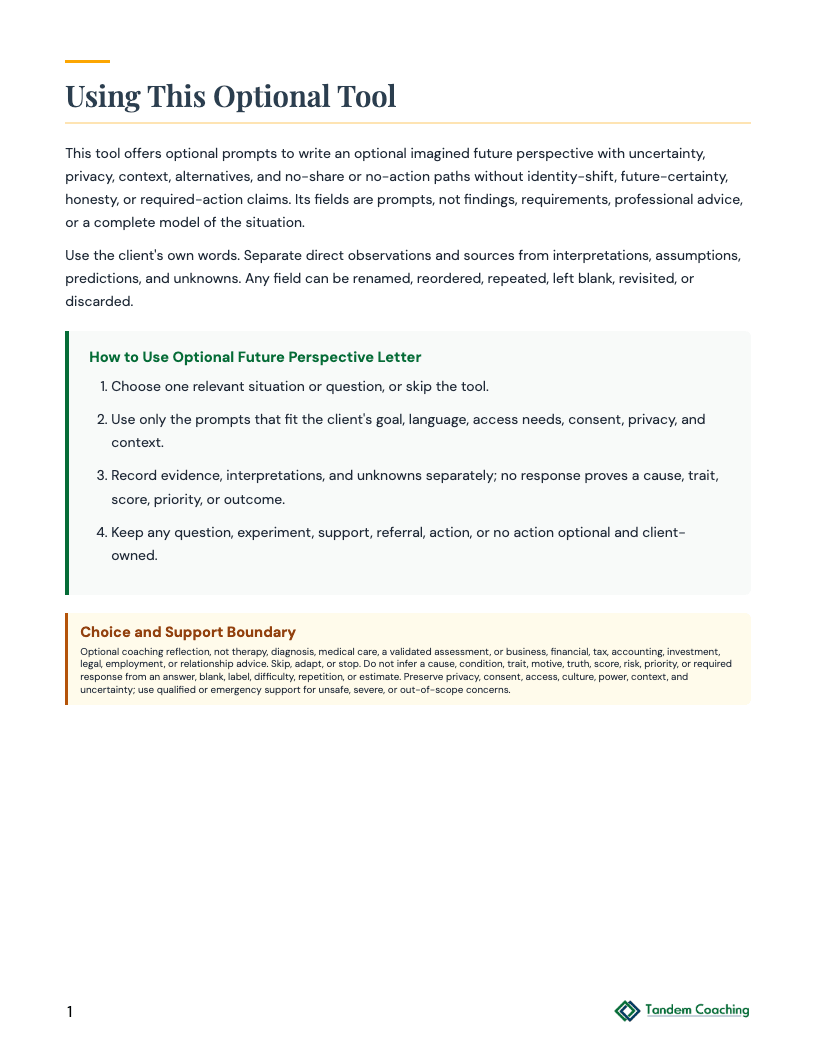
Letter from Your Future Self - preview
When to Use This Tool
Client is making decisions in the short term without consulting who they want to become long term
Client cannot articulate a compelling future self and therefore lacks motivation for present sacrifice
Client's goals feel external and obligatory rather than connected to a genuine vision of the future
How to Introduce This Tool Plus

This exercise asks your future self - from a specific time horizon - to write back to who you are right now - would stepping into that perspective before our next session surface something worth exploring?

Browse All Pages
Interactive Preview Worksheet · 30 min
Tool Classification
Domain
Life Coaching
Type
Worksheet
Phase
Discovery Goal Setting
Details
30 min Between sessions As-needed
Topics
Identity Values Mindset

For the Coaching Practitioner

Plus
Coaching Scenarios Plus
1 Client at a Career Crossroads Who Knows What They Want But Won't Claim It
Context

A professional who has been circling the same career decision for months. In sessions, they can describe with precision what their future could look like, what they'd need to get there, and what's holding them back. They speak about it in the third person - 'someone in that kind of role would need to...' - and never in the first person. The decision-making is not the problem. The claiming is.

How to Introduce

Frame the letter as perspective-taking, not prediction. 'You're not being asked to commit to this future or declare it as certain. You're writing from it - pretending for 30 minutes that it happened, looking back.' This framing removes the stakes that keep clients in the conditional. The time horizon field matters here: clients who choose 5-10 years tend to write more honestly than those who choose 2-3 years, because the longer horizon creates enough distance that the protective censor relaxes. If the client defaults to a short horizon, note it.

What to Watch For

Watch for letters written in the subjunctive - 'I might have,' 'perhaps I would have,' 'if things had worked out.' Conditional language in a letter from the future means the client is still protecting against the possibility of failure rather than writing from the assumed success the exercise requires. Also watch for letters that are entirely professional - describing career accomplishments with no personal life, relationships, or identity claims. The absence of personal content often reveals where the real resistance lives.

Debrief

Start with the 'what I most needed to hear' field rather than the letter itself. That field captures what the client's intuition already knows without the full protective scaffolding of the narrative. Then ask: 'What did you write in the letter that surprised you? What showed up that you didn't expect to write?' The letter's surprise elements are the honest data. Close with the commitment field: 'You wrote that you're committing to X. What would it look like to take the first step on that within the next 10 days?'

Flags

If the client refuses to write the letter in first person and instead writes about themselves in third person throughout, the exercise has not landed and pushing through produces performed compliance, not real data. Severity: low. Offer to debrief what they noticed when they tried to write in first person instead. If the client writes a letter describing a future that sounds nothing like what they've expressed wanting in sessions, explore the gap directly: 'The future you wrote about is very different from what you described last month. What changed?' The discrepancy may surface a new constraint or a previously unnamed preference. Severity: low.

2 Mid-Career Professional Questioning Whether Their Success is Worth the Cost
Context

A client in their mid-40s who has achieved significant professional goals and finds themselves unexpectedly unsatisfied. They have what they said they wanted. The dissatisfaction isn't dramatic - it's quiet, persistent, and harder to name than a crisis would be. They know something is off. They don't know what they'd want instead. The coaching conversation has been circular because there's no clear alternative to work toward.

How to Introduce

Position this as a way to let the client's values write the brief rather than working from existing goals. 'Before we figure out where you want to go, let's find out what kind of life your future self is actually living - not what they've accomplished, but what their days look like and what they feel.' Push gently against professional achievement framing in the letter: 'What is your future self doing on a Tuesday morning that has nothing to do with work?' Many clients have never been asked that question. The silence that follows is often the most useful data in the exercise.

What to Watch For

Watch the letter for signs of what the client isn't writing. If the letter describes a rich professional life and a vague personal one, the cost is being paid in the personal domain and the client already knows it. If the letter describes escaping to a fundamentally different life - farming, nonprofit work, early retirement - note how the client describes the transition: do they describe relief, or fear, or both? The emotional charge on the transition language tells you what the client is working toward and working against simultaneously.

Debrief

Start by reading the letter's emotional temperature rather than its content. 'When you read this back, what do you feel?' If the client feels sad, explore what the letter is mourning. If they feel excited, explore what in the present is blocking access to that. The 'what I most needed to hear' field is often the most direct line to what coaching should focus on for the next phase of work. The close: 'The letter says your future self wants to tell you to [quote directly]. What would it mean to take that seriously right now?'

Flags

If the client's letter describes a life that requires completely abandoning their current commitments - leaving a marriage, an organization, a profession - without any evidence they've weighed these decisions, this is a signal that something more significant may be driving the dissatisfaction than a career misalignment. Severity: moderate. Continue exploring, but notice whether the urgency behind the escape narrative is new or longstanding. If the client becomes distressed while writing or debriefing the letter and has difficulty returning to the present, the exercise may have surfaced something that needs more careful handling than a coaching session provides. Severity: moderate.

3 New Leader Stepping Into First Executive Role Who Needs to Anchor Their Leadership Identity
Context

A first-time executive, recently promoted from a senior individual contributor or director role, who is struggling to inhabit the new identity the role requires. They're technically capable. They're socially intelligent. But they describe feeling like they're performing leadership rather than being a leader. The tool is useful here not to explore options but to create an internal reference point for the leader they are in the process of becoming.

How to Introduce

Frame the letter as a character study, not a goal statement. 'You're not writing about what you'll have accomplished. You're writing about who you'll have become. What kind of leader does your future self look back and describe themselves as?' The time horizon for this client should be set to 3-5 years - close enough to feel real, far enough to have accumulated a track record. The 'what I most needed to hear' field matters most: many new executives are carrying advice from their previous identity that's now obsolete, and this field surfaces what they actually need to hear to step into the new one.

What to Watch For

Watch whether the letter describes the client's future self in leadership terms or still primarily in individual contributor terms. A new VP who writes about their future self as 'someone who still does deep technical work and also has organizational influence' may be writing from their preferred identity rather than the one the role requires. The tension between those identities is the coaching work. Also watch for clients who write the letter quickly, in under 15 minutes, and report it felt easy - easy often means they stayed in the comfortable version.

Debrief

Start by asking the client what they know about the leader they wrote about that they don't yet fully believe about themselves. 'You described your future self as someone who makes decisions confidently in ambiguous situations. How far is that from where you are now?' The gap between the letter's leadership portrait and the client's current self-assessment is the development arc. Close with the commitment field, which often surfaces the most important immediate behavioral change: 'Your future self is telling you to do X. What's the smallest version of X you could do this week?'

Flags

If the client writes a letter describing a leader who is primarily appreciated and liked rather than one who makes hard decisions and absorbs organizational friction, explore whether the client's concept of leadership aligns with what their role actually requires. Severity: low. If the client is unable to write the letter at all - reports that they can't imagine a successful future in the role - this may indicate that the promotion has created more anxiety than the client has disclosed. Severity: moderate. Slow down and explore what's underneath the inability to imagine success.

Tool Flow Plus
Requires
  • articulated long-term vision or desired future state
Produces
  • written letter from specific-horizon future self
  • single most important action to take now
  • future-self perspective on current decisions

Pairs Well With

Life

Values Hierarchy Builder

My client says they know what they value but their choices don't reflect it

30 min Assessment
Life

Life Purpose Discovery

Client is achieving goals but feels disconnected from any larger sense of meaning

45+ min Framework
Life

Dream Life Visualization

Client articulates dissatisfaction with their current situation but cannot describe what they actually want

30 min Framework

Related Articles

Exploring Different Types of Coaching: Finding the Right Fit for Your Needs

Exploring Different Types of Coaching: Finding the Right Fit for Your Needs

Read article →
Life Coach Certification Online: What to Know Before You Enroll

Life Coach Certification Online: What to Know Before You Enroll

Read article →
Natural Time Horizon: The Temporal Lens Your Client's Formation Installed

Natural Time Horizon: The Temporal Lens Your Client's Formation Installed

Read article →
AI Consulting Career Disruption: What Partners Must Do Now (2026)

AI Consulting Career Disruption: What Partners Must Do Now (2026)

Read article →
Identity Architecture: How Career Shapes Who Leaders Become

Identity Architecture: How Career Shapes Who Leaders Become

Read article →
Sylvia Hewlett’s Executive Presence Model: What It Gets Right, Where It Falls Short

Sylvia Hewlett’s Executive Presence Model: What It Gets Right, Where It Falls Short

Read article →