WOOP Goal Exercise
Turn ambitious goals into realistic plans by identifying internal obstacles and pairing them with an explicit if-then response.
Get This Tool
Free, print-ready PDF.
When to Use This Tool
A client who sets ambitious goals but hasn't planned for the internal obstacles that consistently derail them
Someone who wants a structured four-part approach to goal pursuit
A professional who's motivated to start something new but needs to bridge intention and follow-through
How to Introduce This Tool Plus
Use the WOOP model with a goal that matters enough to have real obstacles. What's something you genuinely want but keep stopping short of — and what's the obstacle that's actually in the way?
Browse All Pages
Tool Classification
Domain
Life Coaching
Type
Worksheet
Phase
Goal Setting
Action
Details
15 min
Mid session
As-needed
Topics
Accountability
Resilience
For the Coaching Practitioner
Plus
Coaching Scenarios
Plus
1 The client who sets ambitious goals and is repeatedly surprised when internal obstacles derail them ▶
Context
Client's goals are well-formed. They can articulate what they want, why it matters, and what the steps are. What they do not do is name what inside them will most likely get in the way. Every time a goal stalls, the post-mortem finds an external explanation: the project became more complex, circumstances changed, other priorities emerged. The real obstacle — a habit of avoidance, a fear of exposure, a competing value — has never been named before commitment, so it always arrives as a surprise. The Obstacle step in WOOP is designed to preempt that surprise.
How to Introduce
Frame the Obstacle step as the one that distinguishes this framework from generic goal-setting. 'The thing that makes this tool different from most goal-setting frameworks is the second O — obstacle. Before you commit to the goal, you name what inside you is most likely to get in the way. Not external circumstances. Internal ones: a habit, a fear, a belief. Naming it in advance changes how you respond when it shows up.' The resistance from high-performing clients is that naming their own obstacles feels like admitting weakness or predicting failure. Name it: 'Naming an obstacle is not predicting failure — it is making your intended response explicit before you need it.'
What to Watch For
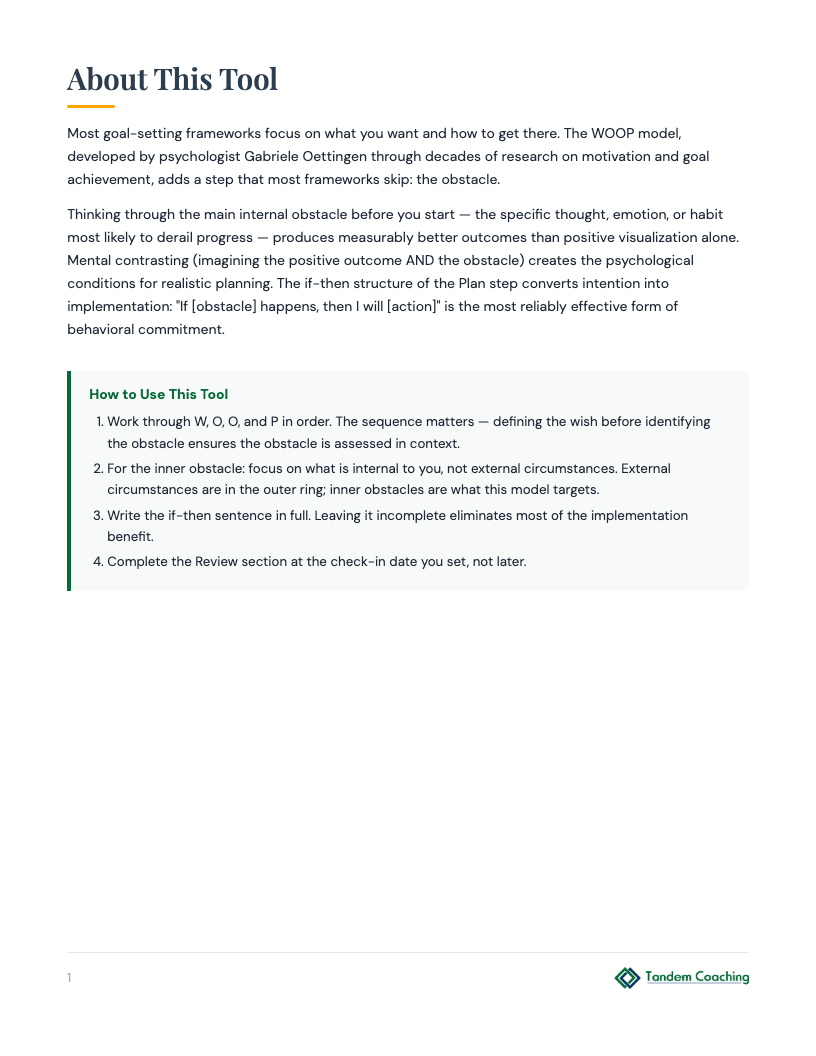
Watch the Obstacle field for external descriptions: 'my schedule is too full,' 'I don't have enough support,' 'the environment is not conducive.' Those are real, but they are not the inner obstacle the model targets. Push: 'What inside you — a habit, a thought pattern, a recurring emotion — tends to show up when you're pursuing something like this and make it harder?' The field should name something the client can observe in themselves and act on directly. Also watch for the if-then Plan sentence being incomplete — 'If I get distracted, then I will...' without the completion. The incomplete sentence eliminates most of the implementation benefit.
Debrief
After W, O, O, and P are complete, read the Plan sentence back to the client: 'If [obstacle], then I will [action].' Ask: 'When this obstacle shows up — and it will — does this plan actually address it, or does it address a smaller version of it?' The question is a stress test on the plan before the obstacle appears. Then: 'What is your commitment on the first concrete step — specifically when this week will you do it?' A specific day and time makes the commitment concrete.
Flags
Severity: moderate. Pattern: the inner obstacle is identified correctly but the if-then plan substitutes a positive intention for a behavioral response. Response: name the gap and ask what the client will actually do when the obstacle appears.
2 The client who wants a structured goal-setting sequence with an explicit implementation plan ▶
Context
Client is analytically oriented and has made commitments to goals before that did not hold. They are not resistant to goal-setting — they want a more explicit structure. When introduced to the WOOP sequence and its Obstacle and Plan steps, this client engages seriously. They are willing to name internal obstacles honestly and work through each field carefully rather than treating the tool as a form to complete.
How to Introduce
Frame the quality standard for each step explicitly. 'Make the Wish meaningful but achievable, describe the desired Outcome clearly, name an inner Obstacle you can observe, and write the Plan as a specific behavioral if-then. We'll work through each one carefully.' The resistance from analytical clients is usually in the Outcome step — visualizing the best possible outcome can feel imprecise or unserious. Name it: 'The Outcome step is not a prediction. It describes why this wish matters enough to plan for the obstacle.'
What to Watch For
Watch the Wish field for goals that are meaningful but clearly not achievable in four weeks — the timeframe specified in the tool. A four-week WOOP should produce a goal the client can reasonably accomplish in a month, not a quarter or a year. If the goal is too large for the timeframe, resize it. Also watch for the Outcome field being completed only with external recognition rather than the client's own desired experience. Keep the field focused on what the client wants to experience and record external outcomes separately.
Debrief
After all four fields are complete, ask the client to evaluate each step against the standard: 'Is the Wish meaningful and achievable in four weeks? Is the Outcome something you can feel, not just observe? Is the Obstacle genuinely internal? Does the Plan specify what you will do in that specific moment?' This keeps the client involved in judging the plan. Close with the Review section: 'Set the check-in date now. When will you actually complete the review?' An empty check-in date leaves the review unscheduled.
Flags
Severity: low. Pattern: the Outcome describes a state months or years beyond the worksheet's four-week timeframe. Response: bring the description back to what the client wants to experience at the end of this four-week commitment.
3 Client starts strongly but stalls when the first obstacle appears ▶
Context
Client has a recurring pattern: strong start, visible progress in the first one to two weeks, then a stall. The client genuinely wants the goal when they commit to it, but when the novelty fades and the first real obstacle appears, there is no prepared response. The client improvises differently each time and momentum breaks. The WOOP if-then plan makes one intended response explicit before the obstacle appears.
How to Introduce
Frame the if-then plan as the thing this client has been missing. 'You start strong and stall around week two or three. That pattern may point to an obstacle that shows up on a predictable schedule but gets handled differently each time it appears. The if-then plan lets you choose one response before the obstacle arrives.' The resistance from this client is often frustration with their own pattern — they have seen it repeat and have self-critical interpretations of it. Name it: 'The stall is not a character flaw. We can treat it as a planning gap and specify what you want to do when it appears.'
What to Watch For
Watch the Obstacle field for descriptions that match the client's known stall pattern. If the client has identified before that they lose momentum when their schedule gets disrupted or when they face the first piece of critical feedback, the Obstacle field should name that specifically. Also watch for the first concrete step being too ambitious — 'complete the first two phases this week' — when the actual first step should be the smallest believable unit of progress. An overly ambitious first step is often why momentum stalls in week two: the step was never realistic for week one.
Debrief
After the WOOP is complete, ask the client to look at the Obstacle they named and the Plan they wrote. 'The last time a goal stalled for you — did this obstacle or something similar play a role?' If yes, the Plan should be tested: 'And if you had executed this plan in that situation, would it have held?' The debrief is retrospective before it is prospective — the client can evaluate the plan against known experience rather than hypothetical future scenarios. Close with: 'What is different about this commitment that makes you think it will hold past week two?'
Flags
Severity: moderate. Pattern: the plan repeats an approach the client has already tried without naming what will change. Response: ask for a different trigger, response, or environmental support that directly addresses the named obstacle.
Tool Flow
Plus
Requires
- specific goal with genuine stakes
- honest self-knowledge of recurring derailment patterns
→
Produces
- wish, outcome, obstacle, and if-then plan
- named specific internal obstacle to goal progress
- written if-then implementation intention statement
- scheduled check-in date with obstacle review
Pairs Well With
Life
Annual Goal Context Review
Use this tracker to notice patterns in accountability and time management over time before drawing conclusions.
Why it pairsOnce you have the if-then plan, the quarterly milestone structure tests whether it holds when the named obstacle reappears months later.
LifeWins and Learning Evidence Log
Use this tracker to notice patterns in resilience and accountability over time before drawing conclusions.
Why it pairsUse this after WOOP to log which enabling conditions supported the if-then plan, creating a record the client can draw on in future cycles.
LifeSelected Accomplishments Journal
Use this tracker to notice patterns in resilience and accountability over time before drawing conclusions.
Why it pairsUse this to name the skills behind each if-then execution, building a capability pattern the client can draw on in future cycles.
This tool is part of a coaching pathway
Step 6 of 6 in A client acts on digital impulses before they've had a chance to notice and choose
Use after Urge Surfing Practice Sheet.
Explore all pathways →Related Articles


You Have the Title but Not the Room
Read article →
Sylvia Hewlett’s Executive Presence Model: What It Gets Right, Where It Falls Short
Read article →
What Your Career Has Taught You — And What It Hasn’t
Read article →
The Four Domains of the ICF Core Competency Model
Read article →