Pinpoint the personal values behind work friction or resentment, using a structured coaching framework to clarify what’s misaligned.
Free, print-ready PDF.
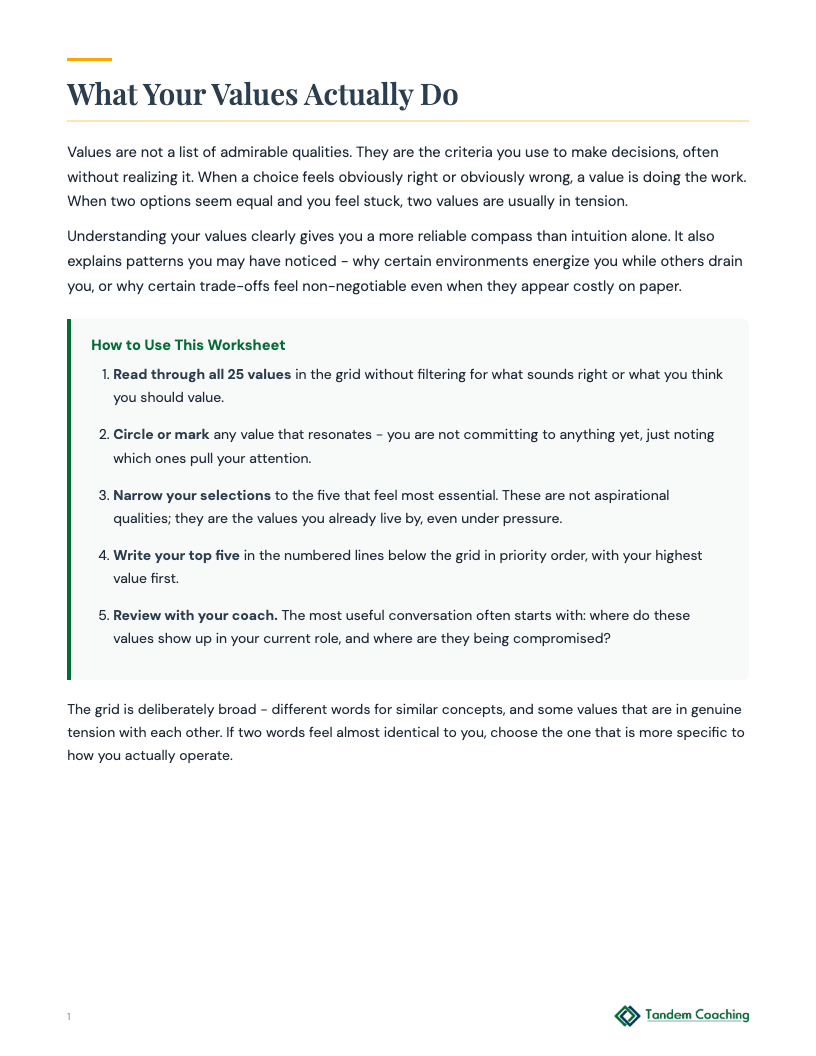
There's a 25-value grid where you identify what genuinely resonates — not what sounds right — and narrow to your top three to five. Would it be useful to start there so we have a values reference for the work ahead?
A newly promoted operations director at a manufacturing company finds themselves paralyzed by competing team demands and budget decisions. They've always been decisive as a manager but now second-guess every choice. The client attributes this to inexperience at the director level.
Frame this as a decision-making calibration tool. 'You mentioned second-guessing yourself on resource decisions. Let's identify what criteria you're actually using to evaluate options.' Many new directors resist acknowledging they have values-based decision filters because it feels less objective than data-driven analysis. Position values as decision efficiency tools, not touchy-feely concepts.
New directors often select aspirational values rather than operational ones. If they mark 'Justice' and 'Fairness' but skip 'Control' and 'Efficiency,' they're performing the role they think they should want. Watch completion speed - if they breeze through without pausing, they're working from job description rather than genuine preference.
Start with the values they didn't mark: 'You skipped Merit and Power. Tell me about a recent resource decision where those came up.' This surfaces the gap between stated values and actual decision pressure. Then ask: 'Which of your marked values would your team say drives your decisions?' The disconnect reveals where role transition stress lives.
If the client marks 8+ values and insists they're all equally important, the promotion may have triggered identity confusion rather than just skill gaps. Severity: moderate. They may be trying to be everything to everyone. Continue coaching but explore whether the role design matches their actual decision-making style.
A marketing VP at a Fortune 500 company earns $180K but feels increasingly disconnected from the work. They've been approached by a nonprofit offering $95K for a similar role. The client frames this as a practical decision about money versus meaning but keeps circling back to the opportunity.
Present this as a values audit, not a decision-making tool. 'Before we weigh pros and cons, let's map what actually drives your engagement at work.' Expect resistance to values that sound selfish - many clients considering nonprofit work perform altruism and downplay values like Mastery, Control, or Recognition that legitimately matter to them.
Corporate-to-nonprofit clients often split their selections into 'noble' values (Justice, Empathy, Integrity) and 'practical' values (Ability, Efficiency, Control). If they apologize for marking practical values or explain why they 'shouldn't' care about them, the internal conflict runs deeper than salary concerns.
Start with the values they marked reluctantly: 'You circled Control but then said maybe you shouldn't care about that. Walk me through your current role - where do you have control and where don't you?' This reveals whether they're running from corporate constraints or toward nonprofit mission. The distinction changes the coaching conversation entirely.
Client marks only altruistic values (Justice, Empathy, Integrity, Fairness) and actively rejects achievement-oriented ones. This may indicate values performance rather than genuine assessment. Severity: low. Explore whether they're trying to justify the nonprofit move by becoming someone different rather than honoring who they are.
A software engineering team lead with ADHD manages six developers while contributing code themselves. They accept every project request, volunteer for cross-functional initiatives, and work 60-hour weeks. The client wants time management strategies but admits they don't know how to say no to anything that sounds interesting.
Frame this as a filtering system, not self-discovery. 'You mentioned saying yes to everything interesting. Let's identify what interesting actually means to you - what pattern drives those yeses.' ADHD brains often struggle with values identification because interest feels more immediate than values. Position this as building a yes/no decision tree.
ADHD clients frequently mark novelty-adjacent values (Insight, Ambitious, Mastery) while skipping structure-related ones (Careful, Efficient, Balance). If they select 10+ values and say 'everything sounds good,' their ADHD may be making values prioritization genuinely difficult, not just overwhelming.
Start with their rejection patterns: 'You didn't mark Careful or Balance. Tell me about the last project you turned down.' If they haven't turned anything down, that's the conversation. Ask: 'What would have to be true about a project for it to feel boring to you?' This reveals their actual filtering criteria.
Client cannot identify any values they would reject or says all 25 values matter equally. Combined with ADHD and overcommitment patterns, this suggests executive function challenges with prioritization that may need ADHD-specific strategies before values work can be effective. Severity: moderate. Consider referring to ADHD coach or therapist familiar with executive function.
A 32-year-old MBA works as operations manager in their family's regional construction company. Their father expects them to take over within five years, but the client feels trapped between family loyalty and personal ambition. They've never worked outside the family business and wonder what they actually want versus what's expected.
Position this as separating inherited expectations from personal drivers. 'You've been in the family business your whole career. Let's identify which values are yours versus which ones you absorbed from the business culture.' Family business successors often resist examining values that conflict with family expectations, so normalize the exploration upfront.
Family business clients typically show one of two patterns: they select only values that align with family business culture, or they reject values associated with the business entirely. Both patterns indicate they're defining themselves in reaction to family expectations rather than identifying genuine preferences.
Start with values that surprise them: 'You marked Ambitious but seemed hesitant about it. What does ambition look like inside the family business versus outside it?' Then explore inherited values: 'Which of these values would your father say drive the business? Which ones would he be surprised you selected?' The gaps reveal the succession tension.
Client cannot separate their values from family business values or becomes distressed when asked to consider values that might conflict with taking over the company. This may indicate enmeshment issues that coaching alone cannot address. Severity: moderate. Consider whether family systems work or therapy might be needed alongside coaching.
Client is achieving goals but feels disconnected from any larger sense of meaning
LifeClient articulates dissatisfaction with their current situation but cannot describe what they actually want
LifeClient is making decisions in the short term without consulting who they want to become long term