Personal Boundaries Worksheet
Clarify exactly where your boundary line is and how to state it, using a structured, coach-tested worksheet for real-life situations.
Get This Tool
Free, print-ready PDF.
When to Use This Tool
Client knows their boundaries are being crossed but cannot articulate where the line actually is
Client can identify the problem but does not have language to communicate the boundary clearly
Client's stated values and how they respond in the moment are consistently out of alignment
How to Introduce This Tool Plus
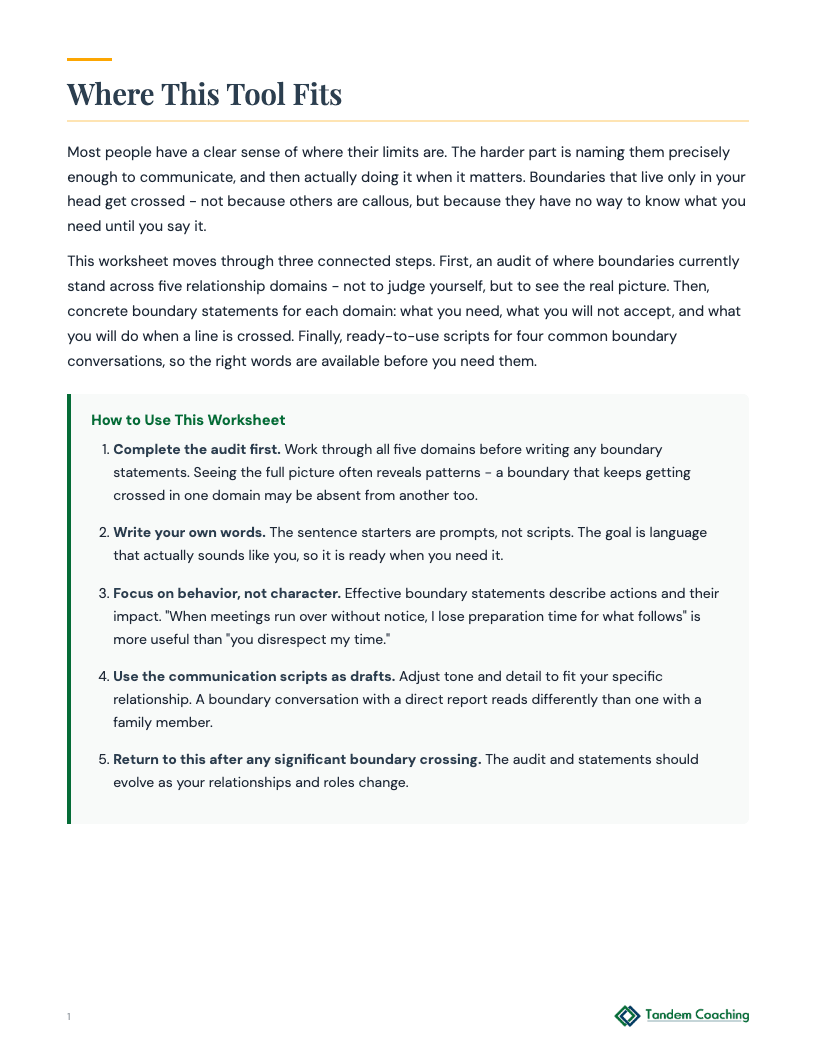
This worksheet moves through three steps - auditing where boundaries are being crossed, writing clear boundary statements, and preparing the words to communicate them - would that structured approach be useful to work through?
Browse All Pages
Tool Classification
Domain
Life Coaching
Type
Worksheet
Phase
Discovery
Action
Details
30 min
Between sessions
As-needed
Topics
Values
Communication
Identity
For the Coaching Practitioner
Plus
Coaching Scenarios
Plus
1 Senior leader whose work boundaries erode in both directions - upward and downward ▶
Context
Your client is a VP who cannot say no to their CEO's last-minute weekend requests and cannot enforce off-hours boundaries with their own direct reports. They present both directions as different problems, but the audit section of this worksheet is likely to surface them as the same pattern operating at different levels of the hierarchy. They have been aware of the pattern for two years. They have named it in sessions before. What they have not done is put the boundary statements in writing or prepare the language to hold them.
How to Introduce
Frame this as moving from awareness to infrastructure. 'We have talked about this pattern several times. What the worksheet does that the conversation hasn't done is give the boundaries somewhere to live outside your head - specific statements, specific language, ready to use.' The resistance pattern to name: clients who have high self-awareness about their boundaries often confuse knowing the problem with having addressed it. The worksheet is explicitly not a conversation - it is preparation for one. Those are different steps.
What to Watch For
Watch whether the boundary statements in the Work domain are behavioral or aspirational. 'I need to be respected' is aspirational. 'I need advance notice of at least 24 hours before weekend requests' is behavioral - specific enough to communicate and specific enough to notice when crossed. If the statements stay aspirational, the communication scripts that follow will also stay vague. Also watch whether your client writes the same statement in both the upward (CEO) and downward (team) domains, or whether they are differentiating appropriately - the language for each is often different.
Debrief
Start with the audit table. Ask your client to read aloud the 'Impact When Crossed' column for the Work domain. Then ask: 'How long has that impact been the cost you pay?' That question makes the accumulated cost concrete. Then move directly to Script 1 (Setting a New Boundary) and ask your client to say the draft aloud, not read it. The spoken version will often be softer than the written version, which tells you where the real rehearsal work needs to happen.
Flags
If your client's inability to hold the upward boundary is exposing them to requests that have a significant professional cost - missed family obligations, health effects, depleted judgment - the urgency level is higher than the worksheet alone addresses. Severity: moderate. Response: the preparation work here is appropriate, but also explore whether there is a direct conversation with the CEO that needs to happen alongside the boundary-setting practice.
2 Client whose self-boundaries are clear in theory but collapse under social pressure ▶
Context
Your client can articulate their personal standards clearly in a coaching session. They know they do not want to work past 6pm. They know they do not want to take on additional projects. They know they need recovery time on weekends. They agree to all of these in conversation. Then a colleague makes a request, or their manager applies subtle pressure, and the boundary evaporates. They are not confused about their limits - they are unable to hold them when the social friction of maintaining them is present. The worksheet's script section is specifically what they need.
How to Introduce
Frame this as preparing the words in advance so they are available in the moment. 'The issue is not clarity - you already know what you need. The issue is that when the pressure arrives, you are improvising. The scripts create language you have already chosen so you are not making it up under social pressure.' The resistance pattern: clients who feel their limits are reasonable often believe the scripts are unnecessary - 'I should be able to just say it.' Name that having practiced language available is not a sign of weakness, it is preparation for a moment that has historically not gone well.
What to Watch For
Watch Script 4 (Declining Without Over-Explaining) specifically. Clients who collapse under social pressure often also over-explain their refusals, which opens negotiation. If your client's draft of Script 4 is three sentences when the template is one, the over-explanation habit is showing up on paper. Work through shortening it together. Also watch whether the 'When ___ happens, I will' field in each domain stays in the first person and stays behavioral - 'I will say no' is weaker than 'I will say I am not available for that, and I will not offer alternatives in the same conversation.'
Debrief
Role-play one of the scripts. Ask your client to give you the most common version of the pressure they receive - the colleague's request, the manager's framing - and then have them respond using what they drafted. Debrief what happened: 'What did you want to add that you did not add?' Whatever they wanted to add is usually the over-explanation habit. The closing question: 'Which of these four scripts are you most likely to use in the next two weeks, and when specifically might that moment come?'
Flags
If your client's difficulty holding boundaries under social pressure is broad enough to be affecting multiple domains simultaneously - work, family, and self simultaneously - and if they report a chronic sense of depletion or resentment, this may be a pattern that warrants more exploration than the worksheet can hold on its own. Severity: low. Response: continue with the tool, but note the potential depth of the pattern.
3 People manager whose team has learned they can override stated boundaries through persistence ▶
Context
Your client announced a 'no after-hours messages' boundary to their team four months ago. They held it for three weeks. Then a team member sent a Sunday message and they replied within the hour. Another followed. Your client has replied to every after-hours message since. They have re-stated the boundary twice verbally. The team has learned the actual rule: boundaries get announced, then exceptions start, then the exception becomes the norm. The pattern is now undermining your client's credibility in other areas as well.
How to Introduce
Frame this as writing the reinforcement script specifically, not re-stating the boundary. 'The boundary exists. The language to set it again isn't the problem. What's missing is a specific script for when it gets crossed after you've stated it - Script 2, not Script 1.' The resistance pattern: clients who have stated a boundary and not held it often feel embarrassed, and that embarrassment makes them reluctant to address the violation directly. They prefer to re-state the rule rather than address the specific crossing. Name that re-stating without addressing the pattern teaches the team that the announcement is the boundary, not the behavior.
What to Watch For
Watch the 'When ___ happens, I will' field in the Work domain and whether it is specific to the after-hours scenario. A vague 'I will address it in our next one-on-one' leaves a 72-hour window for the pattern to continue. The script needs to be closer to 'I will not reply until the next business day, and I will note in our one-on-one that the message came in after hours.' Also watch whether Script 2 (Reinforcing an Existing Boundary) is drafted for the team as a whole or for a specific team member - both may be needed, and they sound different.
Debrief
Ask your client to read Script 2 aloud and then ask: 'If a team member sends a message at 8pm this Sunday, what specifically will you do?' The answer needs to be a behavior, not an intention. If the answer is 'I'll try not to respond,' the script has not produced a commitment. The more useful question: 'What would have to be true in that Sunday-night moment for you to respond anyway?' Whatever they name is the contingency the script needs to address.
Flags
If the credibility erosion from inconsistently held boundaries has spread to other areas - team members testing your client's stated expectations in meetings, on deadlines, or on deliverable quality - the boundary credibility issue is now organizational, not just behavioral. Severity: moderate. Response: the worksheet is the right starting point, but the conversation about what consistent follow-through looks like across all domains may need explicit session time.
Tool Flow
Plus
Requires
- None - standalone tool
→
Produces
- boundary audit across five relationship domains
- written boundary statements for each domain
- four ready-to-use boundary conversation scripts
Related Articles


The Meeting Where Nobody Speaks Your Language
Read article →
What a Personal Executive Coach Actually Does for Your Leadership
Read article →
Why Your CFO and CMO Can't Agree (And Why That's Actually Useful)
Read article →
AI Augmentation vs. Substitution: Where the Line Is in Your Coaching
Read article →