
Panic Assessment
A client documenting a panic episode while details are still fresh and accurate
Get This Tool
Free, print-ready PDF.
When to Use This Tool
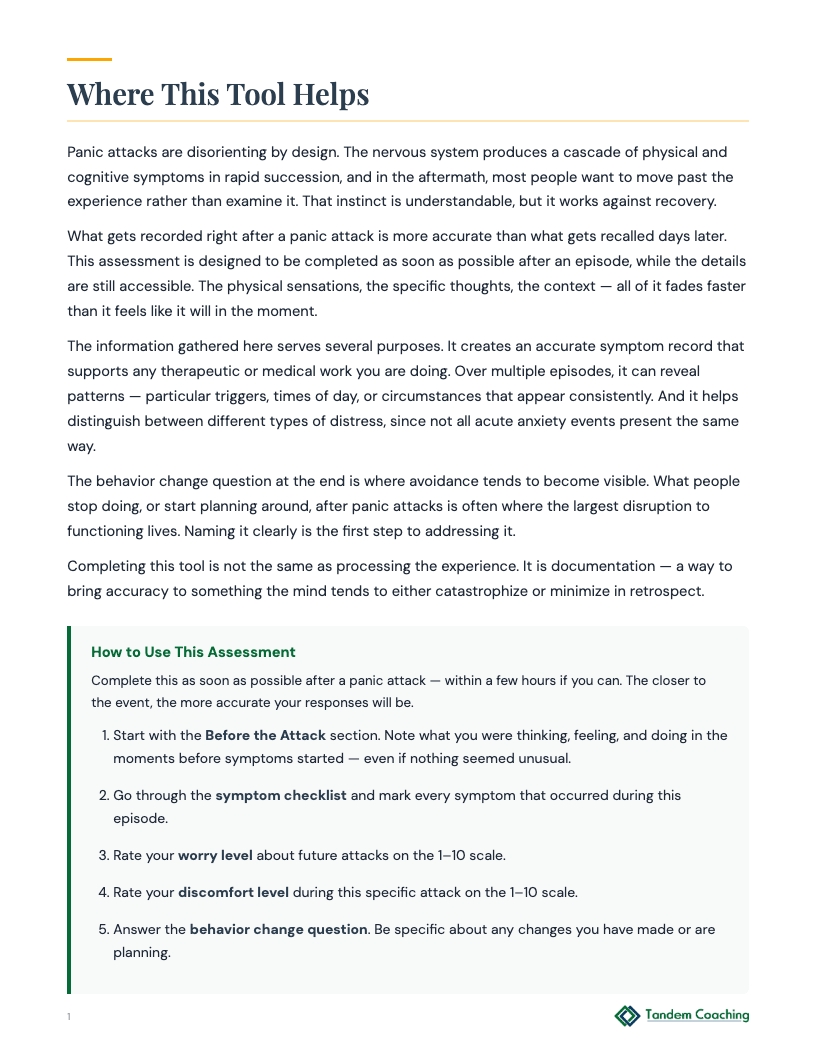
A client documenting a panic episode while details are still fresh and accurate
Someone tracking symptoms, context, and behavioral changes after an acute anxiety event
Capturing what happened before, during, and after a panic attack to find patterns over time
How to Introduce This Tool Plus
You filled this out after your last episode — what do you notice now, looking at what you recorded, that you might not have seen in the moment?
Coaching Tool Disclaimer
This tool is designed for coaching contexts, not clinical use. If you or your client is in crisis, contact the 988 Suicide and Crisis Lifeline (call or text 988) or Crisis Text Line (text HOME to 741741).
Browse All Pages
Tool Classification
Domain
Wellness
Type
Assessment
Phase
Discovery
Details
15 min
Opener
As-needed
Topics
Emotions
Resilience
For the Coaching Practitioner
Plus
Coaching Scenarios
Plus
1 Executive who dismisses recurring physical symptoms as work stress ▶
Context
A VP describes episodes of racing heart, difficulty breathing, and a sudden sense that something is very wrong during high-stakes meetings. He attributes these to 'adrenaline' and 'the pressure of the role.' He has not connected the episodes to a pattern and has not spoken to anyone about them.
How to Introduce
Position the assessment as pattern documentation, not diagnosis. 'This form tracks the specific symptoms and timing of episodes you've described — not to label what's happening, but to build a clear picture of what you're actually experiencing and when. Fill it out immediately after the next episode, while the detail is still present.' Some clients in this profile resist documentation because naming the experience makes it feel more real. Hold the framing as data collection: 'You're gathering information, not drawing a conclusion.'
What to Watch For
Watch whether he completes the behavioral avoidance section honestly. The most diagnostically useful field for clients in this pattern is often what they've quietly stopped doing — which meetings they arrive to late to avoid certain moments, which conversations they've been delaying. If that section is blank on multiple forms, ask him directly: 'Have you changed anything about how you work in the last few months that you haven't connected to these episodes?'
Debrief
Start with the worry rating, not the symptom list. 'When you look at the number you circled there — how much of your week does concern about these episodes take up, even when they're not happening?' That question surfaces the secondary impact, which is often more actionable in the coaching conversation than the episodes themselves. Then ask about the pattern across multiple entries: 'Do you notice anything consistent about when these happen?'
Flags
If the assessment documents four or more symptoms per episode with a discomfort rating above 7, and the client has not spoken with a physician, this is beyond the coaching lane. Severity: high. The appropriate next step is direct: 'Based on what you've documented here, I want to suggest you bring this to your doctor before our next session. This isn't something coaching is the right container for on its own.'
2 Client using busyness to avoid addressing recurrent panic episodes ▶
Context
A director describes episodes that began eight months ago and have continued at roughly the same frequency. She is aware they are not 'just stress' but has not sought any support. She keeps her schedule full enough that she doesn't have to sit with what's happening. She mentions it in session almost in passing.
How to Introduce
Introduce the form as a way of taking the experience seriously for the first time. 'You've been carrying this without much support and without looking at it directly. This form creates a structured place to look at it — what actually happened, what you felt, how bad it was. That's different from trying to figure it out or fix it.' The goal of the first form is completion, not resolution. Some clients in this pattern have been avoiding their own experience for months; the act of documenting it is itself meaningful.
What to Watch For
Watch the pre-attack context field. Clients who are using busyness as avoidance often find that episodes cluster in specific conditions — quiet moments, transitions between activities, evenings, or whenever they are not actively occupied. If the pre-attack context section consistently shows the same triggers across multiple forms, name the pattern: 'These seem to happen most often when you're not actively doing something. What do you make of that?'
Debrief
After two or three completed forms, ask her to read back the context sections aloud and notice what they have in common. Then ask: 'When you see this pattern laid out — what does it tell you about what you've been managing?' That question opens toward underlying causes without diagnosing or directing. If she is ready to talk about what's underneath the avoidance, follow that thread. If not, hold it and check whether she has professional support.
Flags
If she has been experiencing episodes for more than six months at any frequency and has not spoken with a physician or therapist, the coaching container is insufficient as a primary support. Severity: moderate. This is not a clinical judgment from you — it is a gap in her care structure. Name it directly: 'I want to make sure you have support beyond our sessions for what you're describing. Is there someone you're seeing, or someone you could reach out to?'
3 Leader who has sought medical support and is using the assessment as a coaching adjunct ▶
Context
A senior manager experienced a panic episode at work six months ago, has been working with a therapist and her physician, and is now using coaching to address the professional and organizational patterns she identified as contributing factors. She is self-aware, supported, and ready to work. She wants to understand the relationship between her work environment and her nervous system.
How to Introduce
Position the assessment explicitly as a coaching adjunct, not a primary clinical tool. 'You're already tracking this with your therapist, which is the right container for the clinical picture. What this form does in our work together is help you connect the professional context — the specific meetings, conversations, and dynamics — to what you experience. That's the part we can work with directly here.' Assign the form for use after any episode that happens in a professional context, with the instruction to share it at the next session.
What to Watch For
Watch the pre-attack context field for organizational patterns she may not have named yet — specific relationships, types of authority interactions, scenarios where she loses control of outcomes. If the same professional triggers appear consistently, that is the coaching territory. The connection between her nervous system responses and specific work dynamics is precisely what this assessment can surface that purely clinical tracking might not.
Debrief
Start with what she's already brought to her therapist versus what's showing up here that feels more organizational than personal. 'When you look at the context section — is there anything in the work environment that you think your therapist wouldn't see from their vantage point?' That question creates a useful boundary between the therapeutic and coaching containers and positions the coaching work clearly.
Flags
If episodes are increasing in frequency or severity while she is already in professional support, do not adjust the coaching approach without consulting with her therapist's framing. Severity: low. This is not a sign that coaching is failing — it may reflect a phase in clinical treatment. Ask directly: 'What is your therapist's current take on what's happening?' Let her therapeutic support team lead on clinical trajectory.
4 Client who uses the assessment to intellectualize rather than feel ▶
Context
A CFO fills out the panic assessment with analytical precision — specific times, detailed symptom descriptions, carefully calibrated discomfort ratings. The form is a model of structured data collection. In session, however, he shows no emotional contact with what he's documented. The assessment has become another analytical system.
How to Introduce
Introduce the form with explicit instruction to use it immediately after an episode, not in retrospect. 'Complete this within an hour of the episode, while your body still has some memory of it. Not at the end of the day when you've processed and organized it — while it's still present.' That timing instruction creates conditions that are harder to intellectualize. If he completes the form much later and it reads as detached, note that the recency requirement was part of the purpose.
What to Watch For
Watch the discomfort rating. If a client who describes significant physical symptoms during episodes consistently circles 3 or 4 rather than what the symptom count would suggest, the rating has been cognitively adjusted downward. Ask him directly: 'When you circled that number — were you rating how bad it was in your body, or how bad you thought it should be?' That distinction, asked without judgment, often surfaces the regulation strategy he's been using.
Debrief
Rather than reviewing the form analytically, ask him to describe one episode without looking at the sheet. Then compare what he says to what he wrote. If the verbal account is richer than the written one, the form is underperforming its function. If the written account contains things he didn't mention verbally, the form is doing useful work. The comparison itself is the debrief.
Flags
If multiple completed assessments show high symptom counts with consistently low discomfort ratings, and in-session affect is consistently flat when the topic comes up, the assessment has been absorbed into his defensive structure rather than working against it. Severity: low. This is a useful coaching observation: how he uses this form is itself data about how he manages distress. Name it as a pattern, not a failure.
Tool Flow
Plus
Requires
- None - standalone tool
→
Produces
- timestamped panic episode record with pre-attack context
- symptom checklist for the specific episode
- distress and anticipatory worry severity ratings
- documented behavioral avoidance changes post-episode
Pairs Well With
ADHD
Thought Evidence Reflection
ADHD adult who reacts to situations based on assumptions rather than facts
Why it pairsThe pre-attack context the assessment captures often contains automatic thoughts - this worksheet gives you a structured way to fact-check them.
ADHDADHD Gratitude Practice
ADHD adult whose attention defaults to what went wrong rather than what's working
Why it pairsAfter cataloguing distress and worry ratings, use this to rebuild the client's attention toward what's still functioning in their day.
WellnessEvent, Interpretation, and Options Log
Use this worksheet to explore mindset and emotions and turn the client’s observations into one optional next step.
Why it pairsUse this when the panic record triggers self-blame - it separates having an episode from the verdict clients render on themselves.
Related Articles

AI and Coach Training: What to Focus On While You Learn the Craft
Read article →
Executive Transition Runway Calculator | How Long Can You Really Last?
Read article →
How to Become a Career Coach: The Honest, ICF-Accurate Path
Read article →
ADKAR Change Management Model: What to Do When You Find the Gap
Read article →