Thought Evidence Reflection
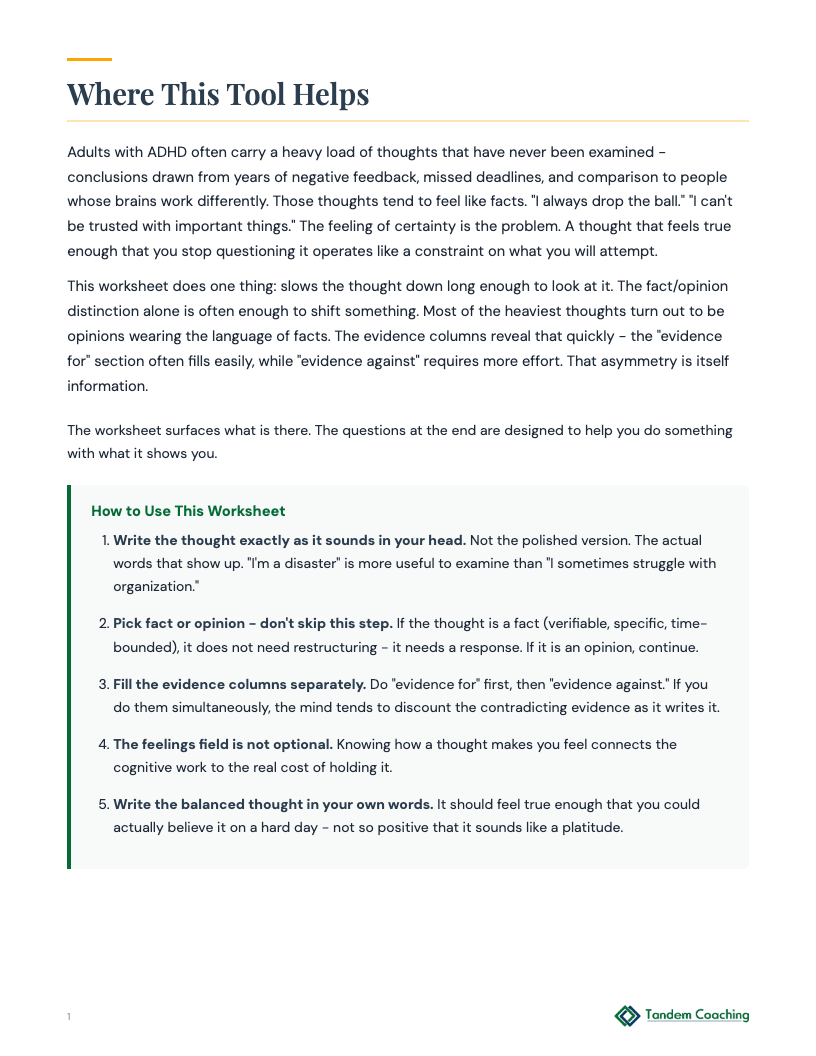
Separate observations, interpretations, and predictions, then write a more workable description in your own words.
Get This Tool
Free, print-ready PDF.
When to Use This Tool
ADHD adult who reacts to situations based on assumptions rather than facts
A client who struggles to separate what actually happened from the story they made it mean
Person who wants a structured way to examine automatic thoughts before acting on them
How to Introduce This Tool Plus
What part of this thought is observable, what part is interpretation, and what wording feels more workable to you?
Coaching Tool Disclaimer
This tool is designed for coaching contexts, not clinical use. If you or your client is in crisis, contact the 988 Suicide and Crisis Lifeline (call or text 988) or Crisis Text Line (text HOME to 741741).
Browse All Pages
Tool Classification
Domain
ADHD
Type
Worksheet
Phase
Reflection
Review
Details
15 min
Between sessions
As-needed
Topics
Mindset
Emotions
Resilience
For the Coaching Practitioner
Plus
Coaching Scenarios
Plus
1 Senior developer passed over for promotion believes they lack leadership potential ▶
Context
A senior software engineer with 8 years experience was passed over for a team lead role for the second time. They're convinced they 'don't have what it takes' to lead and are considering leaving tech entirely. HR suggested coaching after the client mentioned feeling like a fraud in leadership conversations.
How to Introduce
Frame this as examining one specific thought rather than general self-doubt. 'You mentioned feeling like you don't have leadership potential. Let's look at that exact thought - where it comes from and whether it holds up to scrutiny.' Expect resistance to the fact/opinion distinction. Many clients treat career conclusions as objective assessments rather than interpretations of limited data.
What to Watch For
The evidence-for column often fills with feedback from one manager or comparison to extroverted colleagues. Watch whether they can generate evidence-against or if they dismiss their technical mentoring, code reviews, and project ownership as 'not real leadership.' Speed through the feelings section usually means they're avoiding the emotional cost of the belief.
Debrief
Start with what they wrote in evidence-against - most clients surprise themselves with what they know but don't count. Ask: 'What would need to be true about leadership for this evidence to matter?' This often reveals they're measuring against a narrow definition that excludes their actual strengths. The balanced thought should acknowledge both the feedback they received and the leadership they already demonstrate.
Flags
Coaching scope: do not diagnose, interpret symptoms, or recommend treatment. Adapt or stop for distress and use licensed health or emergency support when appropriate.
2 Marketing director with ADHD believes they are fundamentally disorganized and unreliable ▶
Context
A marketing director diagnosed with ADHD at 35 runs a team of six but constantly apologizes for being 'scattered' and 'unreliable.' They've built systems that work but still carry shame from decades of feedback about being disorganized. Recent 360 feedback was positive, but they focus on the one comment about 'inconsistent follow-through.'
How to Introduce
Position this as examining the gap between current reality and old conclusions. 'You mentioned feeling fundamentally disorganized, but you're running a department successfully. Let's examine that specific thought - I'm fundamentally disorganized - and see what it's based on.' ADHD clients often resist this because the thought feels protective - if they accept they're capable, they fear losing accommodations or understanding.
What to Watch For
ADHD clients typically flood the evidence-for column with examples from childhood, school, or early career - often decades old. The evidence-against section may include recent successes but dismissed as 'luck' or 'my team carrying me.' Watch for language that makes current competence temporary and past struggles permanent. They may rush through the balanced thought to avoid sitting with cognitive dissonance.
Debrief
Start with the timeline in their evidence. 'I notice most of your evidence-for is from before you had systems and diagnosis. Most evidence-against is recent. What do you make of that pattern?' Then ask: 'What would your team say about your reliability?' This often surfaces that their internal narrative hasn't updated to match their external reality.
Flags
Coaching scope: do not diagnose, interpret symptoms, or recommend treatment. Adapt or stop for distress and use licensed health or emergency support when appropriate.
3 Operations manager who missed a critical deadline thinks they cannot handle pressure ▶
Context
An operations manager missed a vendor contract renewal deadline that cost the company a preferred rate. They've handled dozens of similar deadlines successfully but are now convinced they 'fall apart under pressure' and are considering stepping back from high-stakes projects. The miss happened during a week when their child was hospitalized.
How to Introduce
Frame this as separating one incident from a pattern conclusion. 'You missed one deadline under extraordinary circumstances, but you're drawing a conclusion about your ability to handle pressure generally. Let's examine that thought specifically.' Clients often resist because the recent failure feels more real than past successes, and examining the thought feels like minimizing the impact.
What to Watch For
Look for whether they include the hospitalization context in their evidence or treat the miss as happening in a vacuum. Many clients will list the recent failure multiple times in different ways while struggling to recall previous successes. If they minimize past successes as 'easier' or 'different,' they're protecting the negative conclusion from contradicting data.
Debrief
Start with the context they included in evidence-for. 'You mentioned your child was hospitalized the week you missed the deadline. How does that context change what the miss means about your ability to handle pressure?' Then move to their track record: 'What does your history with deadlines actually show?' The balanced thought should account for both the real miss and the exceptional circumstances.
Flags
Coaching scope: do not diagnose, interpret symptoms, or recommend treatment. Adapt or stop for distress and use licensed health or emergency support when appropriate.
4 Project manager believes they are bad at managing people after difficult team conversation ▶
Context
A project manager had to address performance issues with a popular team member. The conversation went poorly - the employee became defensive and accused them of micromanaging. Now they're convinced they're 'bad at managing people' and are avoiding necessary conversations with other team members. This is their first management role after 6 years as an individual contributor.
How to Introduce
Position this as examining a conclusion drawn from limited data. 'One difficult conversation has led you to conclude you're bad at managing people. That's a big conclusion from one data point. Let's look at that thought and what it's actually based on.' New managers often resist because they expect to be naturally good at people management and interpret any difficulty as evidence they're not 'management material.'
What to Watch For
New managers typically have thin evidence for being 'bad' at management - often one or two difficult interactions. They may struggle with the evidence-against column because they don't yet recognize routine positive interactions as management skills. Watch for perfectionist language - 'good managers don't have difficult conversations' or 'people should respond well if you're doing it right.'
Debrief
Start with their definition of good management embedded in the evidence. 'Your evidence suggests good managers never have difficult conversations or defensive responses. Where did that definition come from?' Then ask: 'What would your other team members say about your management?' This often reveals they're discounting daily positive interactions while amplifying the one negative experience.
Flags
Coaching scope: do not diagnose, interpret symptoms, or recommend treatment. Adapt or stop for distress and use licensed health or emergency support when appropriate.
Tool Flow
Plus
Requires
- identified recurring automatic thought pattern
→
Produces
- fact-vs-opinion verdict on target thought
- evidence-weighted reframe statement
- balanced replacement thought in client's words
Pairs Well With
ADHD
Feeling Context and Support Notes
Use this framework to structure a conversation about emotions and mindset while keeping interpretation with the client.
Why it pairsAfter the worksheet shifts a thought's meaning, this framework addresses the emotional charge that cognitive reframing alone leaves unresolved.
WellnessSituation and Response Log
A client wants to use Situation and Response Log as an optional reflection
Why it pairsTracking which situations keep firing the original thought pattern shows whether the worksheet's reframe is transferring to real life.
LifeEmotional Response Pattern Map
Client reacts in ways they later regret but cannot identify what triggered the response
Why it pairsMapping the full trigger-to-behavior chain shows your client exactly where to insert the replacement thought the worksheet produced.
Related Articles


ADHD Coaching Certification: Which Path Actually Counts
Read article →
Getting to 85 - Agile Metrics with ActionableAgile Part 1
Read article →
Coaching - It’s more than just asking questions
Read article →
Definition of Done – More Than a Checklist
Read article →