Procrastination Pattern Explorer
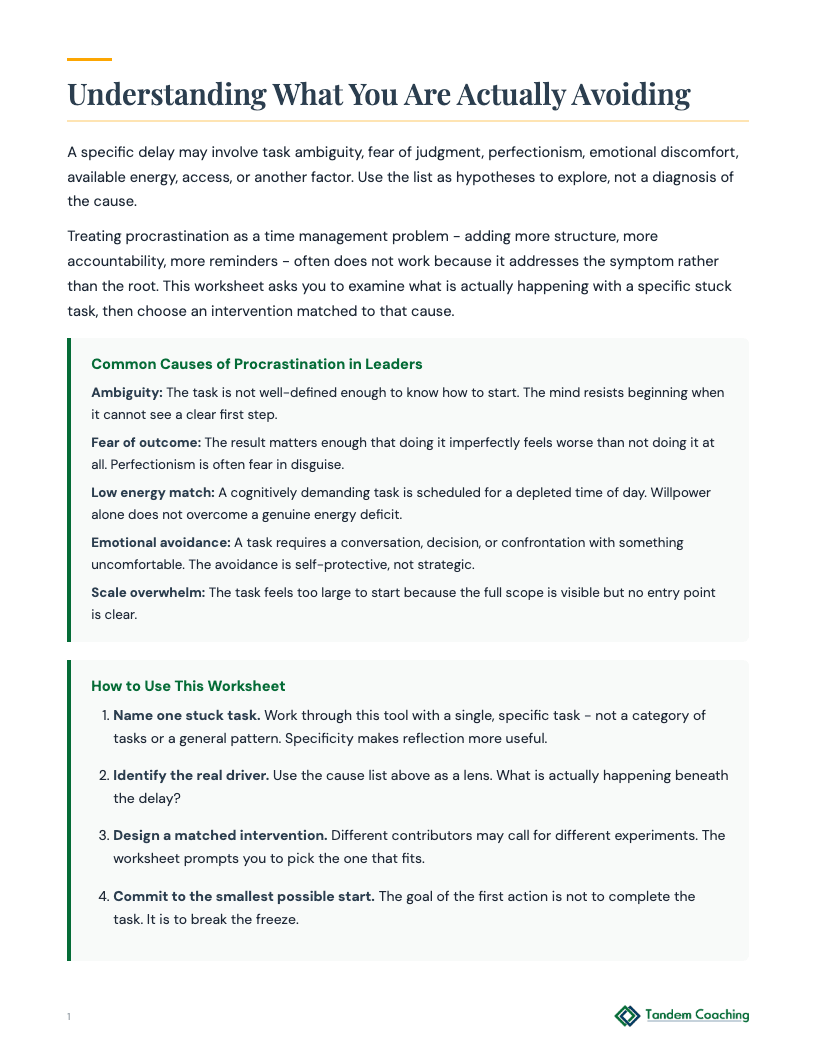
Stop delaying a specific high‑value task with a structured, evidence‑based worksheet that pinpoints blockers and turns them into a clear next step.
Get This Tool
Free, print-ready PDF.
When to Use This Tool
A client keeps putting off a specific task or project despite knowing it matters
Diagnosing the real reason for the delay — fear, overwhelm, perfectionism, or something else
Matching the right intervention to the actual cause of stalling
How to Introduce This Tool Plus
What may be contributing to this specific delay, and what is one small experiment that would give you useful information?
Coaching Tool Disclaimer
This tool is designed for coaching contexts, not clinical use. If you or your client is in crisis, contact the 988 Suicide and Crisis Lifeline (call or text 988) or Crisis Text Line (text HOME to 741741).
Browse All Pages
Tool Classification
Domain
Executive
Type
Worksheet
Phase
Action
Details
15 min
Mid session
As-needed
Topics
Mindset
Time Management
Executive Function
For the Coaching Practitioner
Plus
Coaching Scenarios
Plus
1 Executive avoiding a strategic decision that has been deferred for months ▶
Context
A senior leader has a significant decision sitting on their desk - a restructuring call, a vendor relationship to end, a direct report performance conversation - that has been repeatedly deferred. The delay is now creating downstream problems. When asked why, they say they're 'waiting for more information.'
How to Introduce
Frame the root cause diagnosis as the primary output of the exercise, not the action step. 'Before we talk about what to do, let's figure out what is actually causing the delay - because waiting for more information and fear of a bad decision look identical from the outside but respond to completely different interventions.' The four-category diagnosis (fear, overwhelm, perfectionism, unclear path) will often reveal that the stated reason and the actual reason are different things.
What to Watch For
If the client diagnoses the root cause as 'overwhelm' or 'unclear path' but the stakes of the decision suggest those explanations don't fully account for the delay duration, there may be a fear component being avoided. The worksheet's matched intervention section is only as useful as the root cause is honest. Also watch whether the scheduled first action actually addresses the decision or continues to orbit it. 'Research more options' is not a decision action.
Debrief
Start by asking whether the root cause they identified was what they expected to find or a surprise. Surprises are the more useful data. Then focus on the matched intervention: does the intervention they selected address what they named as the cause? Some clients will diagnose perfectionism but select an overwhelm intervention because it feels less threatening. Name the mismatch if you see it. End with the specific first action - if they named day, time, and location, hold them to that specificity.
Flags
If the deferred decision involves a person - a difficult performance conversation, a difficult client relationship to end - and the delay pattern is long-standing across similar decisions, the avoidance may be more about interpersonal conflict tolerance than decision-making capacity. Severity: low. Note the pattern across decisions and explore whether there is a category of decision the client consistently avoids, and what that category has in common.
2 Entrepreneur stuck on one high-effort task that blocks everything else ▶
Context
A founder or self-employed professional has a specific task - a sales page, a proposal, a system they need to build - that they've been avoiding for weeks. It's not a difficult task technically, but it sits at the top of every weekly list, never gets done, and blocks other things from moving. They can articulate that it matters. They cannot start it.
How to Introduce
The task-specific nature of this scenario makes the root cause diagnosis more tractable than a general procrastination pattern. 'What specifically happens when you sit down to do this?' often produces more useful data than the worksheet prompts alone. Use that answer to pre-orient the diagnosis. Entrepreneurs who have been self-employed for a while often know intellectually why they're avoiding something but have not examined whether their working hypothesis is actually correct.
What to Watch For
The 'first action' section is where procrastination worksheets usually fail in practice. The client writes a first action that is still too large - 'write the sales page' instead of 'open a blank doc and write one sentence.' The diagnostic quality of the action is whether the client could conceivably start it in the next 15 minutes with no preparation. If not, it needs to be broken down further. Also watch whether day-time-location specificity is genuine or formulaic ('this week').
Debrief
Start with the root cause and ask: 'What would have to be true about this task for someone to avoid it for this long?' That framing often produces a more honest answer than asking the client to self-diagnose. Then focus the debrief on whether the matched intervention addresses the task specifically or just the general category of procrastination. End with a public commitment - ask what they will tell you at the next session and when the task will be done.
Flags
If the avoided task is consistently the type that involves putting their work in front of an audience for judgment - sales, pitching, proposals, publishing - and the pattern has repeated across multiple businesses or projects, the root cause may not be the specific task but exposure to evaluation. Severity: low to moderate. Name the pattern across contexts rather than treating each instance as separate.
3 Professional consistently abandoning long-horizon projects at the 60-70% mark ▶
Context
A client has a pattern of starting projects with high energy - a book, a certification program, a business development effort - reaching a point of significant investment, and then quietly stopping. The abandonment doesn't feel like failure to them; it feels like the project ran out of steam or circumstances changed. But the pattern repeats.
How to Introduce
This scenario requires naming the pattern before using the tool: 'The projects we've talked about share something - you start with real momentum and reach a point where forward progress stops. Let's look at one of them specifically and use this to understand what happens at that inflection point.' The 70% abandonment zone often represents the point where the work gets genuinely hard or the finish line gets specific enough to evaluate - both of which produce different root causes.
What to Watch For
The root cause diagnosis is most important here. Perfectionism and fear of completion often look like overwhelm or unclear path - clients with this pattern sometimes genuinely don't recognize that finishing is the threatening thing. If the client diagnoses 'unclear next steps' for a project that is clearly defined, probe whether the unclearity is about the work or about what finishing would mean. The matched intervention for fear of completion is very different from the intervention for unclear path.
Debrief
Start by asking what specifically changed at the 60-70% mark. Not in the external circumstances, but in the client's experience of the project. The shift from 'building something' to 'almost done with something' is significant - it changes what failure means because there is now something specific to fail at. Then explore the scheduled first action: is it directed at crossing the finish line, or does it loop the client back into earlier phases? Re-entering earlier phases is how the abandonment pattern perpetuates.
Flags
If the abandonment pattern has repeated across three or more meaningful projects over multiple years, and the client appears both aware of and frustrated by the pattern without being able to change it, the root cause may be structural enough to warrant exploration beyond this tool. Severity: moderate. Note the duration and breadth of the pattern and consider whether a more dedicated coaching focus on completion, exposure, or identity is warranted.
Tool Flow
Plus
Requires
- identified specific stuck task or project
→
Produces
- one specific delayed task
- possible contributing factors treated as hypotheses
- one small next-step experiment
Pairs Well With
Wellness
Event, Interpretation, and Options Log
Use this worksheet to explore mindset and emotions and turn the client’s observations into one optional next step.
Why it pairsUse this after diagnosing the root cause to give the first scheduled action a week cleared of competing emotional tension.
ExecutiveControl, Influence, and Context Notes
Use this framework to structure a conversation about leadership and mindset while keeping interpretation with the client.
Why it pairsWhen fear or overwhelm is the diagnosed cause, use Circle of Influence to separate the actionable from the noise feeding the avoidance.
LifeDistraction Context and Environment Options
Use this worksheet to explore time management and habits and turn the client’s observations into one optional next step.
Why it pairsOnce you've scheduled the first action, use this to build the environment conditions that let the client actually keep that commitment.
Related Articles


Context Switching Solutions: Save $3M in Executive Focus
Read article →
GTD for Executives: Adapt David Allen's System for Leadership
Read article →
Mastering Time Management and Productivity with Coaching
Read article →
Is Executive Coaching Right for You?
Read article →