Managing Anxiety: A Behavioral Mapping Worksheet
A client anxious about a specific goal or situation and wants a behavioral map
Get This Tool
Free, print-ready PDF.
When to Use This Tool
A client anxious about a specific goal or situation and wants a behavioral map
Identifying what to stop, start, and keep doing to feel less overwhelmed
Turning a diffuse feeling of anxiety into concrete behavior changes
How to Introduce This Tool Plus
In the context of what's making you most anxious right now, what are you doing that's making it worse — and what's one thing you're not doing that might help?
Coaching Tool Disclaimer
This tool is designed for coaching contexts, not clinical use. If you or your client is in crisis, contact the 988 Suicide and Crisis Lifeline (call or text 988) or Crisis Text Line (text HOME to 741741).
Browse All Pages
Tool Classification
Domain
Wellness
Type
Worksheet
Phase
Action
Reflection
Details
15 min
Mid session
As-needed
Topics
Emotions
Mindset
Accountability
For the Coaching Practitioner
Plus
Coaching Scenarios
Plus
1 Manager anxious about their first executive presentation to the board ▶
Context
A manager has been asked to present quarterly results to the executive team for the first time. They have the content but describe feeling paralyzed when they try to prepare. The anxiety is diffuse - they can't articulate exactly what they're worried about, which makes it harder to address. Previous prep sessions have produced minimal progress.
How to Introduce
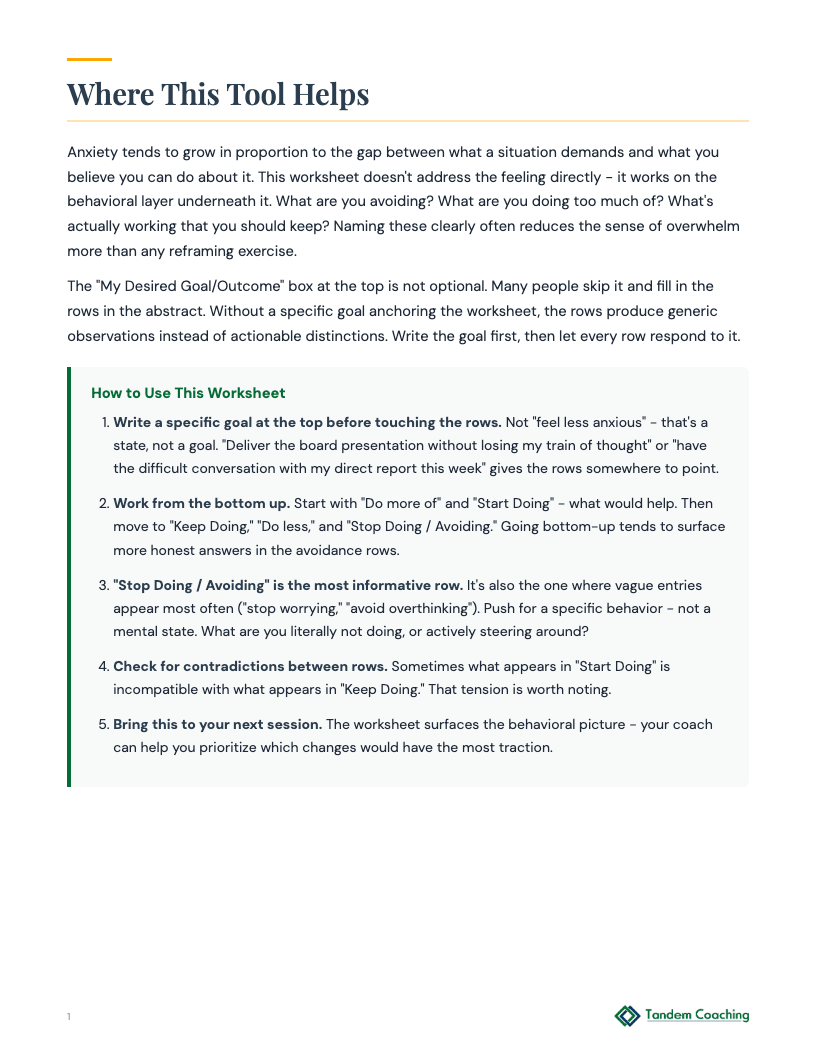
Position this as a behavior map, not a feelings exercise. 'The anxiety doesn't go away by thinking about it differently. Let's look at what you're doing that's making it worse, and what you could be doing that would help - both specifically, for this presentation.' Write the specific goal at the top together before handing over the worksheet. 'Not 'feel less anxious' - what's the outcome that would tell you this went well?' Starting bottom-up often works better with clients who are in activation: begin with 'Do more of' and 'Start Doing' before moving to the avoidance rows.
What to Watch For
The 'Stop Doing / Avoiding' row is the most informative here. Vague entries like 'stop worrying' or 'stop overthinking' indicate the client hasn't yet named the specific behavior. Push for something observable: 'What are you literally not doing that you're steering around?' Watch also whether the 'Keep Doing' row stays empty - clients who believe everything they're currently doing is part of the problem often miss what's already working. If the row is empty, ask directly: 'What have you done in the last week that helped, even slightly?'
Debrief
Start with the goal at the top. Ask: 'Does your behavioral map actually connect to this goal, or did you drift into general anxiety management?' Then move to the 'Stop Doing / Avoiding' row - not to discuss each item, but to identify which one has the most leverage. 'If you addressed this one behavior this week, what would be different by Friday?' Close by looking for contradictions between 'Start Doing' and 'Keep Doing' - items that require the same time or capacity create a planning conflict worth naming before the next session.
Flags
If the goal the client writes at the top is vague despite prompting - 'feel prepared,' 'not embarrass myself' - they may not yet have a clear enough picture of success to use behavioral planning productively. Severity: low. Spend more time defining the outcome before completing the rows. Also watch for 'Stop Doing / Avoiding' entries that describe physiological responses (stop my heart racing, stop sweating before I speak) - these signal that the anxiety is at a level where behavioral planning may not be the most useful intervention.
2 Director anxious about a performance conversation with a chronically underperforming direct report ▶
Context
A director has been avoiding a direct performance conversation for three months. The avoidance is costing the team - others are covering for the underperformer. The director can describe the situation clearly but becomes anxious when they think about having the conversation. They've identified the conversation as a goal but haven't moved toward it.
How to Introduce
Anchor this to the specific conversation, not to managing performance generally. 'Write 'have the performance conversation with [name] before [date]' at the top. Not the broader goal of managing the situation - that specific conversation.' Some clients in this position resist writing a specific date because it creates accountability. Name it: 'The goal needs a deadline or it will keep sliding. What's the latest date this can happen?' Once the goal is written, work through the rows together in session rather than sending as homework - the avoidance pattern tends to extend to the worksheet itself.
What to Watch For
The 'Stop Doing / Avoiding' row almost always reveals the real obstacle. Watch for entries like 'stop researching how to have difficult conversations' or 'stop waiting until the right moment' - these are avoidance behaviors disguised as preparation. Also watch the 'Keep Doing' row: clients who put reasonable management behaviors in 'Stop Doing' may be using the worksheet to talk themselves out of their current approach rather than into the conversation. The 'Start Doing' row should contain at least one item that looks like the actual conversation, not just preparation for it.
Debrief
Start with the 'Stop Doing / Avoiding' row. Ask them to read each entry and identify which one has been active the longest. That item is usually the core avoidance. Then move to 'Start Doing': 'What on this list would make the conversation happen, specifically this week?' If no item on the 'Start Doing' list actually initiates the conversation, the worksheet has mapped around the goal rather than toward it. Close by asking: 'What would you be able to say about this situation in your next session if you followed what you've written here?'
Flags
If the client's anxiety about the conversation is connected to fear of the direct report's emotional response, legal exposure, or broader team dynamics, the worksheet may surface complexity that requires more than behavioral mapping. Severity: moderate. Note what the 'Stop Doing / Avoiding' entries reveal about the underlying concern. If the client writes entries that suggest fear of retaliation, a legal question, or organizational political risk, those concerns should be addressed directly before the behavioral map becomes the focus.
3 New leader anxious about operating in a much larger organization after a promotion ▶
Context
A leader was recently promoted into a role at a significantly larger scope - more stakeholders, bigger budget, broader cross-functional dependencies. They describe feeling perpetually behind and anxious about not knowing what they don't know. The anxiety is real but diffuse, and they've been trying to address it through working longer hours, which is compounding it.
How to Introduce
Write the goal as the one thing that, if addressed, would reduce the anxiety most in the next 30 days. Help the client get specific before starting the rows - 'feel more in control' is too broad; 'have a working stakeholder map and first conversations scheduled with each key stakeholder by March 31st' is a goal the worksheet can respond to. Position the behavioral map as a way to see what they're doing that's making the overwhelm worse, which the client may not see because they're inside it.
What to Watch For
The 'Do Less Of' row is often the most important here. Clients who are anxious about not knowing enough tend to consume rather than prioritize - they read everything, attend every meeting, seek out every piece of context. Watch whether 'Do Less Of' entries are specific or vague. 'Do less of everything' means the client is overwhelmed but hasn't yet identified which activities are actually low-leverage. Also watch the 'Stop Doing / Avoiding' row for behaviors that look like avoidance of the harder work of building relationships: over-reliance on written communication, delaying one-on-ones, not raising questions in meetings.
Debrief
Start by asking them to look at the full map and identify which row has the most entries. That row is where their attention has been concentrated. Then ask: 'Which item in 'Stop Doing / Avoiding' have you been doing the longest?' This is usually the avoidance that has been most costly. Close by connecting the map to their stated goal: 'Does what you've written here actually address the outcome at the top? Or has the map drifted to general anxiety management?' If it's drifted, note that as useful data and identify one item from 'Start Doing' that directly connects to the goal.
Flags
If the goal the client writes describes outcomes outside their control - 'for my team to trust me,' 'for my manager to see that I'm capable' - they may be anchoring their anxiety in external validation rather than their own actions. Severity: low. Redirect: 'What's the behavior you control that most directly influences that outcome?' The goal needs to be in the client's own circle of action for the behavioral map to work.
4 Professional anxious about re-entering the job market after a layoff ▶
Context
A professional was laid off eight months ago after 12 years at one company. They've been in a job search but describe anxiety that's making it difficult to be consistent. They apply when they feel ready, withdraw when they feel overwhelmed, and attribute the inconsistency to the unpredictable nature of job searching. The pattern is recognizable but hasn't shifted despite several coaching conversations about mindset.
How to Introduce
Anchor this to a specific search outcome rather than the emotional state. 'Not 'feel less anxious about the search' - what's the concrete goal for the next four weeks? Three applications submitted, two conversations booked, first round interview secured?' Clients who have been in an extended search often resist specificity because specificity creates a target they can fail. Name that: 'Vague intentions have been running this search. A specific goal makes the behavioral map work.' Work through the rows together, starting with 'Do More Of' rather than 'Stop Doing' to generate forward momentum before surfacing avoidance.
What to Watch For
Watch the 'Stop Doing / Avoiding' row carefully. For clients in an extended search, this row often contains the most specific behavioral data - they know exactly what they're avoiding (certain company sizes, leadership roles, outreach to former colleagues, video interviews). If the entries are vague ('stop avoiding the search'), push for specifics. Also watch for a mismatch between 'Start Doing' and 'Keep Doing' - clients sometimes put the same behavior in both, which means they can't tell whether it's working or not.
Debrief
Start with the goal statement. After the rows are complete, ask: 'Does your behavioral map point toward this goal, or have you been solving for the anxiety rather than the search outcome?' Then identify the single 'Stop Doing / Avoiding' entry that would have the highest impact in the next two weeks. 'If you stopped doing this one thing, what would open up in your search?' Close by asking them to pick one specific 'Start Doing' item and schedule it before the next session.
Flags
Anxiety in a prolonged job search can mask grief, shame, or identity disruption that behavioral mapping won't address. If the client's 'Stop Doing / Avoiding' entries cluster around emotional exposure - avoiding conversations with former colleagues, not telling people about the layoff - rather than tactical search behaviors, the underlying experience may need direct attention. Severity: moderate. The behavioral map is still useful, but frame what it can and can't address.
Tool Flow
Plus
Requires
- specific goal or outcome generating the anxiety
→
Produces
- goal-anchored behavioral map with five categories
- specific avoidance behaviors named and listed
- prioritized behavior change list for anxiety reduction
Pairs Well With
Life
Selected Life Contexts and Options Review
Use this worksheet to explore mindset and emotions and turn the client’s observations into one optional next step.
Why it pairsSeparating fact from assumption about the goal lets you test whether the avoidance behaviors the map named are actually necessary.
WellnessSituation and Response Log
A client wants to use Situation and Response Log as an optional reflection
Why it pairsTracking triggers in real time shows which avoidance behaviors from the map actually activate under pressure, not just in reflection.
WellnessABC Model
A client reacting strongly to situations and wants to understand why
Why it pairsGetting to the belief driving a specific avoidance behavior the map surfaced gives you a lever for changing the response.
Related Articles

The Coaching Stance: What Changes When You Stop Facilitating and Start Coaching
Read article →
Managing Stress and Anxiety: Coaching Strategies for Leaders’ Well-Being
Read article →
ICF Core Competencies: Managing Client Focus, Session Time, and Relationship Completion
Read article →
The Hundred Dollar Trap: Why the Safe Choice Is the Dangerous One
Read article →