ABC Model
Understand why you react so strongly by mapping Activating events, Beliefs, and Consequences in a proven CBT framework used in wellness coaching.
Get This Tool
Free, print-ready PDF.
When to Use This Tool
A client reacting strongly to situations and wants to understand why
Tracing how a belief shapes the consequences you experience
Making sense of a specific incident that felt bigger than it should have
How to Introduce This Tool Plus
Walk me through one situation this week where your reaction surprised you — what do you think was actually happening beneath the surface?
Coaching Tool Disclaimer
This tool is designed for coaching contexts, not clinical use. If you or your client is in crisis, contact the 988 Suicide and Crisis Lifeline (call or text 988) or Crisis Text Line (text HOME to 741741).
Browse All Pages
Tool Classification
Domain
Wellness
Type
Framework
Phase
Reflection
Details
15 min
Mid session
As-needed
Topics
Mindset
Emotions
For the Coaching Practitioner
Plus
Coaching Scenarios
Plus
1 The client who fills in A and C but avoids committing to what they believed ▶
Context
Client can describe what happened (A) in factual detail and can describe the consequences (C) with clarity — often with significant emotion attached. When they reach the Beliefs & Behaviours box, the entry is thin: 'I felt like it wasn't fair,' 'I thought the situation was handled badly.' These are evaluations of A, not beliefs that explain C. The Beliefs & Behaviours box is the hardest to complete honestly because it requires the client to name the interpretation they applied — and that interpretation often reveals something they have not examined before. The client is solving for what to write rather than what they actually believed.
How to Introduce
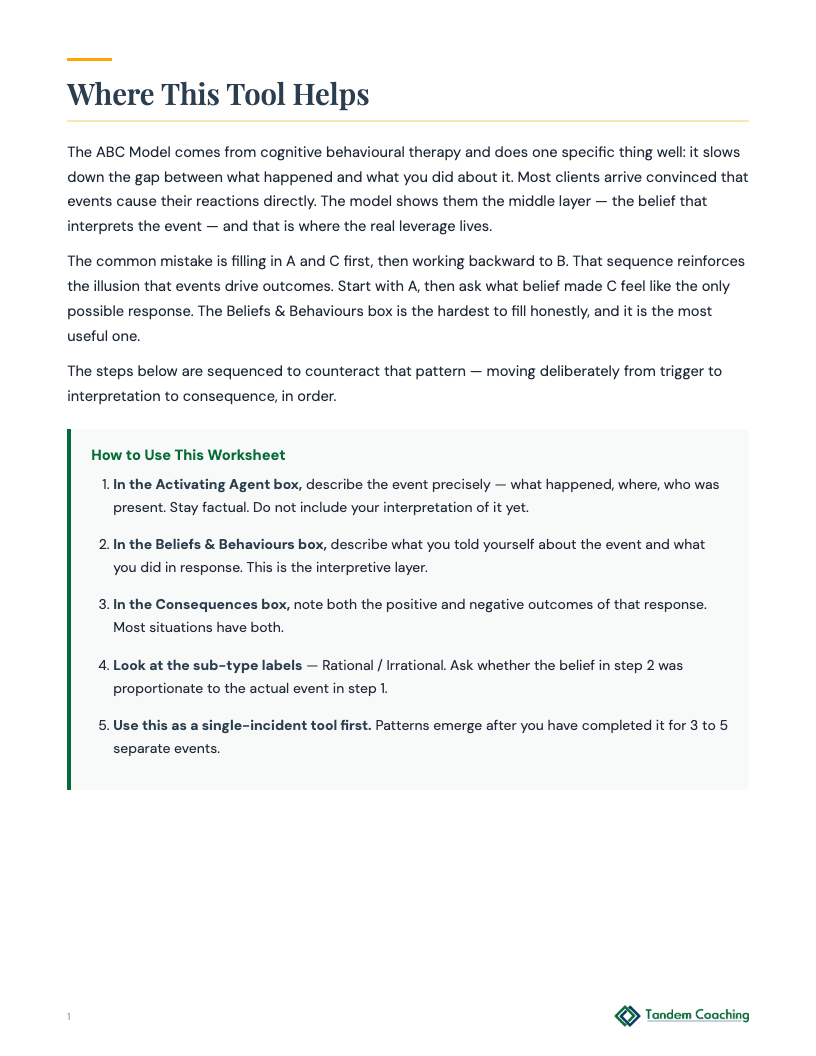
Frame the Beliefs & Behaviours box as the one that does the most work. 'A and C are relatively easy to fill in — what happened and what resulted. The B box is harder because it asks you to name the story you told yourself about A, before we knew what C would be. Not your evaluation of the situation — what you believed in the moment that made C feel like the only available response.' The resistance here is unfamiliarity with the distinction between evaluation and belief. Name it: 'An evaluation says the situation was unfair. A belief says something about you, or about people, or about what this kind of situation means — something automatic enough that you didn't choose it.'
What to Watch For
Watch the Beliefs & Behaviours box for entries that describe feelings rather than beliefs: 'I felt disrespected,' 'I was frustrated.' Feelings are consequences, not beliefs. Push: 'What did you believe about the situation — not how you felt, but what you told yourself about what was happening and what it meant?' Also watch for the box being left with only one item when the rational/irrational sub-type distinction has not been applied. The distinction is the leverage point: a rational belief is proportionate to A; an irrational belief is a fixed rule or catastrophic interpretation applied regardless of evidence.
Debrief
After all three boxes are complete, read the B box back to the client and ask: 'Is this belief proportionate to what actually happened in A — or does it apply a rule that would produce C in almost any situation that looked like this one?' That question locates the irrational belief without pathologizing it. Then use the post-tool prompt: 'Which belief in the B box do you hold most automatically — the one you rarely examine? What would change if that belief were slightly less fixed?' The question is genuinely open and does not require the client to abandon the belief.
Flags
- Low
Client fills in B with what they believed they should have done in the situation rather than what they believed about the situation — 'I should have spoken up sooner,' 'I shouldn't have reacted that way.' The self-judgment is in the B box, not the belief.
Response: Distinguish the two: 'What you've written in B is your judgment of your own response — that's actually a consequence, a secondary C. What I want in B is what you believed about the event itself, before you reacted. What did you tell yourself was happening when A occurred?' The redirect separates the interpretive belief from the post-hoc self-evaluation.
2 The client for whom the ABC sequence reveals a pattern across multiple incidents ▶
Context
Client brings a single incident to the session. When the ABC model is completed, the coach recognizes that the B entry — the belief — is not novel. The same belief has appeared in previous sessions in a different context, connected to different activating events and different consequences. The current incident is one data point in a pattern the client has not yet seen as a pattern. Used sequentially over 3-5 sessions, the ABC model is a pattern detector: the B box, completed honestly across multiple incidents, shows the client which beliefs are load-bearing in their reactions and which are specific to a context.
How to Introduce
Frame the single-incident use as the first in a sequence. 'We'll use this for one situation today. What makes it useful over time is that the B box tends to repeat — the same belief shows up across different activating events and produces similar consequences. We'll build up a record of it over the next few sessions so you can start to see the pattern rather than individual incidents.' The resistance from clients who want immediate insight is impatience with a sequential approach. Name it: 'One completed ABC tells you about one incident. Three or four completed ABCs, compared side by side, tell you which beliefs are structural — the ones that show up regardless of what A is. That's more useful than a single insight.'
What to Watch For
Watch for the B box beliefs being highly context-specific — tied to this particular person, this particular situation, this particular organization — in a way that will make cross-incident comparison difficult. Push for the belief at a level of generality that could apply elsewhere: not 'I believed my manager was dismissing me,' but 'I believed that not being heard means I am not valued.' Also watch for the client selecting the same activating agent type each session (all external A's, or all internal A's) without noticing the selection. If every A is external, the client is constructing a record that will not reveal internally-triggered beliefs.
Debrief
After the current incident's ABC is complete, place it alongside any previous completed ABCs and ask: 'What does the B box say this time compared to the last session? Is it the same belief or a different one?' If the same, name the pattern explicitly: 'This belief has now appeared in at least two distinct situations. That tells us it is active independent of the specific context — it is not about your manager or this team, it is a belief you carry into situations like this one.' The debrief should produce a named recurring belief, not just an analysis of the current incident.
Flags
- Moderate
Client's B entry is 'irrational' by their own assessment for every incident they bring — they consistently label their beliefs as disproportionate before examining them. The irrational label is applied automatically, not as a result of the rational/irrational distinction.
Response: Slow down the automatic labeling: 'You've marked this as irrational before we've looked at whether it's proportionate to A. What would make it a rational belief — what would have to be true about the situation for this belief to be proportionate?' The question opens the possibility that the belief is actually reasonable, which sometimes produces more useful insight than confirming the client's self-critical assessment.
3 The client who understands the model intellectually but resists applying it to themselves ▶
Context
Client has encountered CBT concepts before — through reading, therapy, or prior coaching — and can explain the ABC model accurately. When invited to apply it to a recent incident, they complete the tool with clinical detachment: the A is described in abstract terms, the B is labeled quickly as a cognitive distortion, the C is named without specificity. They are operating the model at arm's length. The intellectual mastery is genuine and also a defense against the self-examination the model is designed to produce. The tool's value comes from the specificity of application, not from being able to explain it.
How to Introduce
Frame the exercise as applied rather than theoretical. 'You know the model. What I want today is not an explanation of it but a specific incident — one where your reaction surprised you, or seemed bigger than the situation warranted. We'll apply it to that incident specifically, in first-person terms, not as a framework exercise.' The resistance here is the client's fluency: they can maintain intellectual distance by engaging with the model as an observer rather than a subject. Name it: 'The diagnostic value is in the B box filled in honestly about your own beliefs — not in analyzing the model. So I want you in the example, not the example described in the abstract.'
What to Watch For
Watch the A box for description at one remove: 'a situation where I felt my authority was undermined' rather than 'the Monday morning meeting where my manager interrupted me twice.' The more abstract A produces an abstract B that is harder to examine. Also watch for the B box containing terminology from CBT or coaching literature — 'catastrophizing,' 'awfulizing,' 'black-and-white thinking' — rather than the client's own language for what they believed. Labeling a belief correctly is not the same as examining it.
Debrief
After the tool is complete, ask the client to re-read the B box and replace any clinical terms with first-person language: 'Instead of catastrophizing — what specifically did you tell yourself would happen?' The question asks the client to drop the abstraction and name the belief as they actually experienced it. Then use the post-tool prompt: 'Which belief in that box do you hold most automatically — the one you don't choose, it just arrives?' The 'it just arrives' framing bypasses the intellectual register and asks for something more honest.
Flags
- Moderate
Client completes the ABC in under three minutes with polished entries in all three boxes. The quality is high and the emotional engagement is absent. The tool has been performed rather than used.
Response: Name the speed: 'You completed that very quickly and the entries are coherent. I want to go back to the B box — when you wrote that belief, were you naming something you actually experienced, or were you writing the correct answer? The useful entry is the one that's true, not the one that's well-formed.' The question creates permission to revise the B entry without suggesting the client was dishonest.
Tool Flow
Plus
Requires
- None - standalone tool
→
Produces
- single-incident A-B-C map of trigger, belief, and consequence
- rational vs irrational belief classification for one event
Pairs Well With
Wellness
Situation and Response Log
A client wants to use Situation and Response Log as an optional reflection
Why it pairsOnce you've mapped a single A-B-C incident, this log builds a two-week record so you can spot whether that same irrational belief keeps hijacking different triggers.
WellnessOptional Sensory Attention Walk
Use this worksheet to explore self care and mindset and turn the client’s observations into one optional next step.
Why it pairsAfter naming the emotional consequence in an A-B-C map, use this to give the client a body-based way to interrupt that consequence before it escalates.
WellnessEvent, Interpretation, and Options Log
Use this worksheet to explore mindset and emotions and turn the client’s observations into one optional next step.
Why it pairsUse this after the A-B-C model to move the client from classifying one belief to practicing alternative responses across multiple real friction points.
Related Articles


Sylvia Hewlett’s Executive Presence Model: What It Gets Right, Where It Falls Short
Read article →
Growth Mindset Coaching: A Practitioner's Guide to Facilitating Belief-Level Shifts
Read article →
Executive Presence in Virtual Meetings: Where the Gaps Get Harder
Read article →
The GROW Model in Coaching: A Practitioner’s Guide to Sessions That Actually Move Forward
Read article →