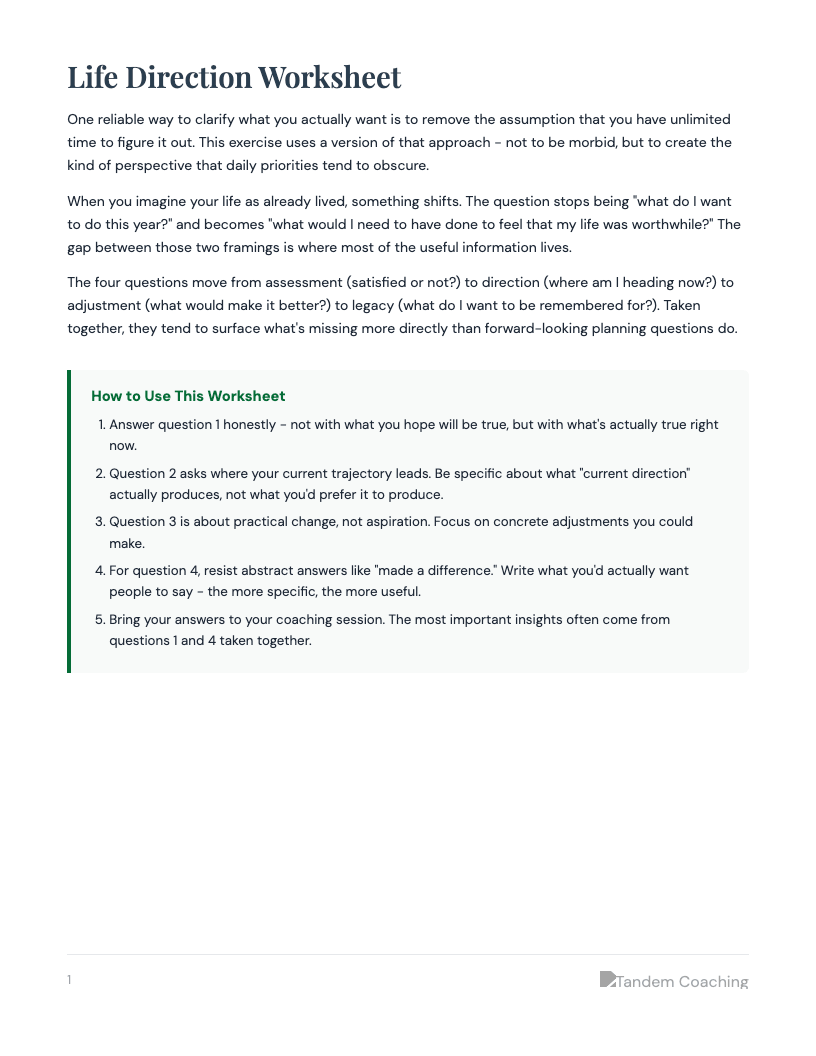
Legacy Reflection

Pathway Builder 🔒
Domain
Life Coaching
Type
Worksheet
Phase
Discovery Reflection
Details
15 min Mid session
Topics
Values Identity

Coaching tools for personal clarity and intentional living.

When to Use This Tool
A client at a crossroads questioning whether the life they're living is the one they want
Exploring legacy and what actually matters beyond day-to-day urgency
Stuck in inertia and needing a long-view perspective shift
How to Introduce This Tool

If you imagine looking back on your life from the very end of it, what would you most want to be true about how you lived?

Download This Tool

Free PDF - print-ready, professionally formatted

Download Free PDF
Preview Worksheet · 15 min

For the Coaching Practitioner

Coaching Scenarios Plus
1 Executive at a crossroads who has not named what she actually wants
Context

A chief marketing officer is being recruited for a CEO role at a smaller company. She is well-qualified, financially secure, and externally appears to be on an obvious upward trajectory. Internally she is uncertain in a way she hasn't been before. She says she doesn't know what she wants, but in practice she's asking a deeper question she hasn't articulated.

How to Introduce

'These four questions work at a different timescale than the choice in front of you. They're asking: from the end, looking back, what mattered? I want you to read all four before you answer any of them. Then answer question 1 honestly - not the answer you'd like to give, but the one that's true if you're being direct with yourself.' The instruction to read all four first reduces the tendency to answer each in isolation.

What to Watch For

Question 1 answers that are 'mostly yes' without the exception - the client who can't name what is absent from her sense of satisfaction is often the one who hasn't examined it. The useful answer is specific: 'Yes, except for...' Watch for question 4 (what would I like to be remembered for?) to stay at the role level - 'a strong leader,' 'someone who built great teams' - rather than reaching qualities and impact that go beyond professional identity.

Debrief

Start with question 3 - the how-can-I-be-happier-today question. 'Read me what you wrote. Which of these could you do this week?' That question makes the long-view exercise immediately practical. Then: 'Looking at your answer to question 4 - does the role you're being recruited for move you toward or away from that?'

Flags

A client who answers question 1 with an unqualified 'yes' - she would be fully satisfied - while simultaneously being in a real decision about whether her current path is right may be defending against the exercise rather than engaging with it. Severity: low. Don't challenge the answer directly. Ask: 'If you could change one thing about how your answer to question 4 will read when the time comes, what would it be?' That second question often surfaces what question 1 didn't.

2 Leader who is productive but persistently dissatisfied without knowing why
Context

A COO at a professional services firm has been successful by every metric he cares about. He is not burned out, not looking to leave, not in conflict. He is mildly but persistently dissatisfied in a way he can't name. It's been present for two years. He describes it as a low-level 'what's this for?' that surfaces mostly on weekends.

How to Introduce

'These questions are designed to be uncomfortable in a useful way. They use a long-view lens to see what the day-to-day makes invisible. Start with question 2 - are you satisfied with the direction of your life right now - and be honest rather than charitable.' The instruction to be honest rather than charitable is the important one. Many leaders default to gratitude and positivity as a first response.

What to Watch For

Question 2 answers (direction of life) that answer the professional direction question without touching the personal one. The persistent low-level dissatisfaction he describes usually lives in the personal-relational domain, not the professional one - but leaders tend to assess direction in career terms. Watch for question 4 (what would I like to be remembered for?) to have entries that are already happening - he's already on course for them - versus entries that feel absent from his current life.

Debrief

'Looking at your answer to question 4 - which items on that list are you currently building toward, and which aren't present at all in your week?' That mapping question produces a specific diagnosis of the gap. Then: 'What's one thing from the absent column that you could make present this month?' That keeps the long-view exercise from staying abstract.

Flags

A client who answers all four questions with articulate, well-considered responses and reports no new information afterward - 'I knew all of this' - may be using articulateness as a way to process without being changed by the processing. Severity: low. Ask: 'What's the answer in here that you most wish were different?' That question asks for contact rather than reporting.

3 Client avoiding a decision by staying in analysis
Context

A senior manager at a consumer goods firm has been deciding whether to leave corporate life and start a consulting practice for fourteen months. She has done comprehensive analysis - financial modeling, market research, conversations with consultants. The analysis keeps expanding. She has framed the delay as 'not having enough information' when the information she actually lacks is clarity about what she wants.

How to Introduce

'These questions don't add more information about the consulting question. They change the frame entirely. The question isn't whether consulting makes sense - you've been analyzing that for over a year. The question is what kind of life you're trying to build. Start with question 2: are you satisfied with the direction of your life right now? Not 'is the analysis complete.' The direction question.' Naming the distinction explicitly reduces the chance she analyzes the worksheet.

What to Watch For

Answers to question 3 (how can I be happier today?) that are entirely future-dependent: 'once I make this decision,' 'when I'm finally doing work I care about.' Present-tense answers are more useful - what is available to change right now, regardless of the big decision. Watch for question 1 to be answered with a qualifier that points directly at the stuck decision: 'I would be satisfied except for this one thing I haven't resolved.'

Debrief

Start with question 3 - what specific changes would help right now. 'Which of these is independent of the consulting decision?' That question identifies what she can do now versus what she's holding hostage to a future choice. Then: 'What would need to be true for you to be satisfied with question 1 if you stayed in your current role?' That question tests whether the dissatisfaction is about the role or about the undecided question.

Flags

A client who completes question 1 and 2 with significant emotion - not sadness exactly, but recognition - and then rushes through questions 3 and 4 may be protecting herself from the specificity of what those questions require. Severity: low. Slow down: 'Let's spend the rest of the session on question 3. What specifically would help?'

Tool Flow
Requires
  • None - standalone tool
Produces
  • long-view life satisfaction assessment
  • legacy statement beyond roles and titles
  • named specific happiness-gap actions

Pairs Well With

Life

Values Clarification Worksheet

A client making decisions that feel off but can't say why

30 min Assessment
Life

Values Hierarchy Builder

My client says they know what they value but their choices don't reflect it

30 min Assessment
Life

Ikigai Discovery

A client feels successful but unfulfilled and wants to understand why

45+ min Framework

Related Articles

Transformational Coaching Skills: Powerful Coaching Questions to Ask Clients

Transformational Coaching Skills: Powerful Coaching Questions to Ask Clients

Read article →
Benefits of Leadership Development Programs - Unveiled for Corporates

Benefits of Leadership Development Programs - Unveiled for Corporates

Read article →
Life Coach Certification Online: What to Know Before You Enroll

Life Coach Certification Online: What to Know Before You Enroll

Read article →
Executive Transition Runway Calculator | How Long Can You Really Last?

Executive Transition Runway Calculator | How Long Can You Really Last?

Read article →
Certified Life Coach: What It Means & Why It Matters (2025)

Certified Life Coach: What It Means & Why It Matters (2025)

Read article →
7 Tried-and-True Change Management Activities (+ Best Tips)

7 Tried-and-True Change Management Activities (+ Best Tips)

Read article →