See how others experience your leadership with a structured, evidence-based inventory that pinpoints strengths and blind spots for executive impact.
Free, print-ready PDF.
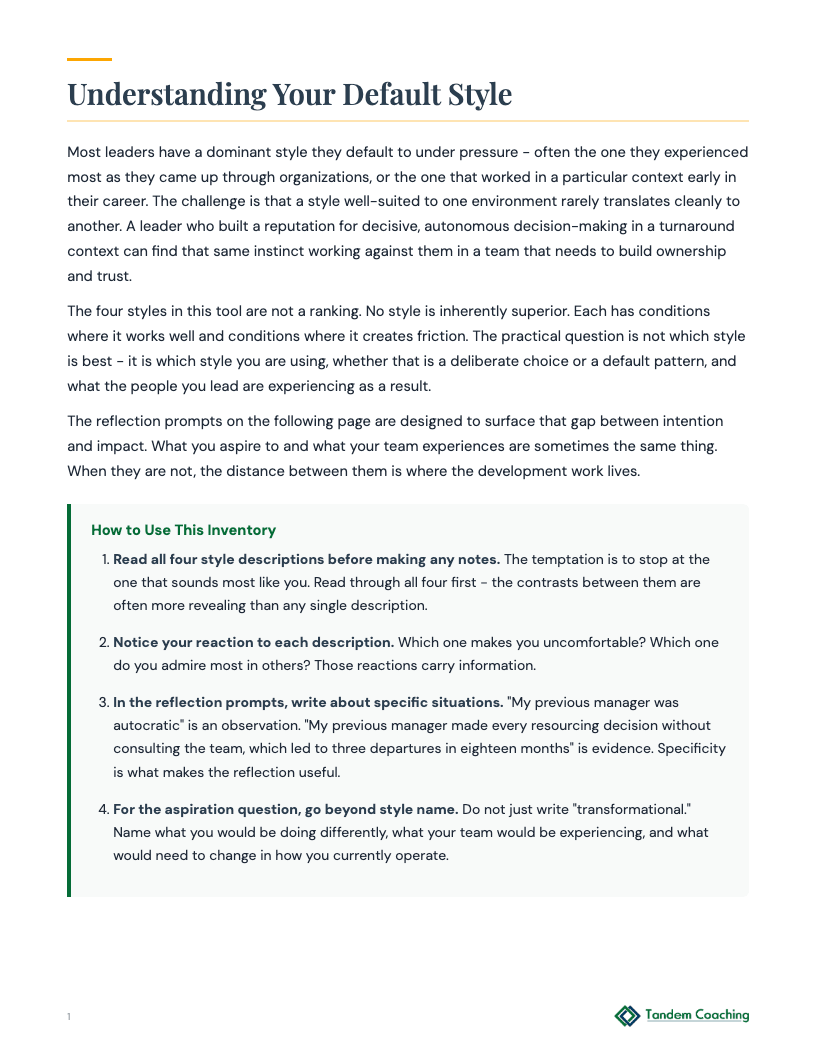
Looking at the four styles you explored — which one felt most familiar, and which felt like territory you almost never enter?
A newly promoted engineering director is managing former peers who now report to them. The team dynamic has shifted awkwardly - some former colleagues are testing boundaries while others have become overly deferential. The client believes they need to be more authoritative but feels uncomfortable with the change.
Frame this as a calibration tool, not a personality assessment. 'Before we work on team dynamics, let's map what leadership approach you're actually using versus what the situation might need.' Many new managers think they need to become more autocratic to establish authority. This tool shows them the range of options beyond command-and-control.
New managers often gravitate toward autocratic descriptions because they think that's what 'real leadership' looks like. If they dismiss democratic or transformational styles as 'soft,' they're performing what they think management should be rather than considering what works. Watch for language about 'respect' - usually means fear.
Start with the style they aspire to, then ask: 'What would your former peers notice if you led that way?' This surfaces the specific behavior changes needed. Then: 'Which of your current reports would respond well to that approach, and which might need something different?' Moves from one-size-fits-all thinking to situational leadership.
If the client can only see leadership through a dominance lens - 'they need to know who's in charge' - the identity shift from peer to manager may not be complete. Severity: moderate. Continue coaching but explore whether they're trying to solve a relationship problem with a power solution.
A marketing VP talks extensively about wanting to be more inspirational and vision-driven but consistently defaults to task-focused, directive management. Their team delivers results but shows little initiative. The client says they want to develop transformational leadership but their behavior suggests they don't trust their team's judgment.
Present this as a gap analysis tool. 'You've mentioned wanting to be more transformational. Let's see what that actually looks like in practice and what might be getting in the way.' Expect resistance to acknowledging their current autocratic tendencies - they'll want to focus only on aspiration, not current reality.
Watch for idealized descriptions in the aspiration section - vague language about 'inspiring people' without specific behaviors. If they can't name what they'd stop doing differently, they're not ready to change. Also notice if they describe transformational leadership as something they do TO people rather than WITH people.
Start with the gap between current and aspired style. Ask: 'What would you have to give up to lead transformationally?' This surfaces the control they're unwilling to release. Then: 'Tell me about a time when someone on your team surprised you with their capability.' This connects aspiration to evidence that trust might be warranted.
If the client cannot identify any situations where their team has shown good judgment, the issue may be hiring/team composition rather than leadership style. Severity: low. Continue with leadership development but consider whether the team capability assessment is accurate or defensive.
An operations director joined a startup that was recently acquired by a larger company. The existing team is used to high autonomy and informal decision-making. The parent company expects more structure and accountability, but the client's attempts to implement processes are met with resistance and complaints about 'corporate bureaucracy.'
Frame this as a culture translation challenge. 'You're bridging two different operating styles. Let's map what leadership approach this team is used to versus what the new environment requires.' The client may assume they need to impose autocratic structure, but the tool shows other options for maintaining autonomy within accountability.
Look for binary thinking - either complete autonomy or rigid control. If they can't see democratic or structured transformational approaches as viable, they're missing the middle ground where this transition usually succeeds. Also watch for language that demonizes either the startup culture or corporate requirements.
Start with laissez-faire: 'What's working well about how this team currently operates?' Then move to aspiration: 'How could you preserve those strengths while adding the structure the parent company needs?' The question that opens this up: 'What would accountability look like if the team designed it themselves?'
If the client shows contempt for either the startup's 'chaos' or the corporation's 'bureaucracy,' they may be caught in a loyalty conflict that coaching alone won't resolve. Severity: moderate. Explore whether they're the right cultural bridge for this transition or if the role expectations are realistic.
A department head prides themselves on collaborative leadership and team input on decisions. However, their inclusive approach has allowed underperformers to slow down projects and avoid accountability. The client is reluctant to become more directive because they see it as abandoning their values, but their high performers are getting frustrated.
Present this as a situational leadership exercise. 'Collaborative leadership works well with capable, motivated people. Let's look at what happens when you apply the same approach to everyone regardless of their performance level.' Frame different styles as tools for different situations, not character judgments.
Democratic leaders often conflate being directive with being mean. If they can't distinguish between autocratic decision-making and autocratic communication style, they'll resist necessary performance management. Watch for language about 'treating everyone fairly' when they mean 'treating everyone identically.'
Start with their democratic aspirations: 'What outcomes is collaborative leadership supposed to produce?' Then ask: 'Which team members are you getting those outcomes with, and which ones aren't?' This creates permission to differentiate approach by person. Follow with: 'What would democratic leadership look like with someone who isn't contributing democratically?'
If the client cannot name specific performance issues or insists that 'everyone is trying their best,' they may be conflict-avoidant in ways that extend beyond leadership style. Severity: moderate. Continue coaching but assess whether performance management skills need development alongside leadership flexibility.
Client is at a decision point and hasn't done a candid inventory of their strengths and gaps
ExecutiveI want to see my business situation clearly before I decide on next steps
ExecutiveClient is spending significant energy on things they cannot change