Leadership Development Plan
Define your leadership approach for your new executive role with a structured plan grounded in proven leadership competencies and measurable goals.
Get This Tool
Free, print-ready PDF.
When to Use This Tool
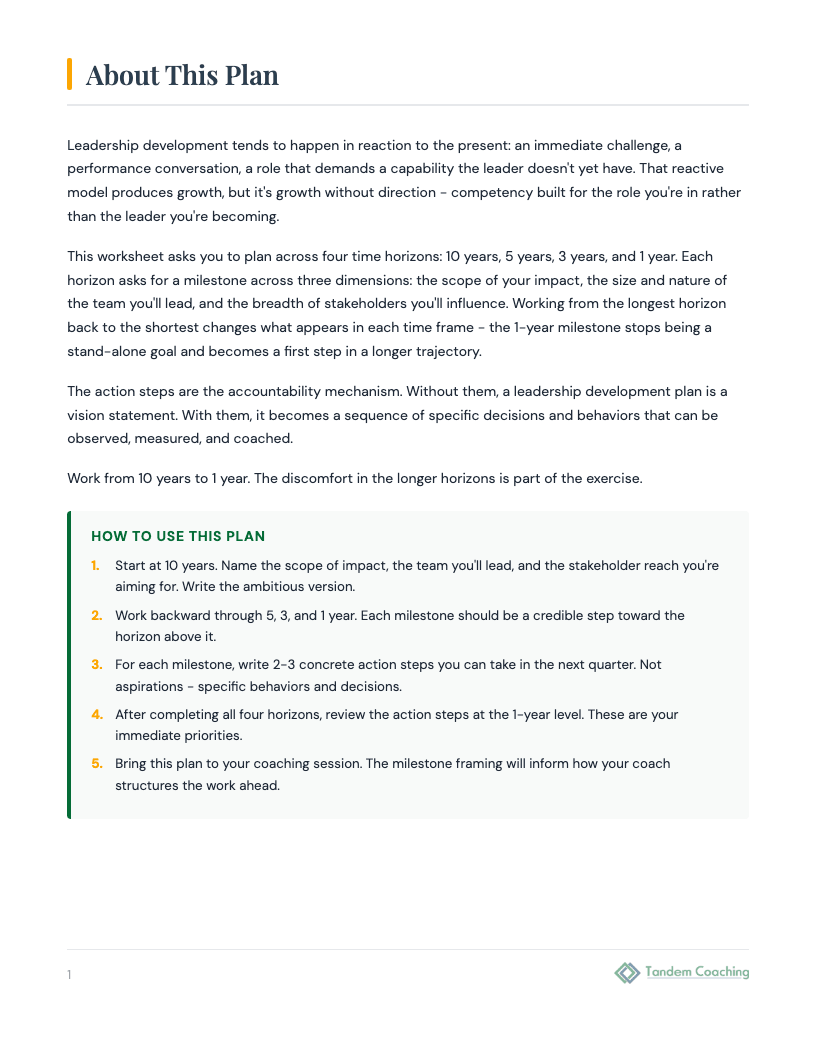
A leader who's been promoted but hasn't yet defined what their leadership looks like at the new level
Someone who wants to grow as a leader but has no structured plan for how
A client whose 360 feedback identified development gaps they now need to address
How to Introduce This Tool Plus
This plan works best when it's built around something real — a challenge you're currently in or a gap that's been named for you. What's the leadership situation you most want to work on right now?
Browse All Pages
Tool Classification
Domain
Executive
Type
Planner
Phase
Goal Setting
Action
Details
45+ min
Between sessions
Monthly
Topics
Leadership
Accountability
For the Coaching Practitioner
Plus
Coaching Scenarios
Plus
1 The newly promoted VP who is managing her former peers and losing authority by the week ▶
Context
A 39-year-old VP of engineering at a software company was promoted six months ago from principal engineer. Three of her four direct reports were her peers before the promotion. One has stopped attending her team meetings. Two route major technical decisions around her to her own manager. She is technically excellent and personally liked — but she hasn't defined what her leadership looks like at this level, so her authority is being filled in by the people who report to her. She came to coaching because her manager told her the team dynamic needs to change. The Leadership Development Plan produces a structured four-horizon map from now through 12+ months, giving her a framework for what she is actively developing and a way to make her leadership arc visible to herself and her manager.
How to Introduce
Frame this as defining what the role actually is before trying to do it better. 'You were promoted six months ago. What I want to understand first is: what does VP of Engineering look like when you're doing it well? Not what it looks like at your company in general — what it looks like for you. The plan we're building asks you to identify leadership milestones at four horizons: this week, this quarter, six months, twelve months. The immediate horizon forces you to name what you're working on right now. The twelve-month horizon forces you to picture what it looks like when the transition is complete.' Name the consumes section explicitly: 'This tool works best when you bring something specific — a named gap, a piece of feedback, a situation that isn't working. You mentioned the team dynamic. I want that to be the anchor for what we build here.'
What to Watch For
Watch for the immediate priority section to focus on technical goals rather than leadership behavior changes — if her three immediate priorities are all delivery milestones, she's still operating as a principal engineer. The immediate section needs at least one explicitly relational or authority-related action: a conversation she's been avoiding, a boundary she needs to set, a dynamic she needs to address directly. Also watch for the 12-month milestone to be aspirational but nonspecific — 'be a strong leader' cannot be worked toward. Push for behavioral specificity: what would she be doing differently in meetings, in decisions, in how she handles disagreement from her reports?
Debrief
Start with the immediate priorities. 'You wrote three priorities for this quarter. Read them to me.' Then: 'Which of these is most directly related to the team dynamic your manager flagged?' If none are, that's the signal — the plan is avoiding the real work. Then move to the 12-month milestone: 'If you achieved everything on this plan, what would be different about how your team experiences you?' Let her describe it specifically. Then: 'Looking at the gap between where you are now and that description — which of your four horizons has the biggest jump?' That question often reveals where the plan is underspecified. Close with: 'What's the first conversation on this plan that you've been putting off?'
Flags
- Moderate
Client's quarterly action steps are entirely self-directed — reading, reflection, goal-setting, attending training — with no actions that require her to do something different in an actual leadership situation with her team. The plan is development theater: structured self-improvement with no behavioral change in the room.
Response: Name the pattern. 'You've built a development plan that happens inside your head and in courses. Leadership development at the VP level happens in rooms — specific conversations, specific decisions, specific moments where you do something different than you have been. Where on this plan do I see you doing something differently with [specific report who is routing around her]? That question redirects the plan from internal preparation to external behavior.
2 The COO who has 360 feedback that named five development gaps and is treating them all as equally urgent ▶
Context
A 51-year-old COO at a healthcare services company received 360 feedback four months ago that identified five leadership development gaps: strategic communication with the board, developing his direct report bench, managing his own reactivity in conflict, delegating at the right altitude, and executive presence in ambiguous situations. He printed the report, shared it with his CEO, and has been 'working on all five.' He has no structure, no sequence, no milestones, and no way to tell whether he's making progress. His coaching engagement was initiated by the board. The Leadership Development Plan takes his five named gaps and converts them into a sequenced four-horizon map with quarterly action steps — giving him both a structure and a way to report progress to the board.
How to Introduce
Frame this as sequencing before action. 'You have five named gaps. Working on all five simultaneously usually means making minimal progress on each while feeling like you're doing a lot. The plan we're building asks you to pick: which of these five has the highest leverage, meaning which one, if you improved it, would most directly affect the others? That becomes the immediate priority. The remaining four get distributed across the horizons.' The 12-month section is important here: 'In twelve months, the board who initiated this coaching engagement will assess whether the gaps have moved. I want you to write the 12-month milestone in language specific enough that a board member could recognize whether it happened or not.' That framing makes the milestone concrete and auditable.
What to Watch For
Watch for the 360 feedback to be translated into the plan at the same level of abstraction it was written — 'improve strategic communication with the board' is a diagnosis, not a development action. Push for specificity: what behavior would strategic communication look like in the next board meeting, and what would it have looked like in the last one that it didn't? Also watch for the reactivity gap to be buried in the later horizons — clients often sequence their most personally uncomfortable development work to the furthest horizon. If the board specifically named reactivity, it belongs in the immediate quarter, not in the 12-month plan.
Debrief
Start with the sequencing choice: 'You identified the highest-leverage gap as [X]. Tell me why — what makes that the right starting point?' The reasoning matters as much as the choice. Then go to the immediate quarter: 'Your quarterly action steps for [highest-leverage gap] — where in this quarter will you actually do these? What calendar events or leadership situations are you already committed to where these show up?' Mapping to existing situations tests whether the actions are real or theoretical. Close with: 'You mentioned the board will assess this in twelve months. Does the 12-month milestone you wrote match what they said they would look for — or is it what you'd like them to look for?'
Flags
- Low
Client's four-horizon plan has strong specificity in the immediate quarter and becomes progressively vaguer at each subsequent horizon, with the 12-month milestone being essentially a restatement of the 360 feedback theme rather than a description of what changed. The plan cannot be assessed at completion because the endpoint isn't defined.
Response: Continue — address the endpoint first. 'Your immediate quarter is specific enough to work with. Your 12-month milestone is too close to the original feedback to serve as a completion criterion. I want you to write the 12-month version as a story, not a goal: 'In twelve months, when [board member] sees me in a board meeting, what will she observe that she didn't see twelve months ago?' That exercise usually produces the behavioral specificity the milestone needs.
3 The technical founder who was asked to step into the CEO role by his board and isn't sure he wants to ▶
Context
A 44-year-old founder of a Series B SaaS company built and ran the product organization for ten years. His board has asked him to take on the CEO role following the departure of the professional CEO they hired three years ago. He is technically brilliant and culturally trusted by the team. He has never managed a full executive team, has minimal board relationship experience, and is genuinely uncertain whether leading the company as CEO matches who he wants to be. He is six weeks into the role. He came to coaching because the board required it. The Leadership Development Plan is introduced as a tool for defining what his version of the CEO role looks like before he decides whether to own it — building toward a decision point, not assuming the decision is made.
How to Introduce
Frame this as definition work, not development work. 'You've been handed a role you didn't seek. Before we build a development plan, I want to understand what you'd be developing toward — what does the CEO role look like when you're doing it in a way that matches your values and strengths, not a generalized version of what CEOs are supposed to do? The four-horizon map we're building can serve two purposes: either it's the plan for a CEO you're committed to becoming, or it's the diagnostic that tells you what that role would require and helps you decide whether you want it.' Name the consumes section: 'This tool works best with named gaps. What do you already know the role requires that you don't currently have, and what does your team or board see in you that would need to be different?'
What to Watch For
Watch for the 12-month milestone to be shaped entirely by board expectations — what the board wants to see — rather than by his own picture of what he'd need to accomplish to feel he'd succeeded. If the milestone language mirrors the board's language and not his, the plan is being built to satisfy an external audience rather than to anchor his own development. Also watch for the immediate priority section to be all external-facing actions (board management, executive team meetings, investor calls) with nothing that develops his internal leadership capacity. The role requires both, but if none of the immediate actions involve developing his own leadership repertoire, the plan is reactive management, not intentional development.
Debrief
Start with the ambivalence: 'You described being uncertain whether this role matches who you want to be. After completing this plan — did the horizon map clarify that or complicate it?' Let him answer fully. Then: 'Looking at your 12-month milestone — is that a milestone that, if you achieved it, would tell you that you'd become the leader you want to be? Or is it a milestone that would tell you that you'd satisfied the board?' The distinction is important and he may not have surfaced it yet. Then go to the immediate priorities: 'Your first-quarter actions — which of these are you genuinely motivated to take, versus which feel like requirements?' Close with: 'What would it take for this plan to feel like yours rather than something you were handed?'
Flags
- Moderate
Client's plan is technically sound but emotionally uninvested — he completed the four horizons competently and in detail, but his energy when discussing it is flat. The plan reads like a job description he wrote for himself, not a development arc he's committed to. The ambivalence about the CEO role hasn't been resolved by the planning exercise; it's been documented around.
Response: Step back from the plan. 'You've built a complete leadership development plan for the CEO role. I want to ask you directly: when you read it, do you feel pulled toward it or obligated to it?' The distinction matters because a plan built from obligation tends to produce compliance, not development. 'If you were building a development plan for a role you genuinely wanted — not this role, but any role — what would it look like?' That question can surface what's missing from the current plan and make the ambivalence workable rather than buried inside a competent document.
Tool Flow
Plus
Requires
- named leadership development gaps or 360 feedback results
- executive presence dimension scores
→
Produces
- four time-horizon leadership milestone map
- quarterly action steps per horizon
- identified immediate leadership development priorities
Pairs Well With
Life
Decision Evidence and Options Grid
Use this framework to structure a conversation about accountability and time management while keeping interpretation with the client.
Why it pairsOnce the milestone map surfaces a deferred leadership choice, this framework gives your client a structured path to resolve it.
LifeSWOT Analysis (Guided)
A client wants to use SWOT Analysis (Guided) as an optional reflection
Why it pairsUse this to verify your client's personal strengths actually support each milestone priority before locking in the quarterly action steps.
ExecutivePESTLE Context Scan
Use this framework to structure a conversation about leadership and accountability while keeping interpretation with the client.
Why it pairsThe milestone map needs external context - PESTLE surfaces broader forces that could accelerate or stall each leadership horizon.
Related Articles


Leadership Development Tools: What Works and How to Choose
Read article →
Executive Coaching Cost: What You’ll Pay by Credential Level, Engagement Type & Pricing Model
Read article →
Executive Presence Coaching: What It Develops and How It Works
Read article →
12 Executive Presence Exercises by Gap Type
Read article →