Client Audience Evidence and Hypotheses Map
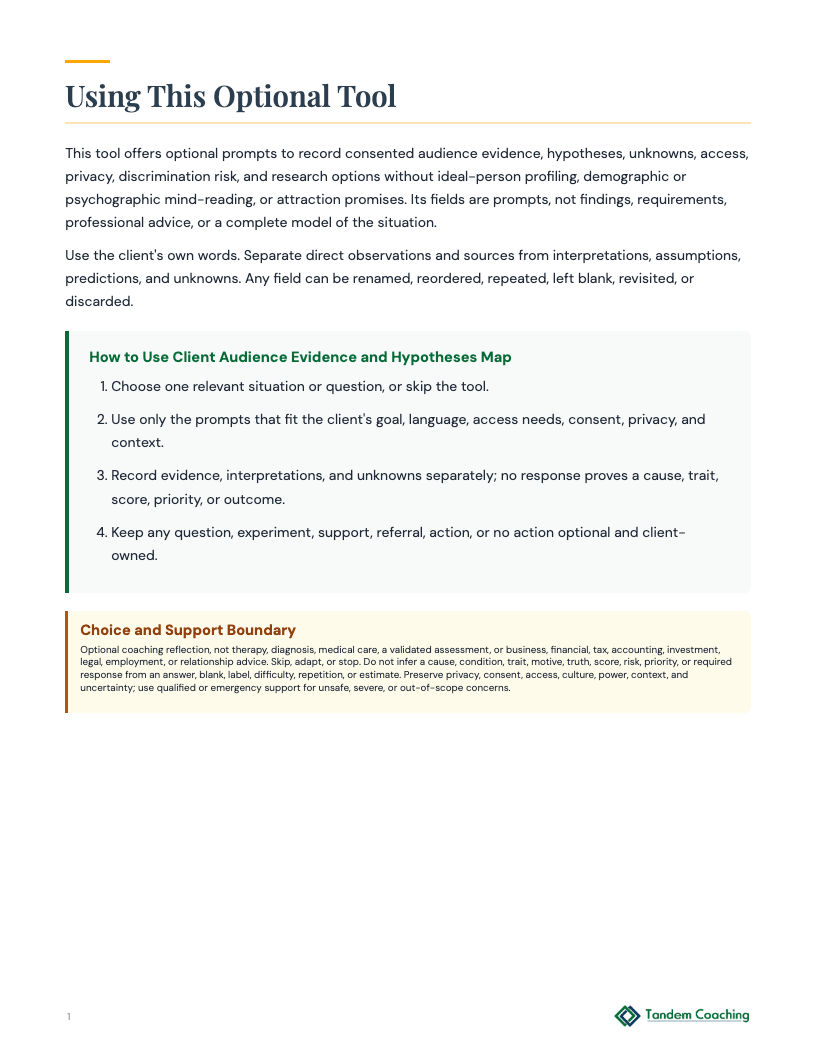
Use client audience evidence and hypotheses map as an optional, client-owned tool while separating observations, sources, interpretations, assumptions, and unknowns.
Get This Tool
Free, print-ready PDF.
When to Use This Tool
A client is considering Client Audience Evidence and Hypotheses Map for one current situation
A client wants to separate observations, interpretations, assumptions, and unknowns
A client wants to preserve choice, consent, privacy, access, culture, power, and context
How to Introduce This Tool Plus
What is directly observed, what remains interpreted or unknown, and which optional question, support, referral, experiment, or no next step feels useful?
Coaching Tool Disclaimer
This tool is designed for coaching contexts, not clinical use. If you or your client is in crisis, contact the 988 Suicide and Crisis Lifeline (call or text 988) or Crisis Text Line (text HOME to 741741).
Browse All Pages
Tool Classification
Domain
Coach Practice
Type
Worksheet
Phase
Discovery
Details
45+ min
Between sessions
As-needed
Topics
Identity
For the Coaching Practitioner
Plus
Coaching Scenarios
Plus
1 Client choosing an optional use of Client Audience Evidence and Hypotheses Map for context 1 ▶
Context
A client brings a situation related to Client Audience Evidence and Hypotheses Map. Confirm their words, direct observations, sources, interpretations, assumptions, unknowns, goal, consent, privacy, access needs, culture, power context, and preferred scope.
How to Introduce
Offer the tool as optional. Explain its limited job, distinguish it from nearby tools, and confirm language, access, consent, privacy, and scope.
What to Watch For
Keep observations client-owned. Do not infer diagnosis, cause, hidden motive, fixed trait, score, truth, risk, priority, or outcome from an answer, blank, label, estimate, difficulty, repetition, or another person's reported behavior.
Debrief
Ask what is directly observed, what remains interpreted or unknown, and whether one optional question, support, referral, experiment, or no next step would be useful.
Flags
Not therapy, diagnosis, medical, business, financial, tax, accounting, investment, legal, employment, or relationship advice. Adapt or stop for distress or risk; use qualified or emergency support when appropriate.
2 Client choosing an optional use of Client Audience Evidence and Hypotheses Map for context 2 ▶
Context
A client brings a situation related to Client Audience Evidence and Hypotheses Map. Confirm their words, direct observations, sources, interpretations, assumptions, unknowns, goal, consent, privacy, access needs, culture, power context, and preferred scope.
How to Introduce
Offer the tool as optional. Explain its limited job, distinguish it from nearby tools, and confirm language, access, consent, privacy, and scope.
What to Watch For
Keep observations client-owned. Do not infer diagnosis, cause, hidden motive, fixed trait, score, truth, risk, priority, or outcome from an answer, blank, label, estimate, difficulty, repetition, or another person's reported behavior.
Debrief
Ask what is directly observed, what remains interpreted or unknown, and whether one optional question, support, referral, experiment, or no next step would be useful.
Flags
Not therapy, diagnosis, medical, business, financial, tax, accounting, investment, legal, employment, or relationship advice. Adapt or stop for distress or risk; use qualified or emergency support when appropriate.
3 Client choosing an optional use of Client Audience Evidence and Hypotheses Map for context 3 ▶
Context
A client brings a situation related to Client Audience Evidence and Hypotheses Map. Confirm their words, direct observations, sources, interpretations, assumptions, unknowns, goal, consent, privacy, access needs, culture, power context, and preferred scope.
How to Introduce
Offer the tool as optional. Explain its limited job, distinguish it from nearby tools, and confirm language, access, consent, privacy, and scope.
What to Watch For
Keep observations client-owned. Do not infer diagnosis, cause, hidden motive, fixed trait, score, truth, risk, priority, or outcome from an answer, blank, label, estimate, difficulty, repetition, or another person's reported behavior.
Debrief
Ask what is directly observed, what remains interpreted or unknown, and whether one optional question, support, referral, experiment, or no next step would be useful.
Flags
Not therapy, diagnosis, medical, business, financial, tax, accounting, investment, legal, employment, or relationship advice. Adapt or stop for distress or risk; use qualified or emergency support when appropriate.
Tool Flow
Plus
Requires
- None - standalone tool
→
Produces
- client-owned observations and sources
- interpretations, assumptions, and unknowns
- an optional question, support, referral, experiment, or no next step
Pairs Well With
Coach Business
Coaching Session Checklist
Coach wants a structured post-session reflection habit to accelerate their development
Why it pairsChoose this checklist for a different angle on identity; use it only if that separate job fits the client.
Coach BusinessCoaching Approach Evidence and Options Map
Use this framework to structure a conversation about identity and creativity while keeping interpretation with the client.
Why it pairsChoose this framework for a different angle on identity; use it only if that separate job fits the client.
Coach BusinessOptional Client Feedback and Use-Consent Notes
Use this checklist to review communication and accountability without assuming every item applies.
Why it pairsChoose this checklist for a different angle on identity; use it only if that separate job fits the client.
Related Articles


Reflective Practice in Coaching Supervision for Growth
Read article →
Ethical Practice in Coaching: What ICF Competency 1 Really Requires
Read article →
ICF Exam Sample Questions: Free Practice Test with Answer Explanations
Read article →
Applying the ICF Coaching Competencies in Practice
Read article →