Coaching Session Checklist
Build a consistent post-session reflection habit with a structured checklist that helps you spot patterns, capture learnings, and improve faster.
Get This Tool
Free, print-ready PDF.
When to Use This Tool
Coach wants a structured post-session reflection habit to accelerate their development
Coach is working on specific presence or communication skills and needs a way to track patterns across sessions
Coach is preparing for supervision and wants concrete observations to bring rather than general impressions
How to Introduce This Tool Plus
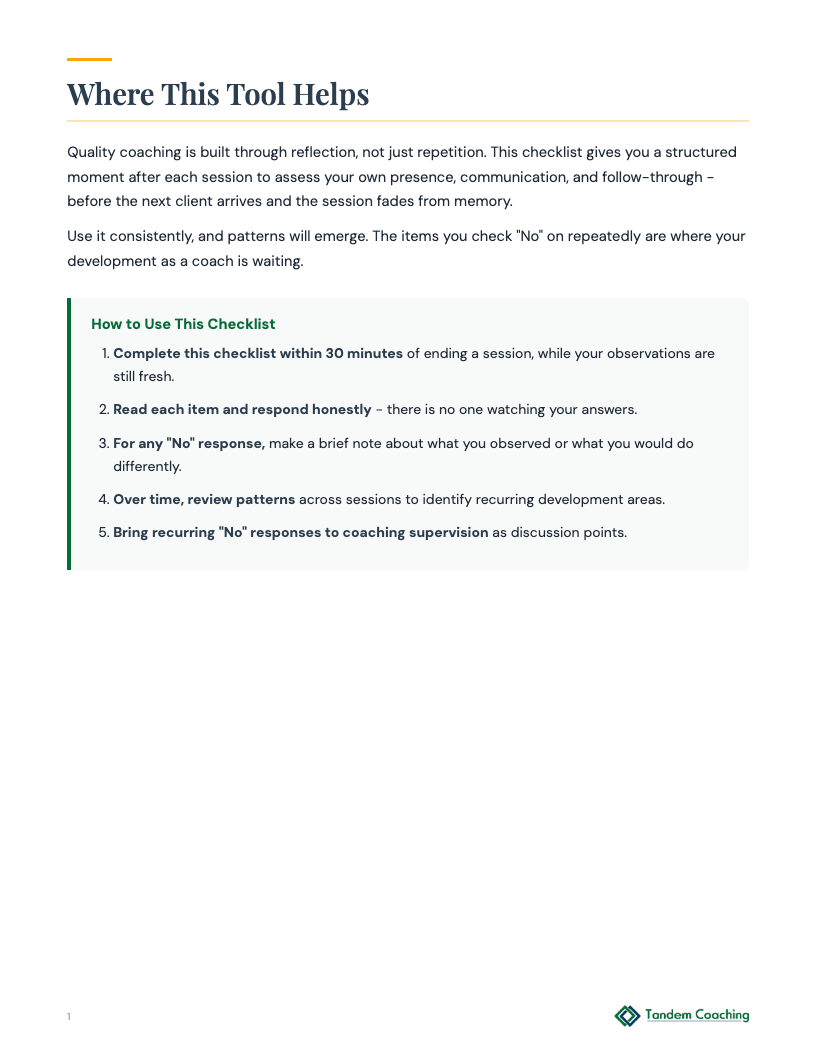
There's an eight-item post-session checklist designed to be completed within 30 minutes of a session — it tracks the patterns that tell you where your coaching development is actually waiting. Would that be useful to build into your practice?
Browse All Pages
Tool Classification
Domain
Coach Practice
Type
Checklist
Phase
Reflection
Review
Details
5 min
Closing
Weekly
Topics
Accountability
Mindset
Identity
For the Coaching Practitioner
Plus
Coaching Scenarios
Plus
1 New coach who wants to build post-session reflection into her practice from day one ▶
Context
A recently certified coach has her first two paying clients and wants to establish good practice habits before patterns form. She is not sure what to track after sessions or how to use the information.
How to Introduce
Frame this as calibration infrastructure for the first year. 'New coaches tend to remember what they did well and forget the moments where they weren't fully present or where follow-through slipped. This checklist creates a consistent record that tells you where to focus your development across sessions, not just within them.' Walk through each item once and ask what each question is actually checking - some items will feel immediately relevant and others will surface as areas where she doesn't yet have a clear answer.
What to Watch For
Watch how she responds to item 08 - the follow-up item. New coaches often don't yet have a systematic practice for following up between sessions. If she marks 'No' on this item consistently, explore whether that is a gap in her practice model or a deliberate choice. Also watch item 04 - presence. New coaches often report feeling present in session but describe being focused on their own notes, next question, or anxiety about performance rather than on the client.
Debrief
After three to four sessions of use, ask her to look at her 'No' pattern. 'Which item has come up most consistently?' Then: 'Is that a skill gap, a habit gap, or something about how you're structuring sessions?' The distinction matters. A skill gap goes to supervision; a habit gap gets addressed in how she sets up her pre-session routine.
Flags
If the coach is completing the checklist but not reviewing it across sessions, the data is accumulating without any learning loop. Severity: low. Set a brief review practice - once every two to three weeks, look back at the last eight to ten checklists and note what patterns are visible.
2 Coach preparing for ICF credentialing who needs structured observation records for supervision ▶
Context
A coach working toward her ACC credential is preparing for credentialing and needs substantive material to bring to coaching supervision. Her supervisor has asked for specific observations rather than general impressions. Her session notes are narrative but not structured around the competencies she is being evaluated on.
How to Introduce
Reframe the checklist as both a practice tool and a supervision preparation tool. 'Your supervisor is asking for observations - this checklist gives you eight categories of observation per session, each producing a Yes or No with a note. After ten sessions, you have eighty data points instead of impressionistic memories.' Have her map the eight items to the ICF competencies she is focused on and identify which items are most directly relevant to her current credentialing goals.
What to Watch For
Watch whether she treats 'Yes' as neutral and only takes notes on 'No' responses. Both are worth capturing. A consistent 'Yes' on item 05 - nonjudgmental response - tells her something about her strengths. A consistent 'Yes' on item 04 that she can't substantiate with a specific example may indicate she is marking what she intends rather than what she observed. Ask her to describe a moment in the session for any item she marks 'Yes' at least once a week.
Debrief
Before a supervision session, have her identify the checklist item with the most 'No' responses in the past month. 'What do you think is driving that pattern?' Her hypothesis before supervision often reveals more than the pattern itself. If she can't generate a hypothesis, that is itself useful information for the supervision conversation.
Flags
If the coach is using the checklist to produce documentation for credentialing review but finds herself answering in ways she thinks look credentialing-appropriate rather than accurately, surface that directly. Severity: moderate. A checklist that produces performance rather than observation has inverted its purpose. The value is in accurate documentation, not favorable documentation.
3 Experienced coach whose practice has become routine and wants to sharpen focus ▶
Context
A coach with six years of practice finds that her sessions follow a comfortable rhythm. She rarely has sessions that go poorly, but she also rarely has sessions that feel exceptional. She wants to re-introduce intentional development without starting over from foundational competencies.
How to Introduce
Introduce this as a way to surface the margin of excellence rather than baseline competencies. 'At six years, items like warmth and confidentiality are operating below awareness. What isn't is the edge - whether you're at 85% presence or 95%, whether the communication is landing or just adequate. The checklist gives you a place to ask those questions explicitly rather than assuming the answer is yes.' Suggest she use the Notes field not for 'No' explanations but for 'where this could have been better' observations even when the answer is technically 'Yes.'
What to Watch For
Watch whether she marks all items 'Yes' without nuance after several sessions. An experienced coach who checks all boxes may be using the checklist to confirm competence rather than find edges. Introduce a harder version of the question: not 'Did I maintain presence?' but 'Was there a moment where I lost presence - however briefly - and what did I do with it?' That version produces learning where the binary version may not.
Debrief
After a month of use, ask: 'Which item gives you the most useful information session-to-session?' That item is worth deepening. 'Which item feels like the least useful question for where you are in your development?' That item may need to be replaced with a more advanced prompt. Coaches at six years often benefit from customizing the checklist rather than using it as-issued.
Flags
If the coach uses the checklist to prepare supervision topics and her supervisor is consistently finding more growth edges than the checklist is capturing, consider whether the checklist's eight items are calibrated for new coach development and not for advanced practice development. Severity: low. This is an invitation to add items, not to abandon the tool.
Tool Flow
Plus
Requires
- completed coaching session within past 30 minutes
→
Produces
- post-session self-evaluation record with yes/no ratings
- identified recurring gaps in presence or follow-through
- concrete observations ready for supervision discussion
Pairs Well With
Coach Business
Response Options Builder
Use this worksheet to explore identity and mindset and turn the client’s observations into one optional next step.
Why it pairsAfter flagging a recurring gap in how you explore client choices, this gives you a bounded structure to correct it next session.
Coach BusinessUnique Value Proposition Builder
A coach whose elevator pitch sounds like every other coach's
Why it pairsRecurring checklist strengths give you behavior-level evidence to replace vague claims with a UVP grounded in what you actually do.
Coach BusinessCoaching Approach Evidence and Options Map
Use this framework to structure a conversation about identity and creativity while keeping interpretation with the client.
Why it pairsPatterns your checklist surfaces across sessions become the repeating-process evidence this tool needs to name and map your methodology.
Related Articles


The ICF Coaching Mindset: Competency 2 and the Work Between Sessions
Read article →
Coaching Supervision Models: How They Actually Work in Practice
Read article →
Learning Loops in Coaching: Turn Every Session Into Skill Development
Read article →
How to Prepare for Coaching Supervision Sessions
Read article →