Turn a clear goal into a step-by-step plan with specific actions, timelines, and checkpoints, using a proven coaching framework for follow-through.
Free, print-ready PDF.
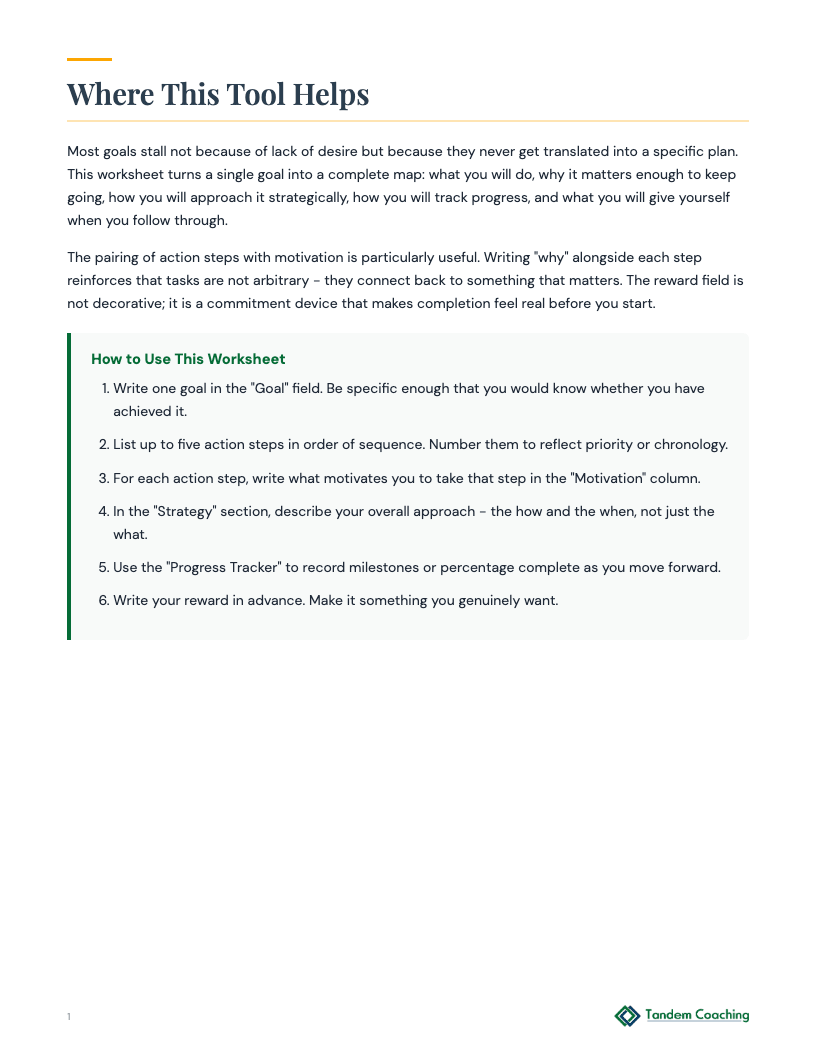
There's a goal planning worksheet that maps one goal into action steps paired with motivation, an overall strategy, a progress tracker, and a reward you commit to in advance — would it be useful to build that out for the goal we've been discussing?
Your client leaves every session with a specific action plan. They write it down. By the following session, they have completed zero to one of the items. The pattern has repeated across six sessions. They have not failed at anything - the between-session actions have simply not occurred. The problem is not the plan's content; it is that the plan has no motivational architecture. The worksheet's motivation column asks, for each action step, why this step matters - a question the client has not been asked to answer in writing for any of the plans that have been abandoned.
Frame this as adding motivation structure to the plan that is already there. 'The session plan you've built has the actions. What it doesn't have is the individual reasoning for each one - why each step matters on its own, not just why the goal matters overall. The motivation column on this worksheet adds that. When the action competes with other demands next Tuesday, the motivation for that specific action is what makes it survive the competition.' The resistance pattern: clients who have built and abandoned multiple plans sometimes experience a new planning structure as more of the same. Name that the difference is not the action list - it is the per-action motivation, which is different from generic commitment.
Watch the motivation column for each action step. If the motivation is identical for every step ('because I want to achieve my goal,' 'because this matters to my career'), it has not been worked. The useful motivation is specific to that action: 'because this step is the one that makes everything else possible' or 'because skipping this step is what I always do and the goal never advances.' Also watch the strategy section - if it is blank or generic, the client has a list of actions with no contingency thinking. Strategy in this context means: if this step doesn't happen as planned, what is the fallback?
At the start of the following session, ask the client to read the motivation for each action step before reporting on what happened. That reverses the usual sequence (what did you do? why didn't you?) and connects the accountability to the reasoning rather than the result. Then for any step that didn't happen, ask: 'Looking at the motivation you wrote - was it true when the moment came to act, or had something shifted?' That question often surfaces a motivation that wasn't fully owned at the time of writing. The reward field matters: ask whether the client will actually do what they wrote there, or whether they wrote something acceptable rather than something they will actually do.
If the client's between-session non-completion is consistent across six or more sessions regardless of plan structure, the issue is not plan architecture. Something is blocking execution in a more fundamental way - competing commitments, an ambivalence about the goal, or an anxiety the coaching has not yet surfaced. Severity: moderate. Response: complete the worksheet and add one direct question to the debrief: 'What is the actual thing that stopped you last time, not the practical reason but the real one?' If the motivation column is filled in honestly, this question should be easier to answer.
Your client is action-oriented and execution-competent. They complete the items they commit to. What they have never done is ask whether completing the items is producing the result. They have been taking action toward a goal for four months and the goal is not materially closer. The actions have been completed. The progress tracker on this worksheet has never been used because no tracking structure was in place. Without tracking, the client cannot distinguish between actions that are working and actions that are movement without progress.
Frame this as adding a feedback loop to a system that already works. 'You complete your actions - that part is working. What the worksheet adds is a progress tracker that asks whether the completions are producing movement. Those are different questions. The tracker closes the loop between effort and outcome.' The resistance pattern: action-oriented clients sometimes resist tracking because it feels like overhead on a process that is already running. Name that tracking for this client is not about accountability - it is about distinguishing high-return actions from low-return ones, which the current system cannot do.
Watch the progress tracker for entries that are activity-based rather than outcome-based. 'Had three networking conversations this week' is an activity entry. 'Three conversations, two of which produced specific next steps' is an outcome entry. The tracker is only useful if it measures something that changes when progress happens. Also watch whether the goal field is specific enough to be trackable. 'Improve my leadership presence' cannot be tracked. 'Receive unsolicited feedback from two direct reports that my communication style in meetings has changed' can be.
After two to three weeks of tracker data, ask: 'Looking at the actions that got done versus the progress entries - which actions are clearly connected to movement and which are you less sure about?' That question produces the evaluation the client has not had a structure for. Then ask: 'If you stopped doing the action that is least clearly connected to progress, what would you do with that time instead?' That question identifies the reallocation opportunity the tracker makes visible. The reward field often gets skipped by action-oriented clients - note whether they are planning to celebrate progress or just continuing to execute.
If four months of consistent action has produced no measurable progress on a goal that should be responsive to action at that level of effort, the problem may not be plan structure - it may be that the goal itself or the theory of change connecting the actions to the goal is wrong. Severity: low to moderate. Response: after the tracker produces data, create space for: 'Looking at these four months of data, what's your honest read on whether the actions are connected to the goal - or whether there's a different lever we haven't identified?'
Your client makes thorough plans. The plans are well-structured, multi-step, and comprehensive. The plans also make them anxious. Looking at a long action list produces overwhelm rather than orientation. They know this about themselves and continue to produce comprehensive plans because they believe thoroughness is responsible preparation. The plan then sits beside them as a source of low-grade pressure rather than functioning as a guide. The Goal Planning worksheet, used with deliberate constraint rather than expansion, is the right tool here because the five-row action step limit forces selection that the client cannot impose on themselves.
Frame this as a constraint exercise. 'The worksheet has five rows. That's the limit - five action steps, each with a specific motivation and a deadline. The constraint is the point. We're not building a comprehensive plan; we're building the five most important steps and dropping everything else until those five are done or evaluated.' The resistance pattern: comprehensive planners sometimes experience a constrained format as irresponsible. They will want to add a sixth step, then a seventh. Name that the constraint tests which five steps are actually the most important - and that if the client cannot identify five most-important steps, the goal needs more clarity work before planning begins.
Watch whether the five action steps that get written are the five most high-leverage steps or the five most comfortable ones. Clients who experience planning anxiety often manage it by filling the action list with steps they are confident about rather than steps that will move the goal fastest. Also watch the strategy section - for comprehensive planners, this section is often the release valve where all the contingency thinking that didn't fit in five steps gets deposited. If the strategy section becomes a sixth through tenth action step, the constraint has been bypassed.
After the worksheet is complete, ask: 'If you could only do two of these five steps before the next session, which two would produce the most movement?' That question forces a ranking within the already-constrained list. Then ask: 'Looking at this plan - when you read it, do you feel oriented or do you feel pressure?' The honest answer tells you whether the constraint has helped. If the client feels pressure from five steps, the planning structure is not the problem - the anxiety management around planning is the deeper question. The reward field is especially important for anxious planners: ask whether they have written something they will genuinely do or something that sounds reasonable.
If the client's planning anxiety is connected to perfectionism - if the source of the pressure is the belief that the plan must be comprehensive and correct before they can act - the Goal Planning worksheet is appropriate as a constraint tool, but the perfectionism pattern may need direct coaching attention. Severity: low. Response: complete the worksheet with the five-step constraint and, at the close, note: 'What would it feel like to take the first step before you know whether the whole plan is right?' The answer to that question opens the perfectionism conversation if it needs to be had.
I read a lot but I never retain or apply what I learned
LifeClient knows the goal but hasn't mapped what daily behaviors will actually carry them there
LifeCoach wants structured session feedback but a free-form debrief produces inconsistent and hard-to-compare responses
Step 3 of 6 in A client is avoiding something important and keeps finding reasons not to move forward
Next: 28-Day Dopamine Reset Challenge → Explore all pathways →