Map your network to see who truly supports you and where to invest. A structured coaching framework that clarifies relationships fast.
Free, print-ready PDF.
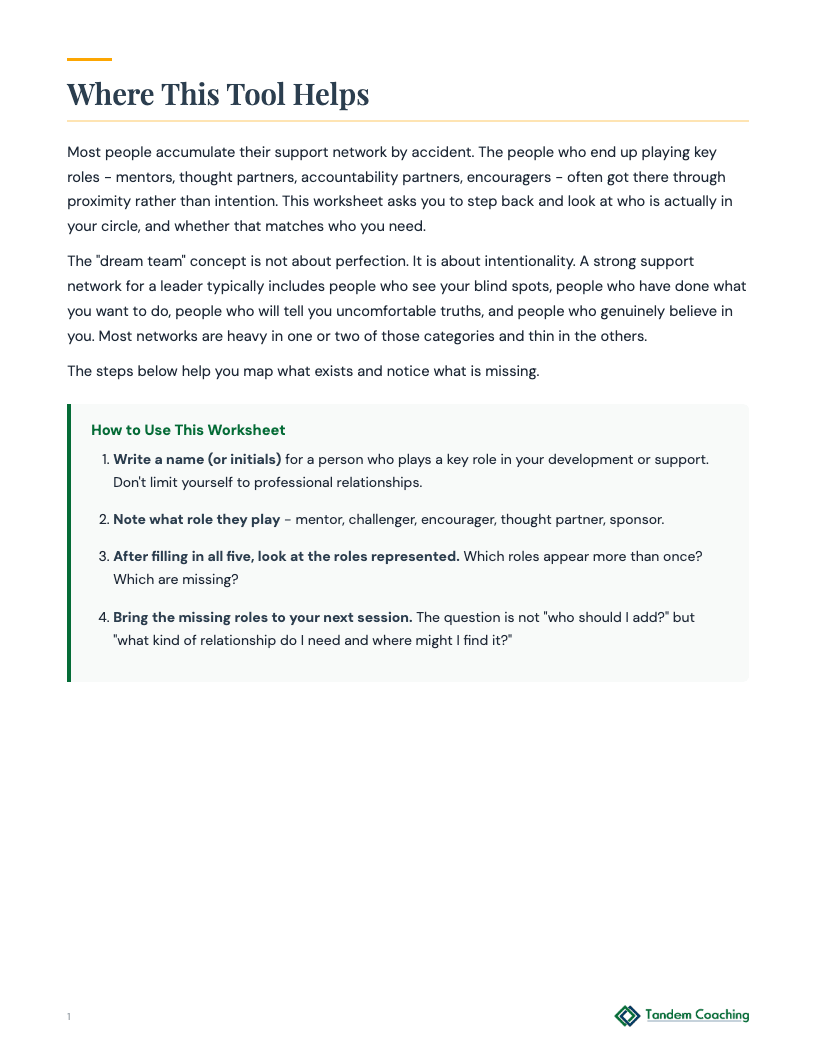
There's a mapping exercise where you name up to five people who play key roles in your development and note what role each one actually fills — would it be useful to look at who's in your circle and what might be missing?
Your client is a VP in a large organization who presents each session with a rotating list of frustrations - market conditions, board decisions, organizational politics above their pay grade. They are articulate about what is wrong and have little energy left for what they can actually do. Their team is performing below potential while their attention is consumed by things that are genuinely outside their control.
Frame this as an energy audit, not an influence map. 'We're going to look at where your attention is actually going versus where it would have the most impact. The three rings give us a way to see that.' Resistance pattern to name upfront: clients whose Concern ring fills quickly and whose Control ring fills slowly often experience naming that pattern as dismissing their legitimate frustrations. Name this directly - 'The Concern ring isn't wrong. We're just checking whether the balance is where you want it.'
A Control ring with fewer than 3 specific items after 10 minutes of work is a signal. Either the client is genuinely in a low-agency context (possible but usually not as extreme as they perceive), or they have been operating in Concern mode long enough that Control has atrophied as a category. If the Influence ring is also sparse, the client may be experiencing a sense of learned helplessness that is not proportionate to their actual authority.
Start with the Concern ring - let your client read it back. Then ask: 'What is the cost of keeping your attention here?' This is not a rhetorical question; ask them to name a specific cost (team performance, missed opportunity, depleted capacity). Then move to the Control ring. 'Which item here, if you actually acted on it, would have the most leverage on what is in Concern?' That link is the coaching conversation.
If the Concern ring contains items that are genuinely within your client's organization to address but are being placed in Concern because your client feels unable to raise them - organizational dysfunction, leadership behavior above them - explore whether the issue is actually influence capacity or political risk. Severity: low. Response: continue the mapping, but note whether items in Concern might belong in Influence with a different approach.
Your client is six months into a post-merger integration. Reporting lines, decision rights, and team structures are all in flux. New stakeholders are appearing regularly. Your client's previous clarity about what they control has evaporated, and they are defaulting to reacting to incoming demands rather than leading from any stable position.
Frame the three-ring map as finding stable ground inside instability. 'Even in a fully fluid environment, there are things you control - starting with your own behavior, decisions, and how you show up to your team. Let's find those anchors before we map the rest.' The Concern ring will fill easily in a merger context; the coaching value is in not letting it dominate. Make that explicit before your client starts.
In merger contexts, the Influence ring is where the most useful work often lives - relationships with new stakeholders, access to information, the ability to shape decisions not yet made. Watch whether your client's Influence ring remains sparse because they have not yet built relationships in the new structure, or because they do not see relationship-building as within their role. These are different problems.
After all three rings are populated, ask your client to identify one item from Concern that they have been spending time on that they could consciously decide to release. Then identify one item from Influence that they have not been acting on. The question that opens this up: 'If you moved your energy from that Concern item to that Influence item, what would be different in 30 days?' Do not move too fast - the client needs to genuinely reckon with what they are choosing to hold.
If the Concern ring is full of items that are genuinely threatening to your client's role security - restructuring, headcount reductions, potential elimination of their function - the coaching question shifts from energy allocation to strategic response. Severity: moderate. Response: the Control/Influence mapping is still relevant, but the strategy question may need a direct conversation rather than a framework exercise.
Your client founded a company 7 years ago and has built it to 35 people. The Control ring, if they were to map it, would contain almost everything - because they have never built systems that allow genuine delegation. They are bottlenecked, exhausted, and aware that the control pattern is limiting growth. The problem is not unwillingness to delegate; it is that delegation without trust feels impossible and they have not built the trust infrastructure to make it possible.
Frame this as a delegation map rather than an influence map. 'The three rings give us a way to see what you are currently choosing to control, what you could choose to influence instead, and what you could actively move to Concern - not because it doesn't matter, but because someone else can carry it.' The founder resistance pattern: founders often intellectually accept delegation but resist it in practice because they believe no one else can do it at the required standard. Name this.
Watch whether your client's Influence ring - the items they are willing to shape without controlling - is genuinely populated or is a list of low-stakes items that would not matter if they lost control of them. True delegation requires putting high-stakes items in Influence or Concern. If all high-stakes items remain in Control, the founder has not genuinely engaged with delegation. Also watch whether Concern is populated with market and competitive dynamics rather than internal operations - founders who are ready to scale start moving internal operations toward Influence.
Start with the Control ring. Ask your client to pick three items they control that someone on their team could theoretically control instead. 'What would have to be true about that person for you to be willing to give this to them?' Their answer describes the trust conditions for delegation - which is more actionable than the general aspiration to delegate. The question that opens growth planning: 'Which of those conditions could you actually create in the next 90 days?'
If your client's need to control everything is generating visible burnout symptoms - sleep disruption, inability to be present outside of work, physical health impact - the sustainability of the current pattern needs to be named directly. Severity: moderate. Response: complete the mapping, but name what you observe and assess whether the pace of change needs to accelerate beyond what feels comfortable.
A leader wants to understand how their past has shaped their current leadership approach
ExecutiveI've never written a contingency plan and I realize I'd be scrambling if something disrupted the business
ExecutiveA client wants to understand their executive strengths and development gaps
Step 2 of 6 in My 12-month goals don't connect to any longer-term vision and I want to fix that
Next: Eisenhower Priority Matrix → Explore all pathways →