Build leadership habits that stick with a structured, coach-tested plan that turns goals into daily actions and tracks progress over time.
Free, print-ready PDF.
Looking at your habit tracker from this week — where did you stay consistent, and what got in the way on the days you didn't?
A director promoted three months ago from a senior individual contributor role is working with her coach on the transition into people management. She has identified three behaviors she wants to build: a weekly check-in ritual with each direct report, a preparation practice before difficult conversations, and a team meeting format that consistently covers the right content. She has not yet attempted to build any of them as habits — she is implementing them episodically, depending on whether she remembers. Her calendar does not protect time for any of them.
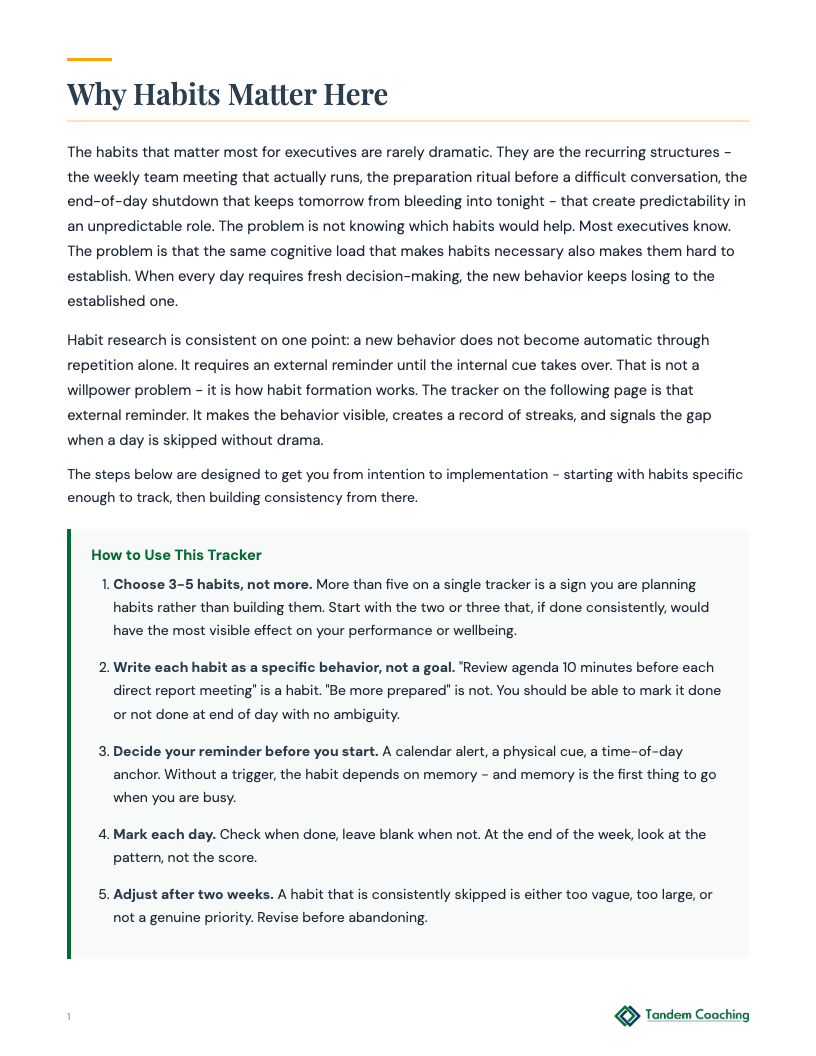
Use the tool's specificity requirement as the entry point. 'Most leadership habits fail at the same place: they're defined at the wrong level of abstraction. This tracker asks you to write the habit as a specific, unambiguous behavior — something you can mark done or not done at the end of the day without deciding in the moment whether you did it. It also asks you to name the trigger before you start. A habit that depends on remembering is already failing. What anchors it to your calendar or to another established behavior?' The discipline of writing a trigger before the habit begins is where the tool adds value beyond simple tracking.
Watch whether her habit descriptions are concrete enough to track without judgment calls. 'Check in with direct reports' is ambiguous — it could be satisfied by a passing hallway comment or a 30-minute conversation. 'Hold 15-minute check-in with each direct report — Tuesday and Thursday, 9 AM' is trackable. Also watch the Trigger column: clients who leave it blank or write 'when I remember' have not yet completed the habit design. Without a trigger that exists independent of willpower, the habit is still a goal.
After two weeks of tracking, start with the pattern, not the score. 'Looking at which days have checks and which are blank — what do the blank days have in common? What was happening on those days?' The answer almost always reveals either a scheduling pattern (the habit was displaced by recurring meetings) or a trigger failure (the anchor hasn't been reliable). From there: 'Of the three habits, which one is the most important to protect even when the week gets difficult? What would it take to make that one nearly automatic in the next four weeks?'
If after two weeks all five habit rows are largely blank and she describes each day as 'just too busy,' the tracker has surfaced a different problem: not habit design, but prioritization. Severity: low. The habits she defined are being treated as discretionary, which means they are not yet connected to what she believes is most important in the new role. A direct conversation about what she is actually building toward — and whether these habits serve that — may be more useful than habit redesign.
A VP of technology has been in coaching for four months. Each session produces clear commitments: he identifies a specific leadership behavior, articulates why it matters, and agrees to implement it before the next meeting. In the following session, he reports that he intended to follow through but the week 'got away from him.' This has happened in four consecutive sessions across four different commitments. He is frustrated by his own inconsistency and attributes it to the pace of his role. His coach suspects the problem is not pace but implementation architecture — he is leaving sessions with intentions rather than habits.
Name the pattern before introducing the tool. 'I want to try something different this session. The last four commitments haven't made it to implementation, and I don't think that's about your intention or the importance of the behaviors. I think we're building without a structure that survives Monday morning. This tracker asks for three things before we leave today: exactly what the behavior is, what will trigger it, and why it matters enough to protect. If we can't answer all three in this room, the commitment won't survive the week.' The directness here matters — the tool should feel like a structural fix, not another commitment.
Watch the Trigger field specifically — this is where implementation fails most often for high-demand executives. If he writes 'before important conversations' as his trigger, that is still a cognitive decision he will have to make in the moment. A usable trigger is a specific event that is already in his week: 'after the Monday staff meeting' or 'the calendar alert that fires at 7:50 before my 8 AM 1:1s.' If the trigger requires him to remember that it's a good time for the habit, the trigger isn't doing its job.
In the session following two weeks of tracking, lead with what the data shows rather than how he feels about it. 'Looking at the pattern — Monday and Tuesday are solid across all three habits. Wednesday and Thursday are inconsistent. Friday is blank. What is different about Wednesday?' Pattern analysis produces more useful information than self-assessment, which tends to generate either excessive self-criticism or rationalization. From the pattern: 'Given that Wednesday and Thursday appear to be the week's most volatile days — which habits are most important to protect on exactly those days?'
If the pattern of commitment without follow-through persists after two rounds of tracker use with explicit trigger design, the barrier is no longer implementation architecture. Severity: low to moderate. A direct conversation about whether the behaviors he is committing to are actually priorities — versus aspirations he believes he should have — may surface a more accurate account of what is driving the gap.
A senior manager is working on expanding her executive presence — specifically her preparation and visibility in senior forums. She has identified what she wants to do differently: spend 20 minutes in pre-preparation for every senior leadership meeting, speak at least once in the first 15 minutes of each meeting she attends, and send a brief written synthesis to key stakeholders after each cross-functional decision. She has articulated all three clearly. She has not yet built any tracking or trigger system to make them repeatable. She is relying on recall and motivation, which works when things are going well and fails when her week becomes demanding.
Frame the tracker as a bridge between aspiration and habit. 'You have named three specific behaviors with enough precision that we can actually track them. The tracker converts these from intentions — things you're holding in memory — into a visible system. The difference matters: when your week is demanding, memory is the first thing that fails and intention is the first thing that gets displaced. A tracker makes the habit visible even when you're not thinking about it.' Clients who have already defined their behaviors well respond to the tracking layer as maintenance infrastructure, not remediation.
Because she has already done good behavior definition work, watch whether her habit descriptions on the tracker match the precision she articulated verbally. Sometimes the translation to paper produces a softer version — 'prepare for senior meetings' instead of 'spend 20 minutes in prep before each SLT meeting.' If the written version loses specificity, name it and tighten it before the tracker is used. Also watch the 'Why it matters' field: if she writes a generic answer ('to show up better'), push for the specific consequence — 'because three months from now I want the CHRO to have seen me contribute in every forum, not just occasionally.'
After four weeks, the debrief is less about pattern and more about which habits are starting to feel automatic versus which ones still require active effort. 'Which of the three feels closest to being on autopilot — the one that no longer requires you to decide to do it?' That habit is ready to be maintained with less tracking and possibly replaced on the tracker with a new behavior. 'Which one is still requiring effort every time? Is that a trigger problem, a definition problem, or a motivation problem?' These three causes have different solutions, and naming which one applies speeds the work.
If after four weeks, the 'speak in the first 15 minutes' habit is consistently skipped in specific meetings — particularly those with a specific subset of senior leaders — and she cannot fully account for why those meetings are different, the skip pattern may reflect a situational trigger beyond habit architecture. Severity: low. Note the pattern and explore whether those meetings involve specific dynamics (power, evaluation, relationship history) that are making the behavior less accessible there than in other forums.
A leader who wants to learn from experience rather than just accumulate it
LifeI plan my weeks but never reflect on how they actually went
LifeClient reviews the month but the reflection stays at the level of 'did I do the thing' rather than what it revealed