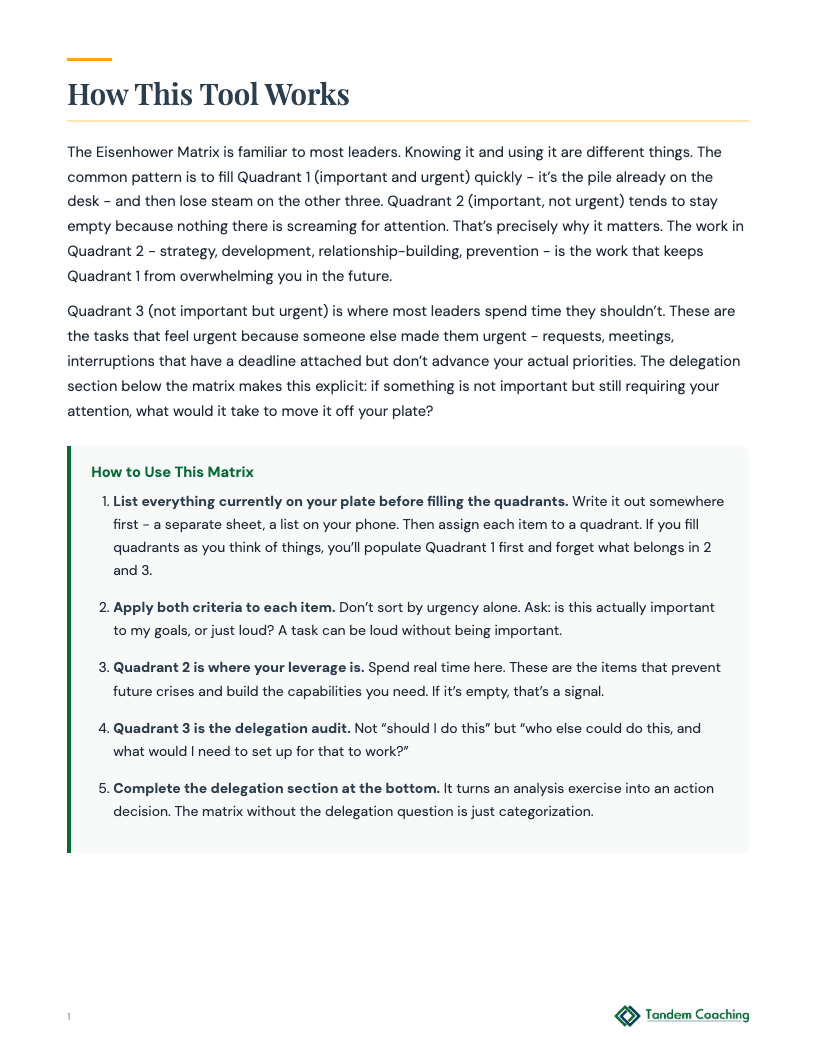
Stop reacting and focus on what matters by sorting work by urgency and importance using the proven Eisenhower Priority Matrix used by executives.
Free, print-ready PDF.
After sorting your tasks, what surprised you about where things landed — and what's sitting in Quadrant 1 that you suspect belongs in Quadrant 2?
A VP of product at a growth-stage company whose calendar is booked solid two weeks out with meetings. He has not had more than 30 minutes of unscheduled time in any given day this quarter. He describes himself as 'constantly in reactive mode' and his leadership team has started routing around him because getting on his calendar takes too long.
Frame this as an audit before any prescription. 'Let's run your current week through the matrix before deciding what to change.' Expect defensiveness: executives with packed calendars often believe the meetings are necessary and that the alternative is neglect. Don't argue that yet. 'We're not deciding what to cut right now. We're mapping what quadrant each commitment falls in, so we can see the distribution.' The Q1-versus-Q2 distribution will do the work of the conversation.
Watch how he categorizes meetings. If every meeting lands in Q1, he's not differentiating - urgency and importance are collapsed. Also watch whether Q2 is empty: a leader with no scheduled strategic work is a leader who has stopped leading and started managing. Note specifically whether he categorizes standing meetings as urgent-important by default without examining them individually.
Start with Q1 count. 'How many items? Now, which three of those are genuinely time-sensitive in the sense that something breaks if they don't happen this week?' That question forces him to apply urgency criteria rather than assume them. Then move to Q2: 'What belongs here that isn't scheduled?' The question that creates movement: 'Your team is routing around you. What Q2 work would reverse that pattern if it were on your calendar?'
An executive who has eliminated all Q2 time over a sustained period and shows no awareness of the strategic cost may be in an organizational spiral that's structural - the org has trained him into reactive mode. Severity: moderate. Response: name the systemic pattern and explore whether this is a personal effectiveness conversation or an organizational design conversation.
A senior manager with six direct reports who has told everyone they have authority to decide in their domains. In practice, every significant decision routes back through her for final sign-off before action is taken. She is confused about why delegation isn't working and describes her reports as 'not taking ownership.'
Frame this as a workflow mapping exercise. 'Let's look at what's coming to you and categorize it by what quadrant it's actually in - and whether the quadrant it lands in requires you specifically.' The delegation section of this matrix makes visible the mismatch between stated authority and actual workflow. The resistance pattern is about letting go: she'll argue that sign-off is 'just a check' rather than a decision. Name the check as a decision: 'If you can reverse it, it's a decision. And if it's a decision that routes to you, your reports aren't the decision-makers.'
Watch the delegation section specifically. If she populates it with administrative tasks but not decisions, she's delegating tasks, not authority. Watch whether items she marks 'delegate' still include 'with my sign-off' in the notes - that's pseudo-delegation. Also watch the Q2 section: leaders who are caught in delegation loops rarely have time for Q2 work, so an empty Q2 alongside a long Q1 list confirms the pattern.
Start with what she's written in the delegation section. 'Walk me through two or three of these. What happens after you hand this off?' If 'they come back to me before they act,' ask: 'At what point in that process is the decision actually theirs?' The question that creates movement: 'If you were out of contact for a week and your team had to move forward without you, which of the Q1 items here would they actually handle successfully?'
A manager who reports her direct reports 'aren't taking ownership' while structuring every workflow to require her sign-off may be creating the dependency she's frustrated by. If she shows confusion or defensiveness when this loop is named, explore what function the sign-off process serves for her beyond quality control. Severity: moderate. Response: name the structural pattern and invite her to examine what she's protecting by remaining the final step.
A sole-proprietor business owner in year three of his business. His Q1 is real - client deadlines, billing, deliverables. But his Q2 is consistently empty because 'I can't find time for it.' The Q2 work that never gets done includes business development, process documentation, and a pricing strategy review - tasks he finds uncomfortable, not unimportant.
Frame Q2 as the category where avoidance hides. 'Q1 is urgent - it has natural pressure behind it. Q2 has no deadline and no one asking for it, which means the only thing that gets it done is you choosing it.' The resistance here is time-based: 'I genuinely don't have time.' Don't argue with that yet. 'Let's see what Q1 looks like this week and whether any of it could be scheduled, delegated, or compressed to create Q2 time.'
Watch whether his Q2 list has more than five items. If it does, he's been aware of what he's avoiding for some time - the issue isn't awareness, it's execution. Also watch whether the Q2 items he lists are genuinely strategic or are aspirational (a new product idea, a website redesign) versus operationally necessary (pricing review, capacity planning). The aspirational Q2 items are easier to defer; the necessary ones have a cost he may not be tracking.
Start with Q2 and ask him to read each item. Then: 'Which of these has a business cost if it stays undone for another quarter?' That narrows Q2 to the work that actually matters versus what he's been telling himself matters. The question that creates movement: 'If you blocked two hours every Thursday morning for Q2 work starting this week, which item goes first - and what would you need to not check email for those two hours?'
A business owner who consistently avoids Q2 work in categories that directly affect business health (pricing, business development, financial review) may be managing anxiety about the implications of what that work would reveal. Severity: low. Response: note the avoidance pattern and invite direct exploration of what he expects to find.
I want to audit how well my business actually operates across all major functions
ExecutiveMy 12-month goals don't connect to any longer-term vision and I want to fix that
ExecutiveClient reviews the quarter by outcomes but has never mapped how time was actually distributed across priorities