DBT Emotion Regulation Check-In
A DBT-based check-in to identify emotions, understand triggers, and choose skillful responses instead of reacting on impulse.
Get This Tool
Free, print-ready PDF.
When to Use This Tool
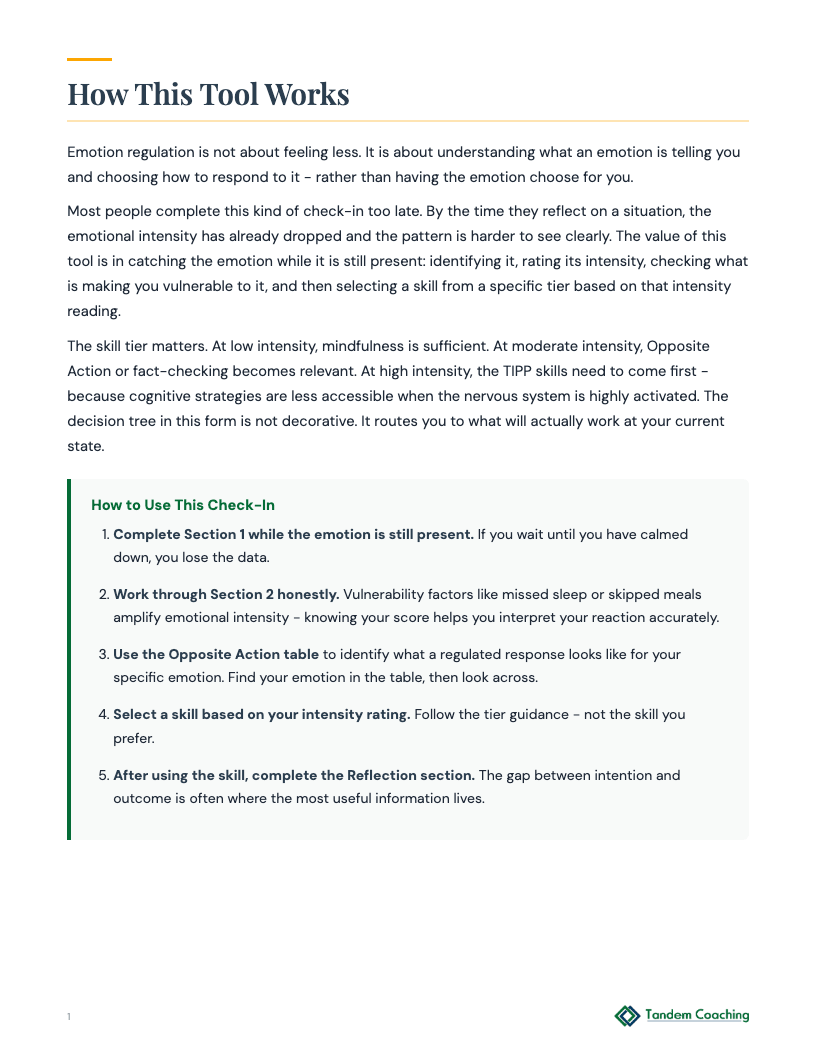
A client wants a structured way to name and respond to emotions rather than just reacting
Someone identifying emotion, intensity, vulnerability factors, and opposite action in sequence
Selecting the right DBT skill tier based on what they're actually experiencing right now
How to Introduce This Tool Plus
Use the intensity number only to describe the moment, not to prescribe a technique. What are you noticing, what has helped safely before, and is qualified support needed?
Coaching Tool Disclaimer
This tool is designed for coaching contexts, not clinical use. If you or your client is in crisis, contact the 988 Suicide and Crisis Lifeline (call or text 988) or Crisis Text Line (text HOME to 741741).
Browse All Pages
Tool Classification
Domain
Wellness
Type
Worksheet
Phase
Discovery
Action
Details
15 min
Opener
As-needed
Topics
Emotions
Resilience
For the Coaching Practitioner
Plus
Coaching Scenarios
Plus
1 Director who acts on emotion and regrets it within the hour ▶
Context
A director sends sharp emails and makes unilateral decisions when activated, then walks them back after the feeling has passed. She is aware of the pattern retrospectively but cannot interrupt it in the moment. She describes herself as 'reactive by nature' and has largely accepted it.
How to Introduce
Frame the check-in as a between-stimulus-and-response tool, not a mood diary. 'The form is designed to be completed while the emotion is still present — not in retrospect, when the intensity has already dropped. What it does is create a gap. Most reactive decisions happen in the moment between feeling something and doing something. This interrupts that moment.' The vulnerability check section is worth explaining explicitly: 'If your score is 3 or above, that means your emotional system is working harder than usual. That context changes how you interpret your own reaction.' Some clients resist rating vulnerability factors — frame it as baseline correction, not excuse-making.
What to Watch For
Watch whether she completes the form after the reaction rather than during it. If every entry describes what happened as a completed event — 'I sent the email, then felt better' — the check-in is being used for review rather than interruption. The form requires completion while the emotion is still active. Ask her to identify what using it in-moment would require practically: phone access, a physical copy, a place to step away.
Debrief
Start with the vulnerability count across the week's entries and ask: 'What's the average score when your reactions were highest intensity?' If vulnerability count consistently correlates with intensity, that finding alone is worth significant time. Then look at the Opposite Action table: 'Which emotion on the table was hardest to find a regulated response for? What makes that particular one different?'
Flags
If the skill selection section (page 3) is consistently blank — she identifies the emotion and rates the intensity but doesn't select a skill — the tool is being used for observation without producing action. Severity: low. Hold her on the skill selection step specifically: it is the bridge between awareness and behavior.
2 Client learning to distinguish anxiety from anger in high-stakes moments ▶
Context
A VP consistently misreads his own emotional state under pressure — what he labels as frustration or irritation is often more accurately described by others as anxiety or fear. He acts from the mislabeled emotion and his responses don't match the actual situation. He has no vocabulary for fear in a professional context.
How to Introduce
Lead with the identification layer. 'The first section asks you to name the emotion as specifically as you can. Not just activated or stressed — what is it actually? Some clients find this harder than expected, particularly for emotions that don't feel acceptable at their level. Fear shows up as irritation. Anxiety shows up as control behavior. Getting the label right changes what the Opposite Action table recommends.' The Physical Sensations field is useful for this client specifically — ask him to start there rather than with the emotion label.
What to Watch For
Watch the Primary Emotion field across multiple entries. If it consistently says 'frustrated' or 'irritated' for situations that clearly contain threat or uncertainty, the labeling is still at the surface. Ask him to sit with the physical sensations first and work backward to the emotion: 'You described a tight chest and a need to control the conversation. What emotion produces those sensations?'
Debrief
After two weeks, read back his Primary Emotion entries and ask: 'Looking across these, what pattern do you notice in which emotions show up most? Are there any that are missing — emotions that you'd expect given the situations you described?' That absence question often surfaces the emotion he is not naming.
Flags
If the Action Urge field consistently describes controlling, checking, or monitoring behaviors across situations that also show high intensity and physical symptoms in the chest or throat, there is a pattern worth naming directly. Severity: low. The tool has identified a specific emotional signature — the next step is deciding whether to address it as a coaching topic or refer to a more specialized conversation.
3 Manager who understands emotion regulation theory but cannot apply it ▶
Context
A team lead has read widely on emotional intelligence and can explain regulation models fluently. Despite this, he continues the same reactive patterns. He attributes the gap to 'knowing what to do but not being able to do it when it matters.' He has tried tracking exercises before without sustained change.
How to Introduce
Reframe the tool explicitly for someone who already has the theory. 'You're not doing this to learn what emotions are or how the nervous system works — you already know that. You're doing it to build in a pause that your current system doesn't have. The skill tier decision tree is the operative part for you: getting in the habit of checking intensity before selecting a response changes the sequence from automatic to chosen.' Some clients in this profile resist structured tools because they feel like remedial work. Address that directly: 'This is about building a reflex, not understanding a concept.'
What to Watch For
Watch the Skill Selection section. If he selects the same skill regardless of intensity level — always chooses mindfulness, always chooses opposite action — the routing step is not working. The tool routes differently based on intensity: 0-3 to mindfulness, 4-6 to opposite action or fact-checking, 7-10 to TIPP first. If he is at 8 and choosing mindfulness, the selection is wrong for the activation level.
Debrief
Start with the post-skill reflection section: emotion intensity before and after, and what helped. Ask him to compare the before and after intensity numbers across multiple entries. 'When the intensity went down after using the skill, what do you think happened? When it didn't, what was different about that situation?' This moves the debrief from evaluating the tool to analyzing his own data.
Flags
If the check-in entries show consistently high intensity (7-10) across multiple sessions with no reduction in the after-skill intensity ratings, the skill selection may be consistently wrong for the level of activation — or the TIPP skills are being used incorrectly. Severity: moderate. Bring the specific entry into session and work through the skill selection and execution step by step.
4 Leader building a self-awareness practice after 360 feedback about emotional unpredictability ▶
Context
A senior director received 360 feedback indicating her team experiences her as emotionally inconsistent — they cannot predict which version of her they will encounter. She was surprised by the feedback and wants to understand what drives the variation.
How to Introduce
Position the vulnerability check section as the most useful single feature for this client. 'The PLEASE factors — illness, sleep, food, substance, exercise — are variables that amplify emotional intensity. Your team doesn't know your sleep debt or whether you've eaten. What they see is the output. Using this form regularly gives you a way to connect your internal state to the signals your team is reading, which is the gap the 360 is pointing to.' This client is likely high-functioning and will engage with the data-gathering framing rather than a wellness framing.
What to Watch For
Watch whether the vulnerability count on her high-reaction days is consistently higher than on her low-reaction days. If it is, that correlation is the first concrete finding. If the vulnerability count is consistently low even on high-reaction days, the activation is coming from something the PLEASE factors don't capture — relational triggers, topic sensitivity, accumulated pressure. Either finding is useful.
Debrief
After four weeks, lay out the vulnerability count and the intensity ratings side by side. Ask: 'On your highest-intensity days, what does the vulnerability count look like? On your most predictable days for your team — the ones where you know you're at your best — what's different?' The debrief is not about the tool; it is about the pattern the tool surfaced.
Flags
If the Action Urge field is consistently blank — she can name the emotion and rate the intensity but not the urge — she may be disconnected from the behavioral layer of her emotional state. Severity: low. The action urge is often the most useful field for a client working on behavioral predictability, because it names what she is resisting doing. Ask her directly in session what the emotion makes her want to do.
Tool Flow
Plus
Requires
- basic emotion vocabulary for naming feelings
- familiarity with TIPP skills for high-intensity routing
→
Produces
- emotion and context observations
- vulnerability-factor notes without a cutoff
- options to discuss rather than a prescribed skill tier
Pairs Well With
Wellness
Situation and Response Log
A client wants to use Situation and Response Log as an optional reflection
Why it pairsTwo weeks of logged triggers shows whether the vulnerability factors your client scored on the check-in are situation-specific or part of a broader reactive pattern.
ADHDFeeling Context and Support Notes
Use this framework to structure a conversation about emotions and mindset while keeping interpretation with the client.
Why it pairsOnce your client can name and rate an emotion in sequence, this framework builds the tolerance to stay with it rather than jumping straight to opposite action.
ADHDBody Sensation Noticing Map
A client knows something feels off but can't articulate the emotion
Why it pairsClients who struggle to name the emotion before rating intensity can use this to anchor the check-in's vocabulary step in physical sensation instead of guesswork.
Related Articles


Executive AI Vulnerability Assessment | Know Where You Stand
Read article →
Powerful Questions in Coaching: Why Timing Beats Technique
Read article →
ICF Core Competencies: Empathy, Neutrality, and Vulnerability
Read article →
Coaching Supervision Models: How They Actually Work in Practice
Read article →