Turn daily coaching tasks into a clear business vision and 1-year goals with a structured plan used by practice-building coaches.
Free, print-ready PDF.
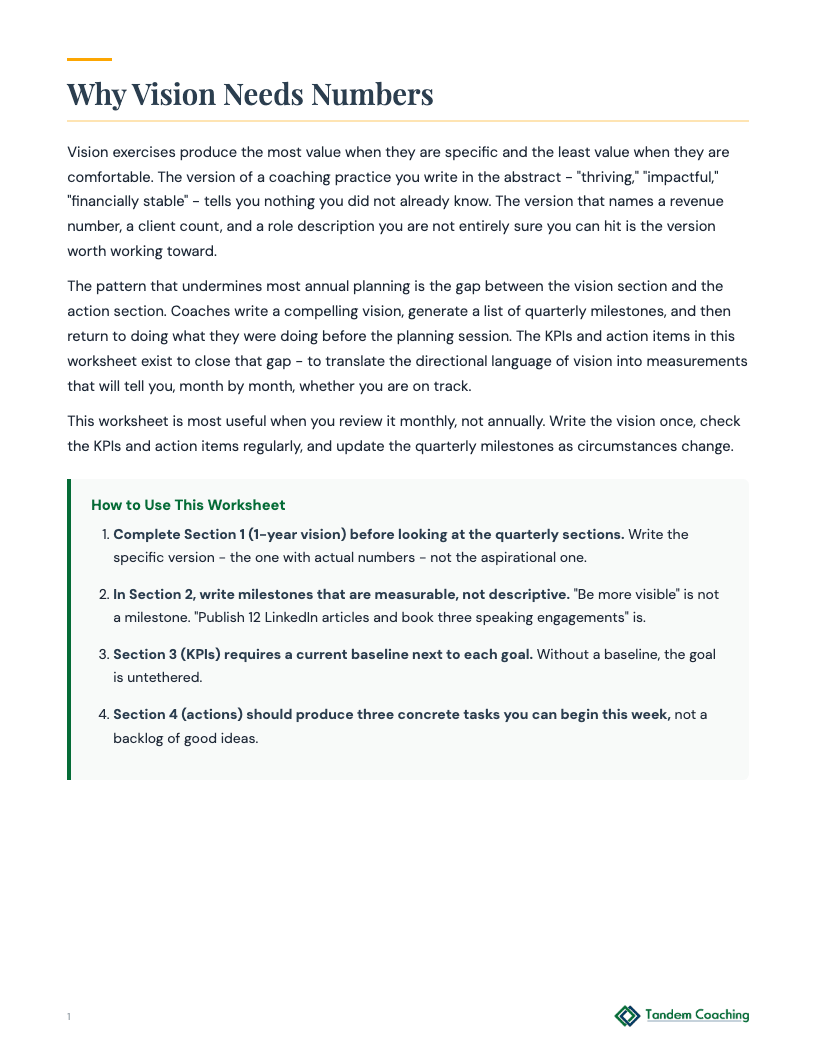
Before we get into tactics, it helps to know what you are building toward. This planner is about naming where you want the practice to be in twelve months and working backward from there.
A coach is fully booked at a rate they set when they started, and is simultaneously exhausted and underearned. They want more revenue but are afraid that raising rates will lose clients.
Introduce Section 1 specifically: 'Start with the revenue number. Not a range - a number. What does the business need to produce in the next twelve months for you to stop having the rates conversation with yourself?' Some coaches will want to skip the revenue field or write a range instead of a number. Hold the specificity: 'A range means the decision isn't made yet. We need a number.'
If the annual revenue number in Section 1 is within 20% of current revenue, the coach is not writing a vision - they are writing a projection. Push: 'That number reflects what is likely. What does the business need to look like to feel meaningfully different from today?' Also watch the KPI table in Section 3. If the coach writes no baseline in the 'Current' column, they may not actually know their numbers - that gap is more important than the goal.
Start with the gap between the Section 1 revenue number and the current baseline. Ask: 'How many more clients at your current rate would close that gap? Now how many clients at a rate that reflected three years of experience?' The math usually makes the rates conversation unavoidable. Move to the quarterly milestones and ask which one requires the hardest decision - often the answer reveals the block the rest of the planning has been organized around avoiding.
If the coach's Section 1 vision includes a significantly larger client count but no rate increase, and they resist exploring pricing, this may indicate deeper money beliefs that planning tools won't resolve. Severity: low. Continue coaching, but name the pattern: 'You've written a plan that requires you to work more rather than earn more. Is that the intention?'
A coach currently employed part-time is building toward leaving employment to run a full-time practice. They have a date in mind but have not modeled what the business needs to produce to make that date viable.
Frame Section 3 as the decision-gate tool. 'Before we talk about the timeline, let's get the numbers on the page. What does the practice need to generate, month by month, for the transition date to be financially sound rather than just aspirational?' Coaches in pre-transition often set the date emotionally and then build the plan backward. That order is fine if the numbers are real - but the plan needs to survive a stress test.
Watch whether the Section 4 action items are business-building actions - new client outreach, package development, rate review - or practice-building activities - website updates, branding refinements, getting a new certification. The first category generates revenue; the second delays the decision. If the coach fills three action items with things that don't directly produce clients, name it without judgment: 'All three of these improve the practice. Which one generates a conversation with a potential client?'
After the KPI table is complete, work the monthly revenue math with the coach directly: 'At your current conversion rate, how many discovery calls would generate the revenue target? How many clients does that require? How long does your current pipeline take to fill?' The goal is not to deflate the timeline - it is to make it concrete enough to act on. End with the quarterly milestones: 'Which quarter is the decision quarter - the point where you either commit to the date or revise it?'
If the transition date is within six months but the KPI table shows current monthly revenue at less than 50% of the target, explore whether the coaching container is the right place to work through this or whether financial planning support is also needed. Severity: low. Coaching can address the mindset and decision-making; it cannot substitute for cash flow modeling.
A coach who paused their practice for a family or health reason is rebuilding from nearly zero. They have prior client relationships and credibility but uncertainty about whether their former positioning still fits.
Frame this as a re-entry design tool, not a retrospective. 'We're not rebuilding what you had. We're designing what you want. Those may be similar, but let's not assume they are before you've written it down.' The coach in this situation often has a strong pull toward simply recreating the prior practice - it's faster and more familiar. The worksheet works when it surfaces whether that instinct is intentional or just habitual.
Watch Section 1 for whether the vision is specific or nostalgic. 'Return to where I was before' is not a one-year vision - it is a loss-recovery goal, and it sets a different kind of target than a genuine forward direction. Also notice whether the coach's Section 2 quarterly milestones map a rebuilding sequence (months 1-3: reconnect with former referral partners) or a growth sequence (months 1-3: define the new niche and test positioning). Neither is wrong, but the coach should know which they are choosing.
Start with the gap between the Section 1 vision and the prior practice. Ask: 'Where is the new version different from what you were doing before? What is the same by choice, and what is the same by default?' The question opens the conversation about whether the pause changed anything significant about what the coach wants to build. End with Section 4: 'What are the three actions that need to happen in the next 30 days before anything else matters?'
If the coach's vision is explicitly framed as returning to a prior state rather than moving forward, and they show significant energy around recreating specific past elements, explore whether there is unresolved grief or loss associated with the pause. Severity: low. Coaching appropriate, but the planning work may need to wait until the underlying readiness to re-enter is clearer.
A coach who is onboarding a new client and needs a structured way to collect goals, background, and preferences before the first session
Coach BusinessA coach who has never articulated what their practice actually stands for
Coach BusinessA coach is building their brand and needs a visual reference document that captures colors, fonts, imagery direction, and tone in one place
Step 5 of 6 in A coach who markets to 'everyone' and wants to get specific about who they do their best work with
Next: Revenue Goal Planner → Explore all pathways →