Brand Board Template

A coach is building their brand and needs a visual reference document that captures colors, fonts, imagery direction, and tone in one place

Framework · 45+ min · Print-ready PDF · Free download

Get This Tool

Free PDF - professionally formatted, ready to print or fill digitally

Preview Framework · 45+ min
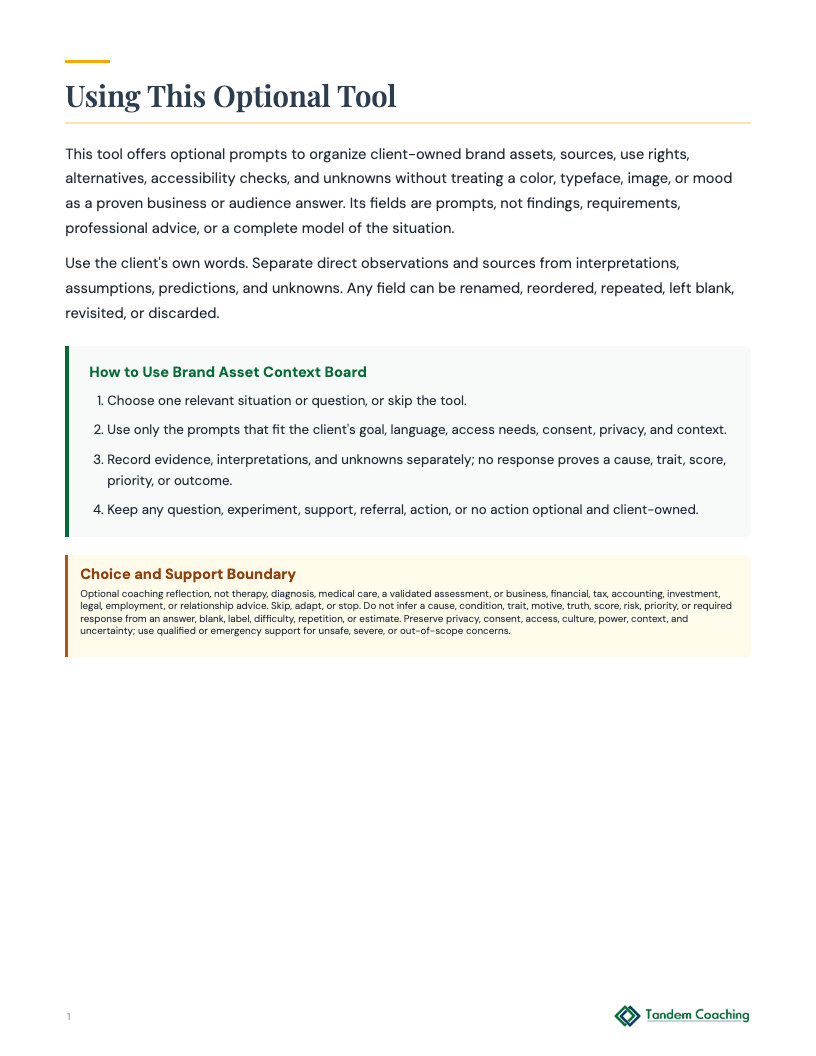
Brand Board Template - preview
When to Use This Tool
A coach is building their brand and needs a visual reference document that captures colors, fonts, imagery direction, and tone in one place
A coach wants to maintain consistency across all client-facing materials and needs a brand board to guide design decisions
A coach who is working with a designer or VA and needs a single document that communicates their visual brand without lengthy explanations
How to Introduce This Tool Plus

A brand board translates your identity into a visual system. What do you want clients to feel the moment they see anything you put out?

Browse All Pages
Interactive Preview Framework · 45+ min
Tool Classification
Domain
Coach Practice
Type
Framework
Phase
Action
Details
45+ min Mid session
Topics
Identity Values Creativity

For the Coaching Practitioner

Plus
Coaching Scenarios Plus
1 The new coach who has a logo but no idea how to use it consistently
Context

A 38-year-old newly certified coach left a corporate HR career to build an independent practice. She has a logo she loves — a designer created it six months ago — and has since produced a website, a LinkedIn banner, two PDF worksheets, and an email signature, none of which match each other. The logo hex code lives in a file on her old laptop. She's using four different fonts across her materials and doesn't know which is 'hers.' She has been building client-facing materials by feel and is starting to notice that nothing quite coheres. She came to coaching supervision to work on practice development. The Brand Board is introduced as the infrastructure layer her materials are missing: a single document that captures the visual decisions already made — and the ones not yet made — so everything can be built from a common reference.

How to Introduce

Frame this as closing the gap between the brand she has and the materials she's producing. 'You've made the core visual decisions — logo, colors, typography — but you haven't documented them. So every new piece of material requires you to reconstruct those decisions from scratch, and the reconstruction is inconsistent. The brand board captures what's already decided: hex codes, approved font pairings, logo variations, and the visual references that point toward the feeling you're going for. Once it exists, anything you or a designer or a VA creates can be checked against it.' Name the consumes requirement: 'This tool works best when the logo colors and typography choices are confirmed. Before we fill in the board, I want to confirm: do you have the hex codes from your designer? That's the foundation everything else sits on.'

What to Watch For

Watch for the mood board section to be filled in aspirationally — images that represent how she wants the brand to feel eventually — rather than as a description of what the existing logo and color palette already communicate. The mood board should be calibrated to the visual assets she already has, not to a brand she wishes she'd built. Also watch for the typography section to default to whatever she's been using rather than what she's been choosing — there's a difference between the font that happens to be on her machine and the font that's right for the brand. If she can't name the fonts she's been using or explain why they fit, the typography pairing work needs to happen before the board can be finalized.

Debrief

Start with the hex codes: 'Do you have the primary and secondary colors documented here with their hex values?' If no, that's the first task before anything else. Then go to the typography pairing: 'You've listed your heading font and body font. Read them to me. Where did those choices come from — did a designer specify them, or did you pick them yourself?' That question distinguishes a deliberate pairing from an accidental one. Then go to the mood board: 'Looking at the visual references you've collected — does that match what your logo and color palette already communicate, or does it represent something you're aspiring toward?' Close with: 'A brand board translates your identity into a visual system. What do you want clients to feel the moment they see anything you put out?'

Flags

Array

2 The established coach who is handing visual work to a VA and losing brand consistency in the process
Context

A 51-year-old executive coach has a six-year-old practice with a strong client reputation. She produces a monthly newsletter, speaks at conferences, and has consistent intake from referrals. She recently hired a virtual assistant to handle design work — slide decks, social graphics, PDF resources. The VA is capable and well-intentioned. The outputs don't look like the same brand. The coach can't explain what's wrong because she doesn't have a documented visual standard to point to. She came to coaching supervision to work on scaling her practice. The Brand Board is introduced as the briefing document that would give the VA a precise reference rather than interpretable instructions.

How to Introduce

Frame this as solving a communication problem, not a design problem. 'Your VA isn't making bad choices — she's making choices in the absence of a documented standard. The brand board converts your visual identity into a reference document that answers the questions a designer or VA would ask: which shade of blue, which font for headlines versus body copy, which logo version to use on a dark background versus a light one. Right now, every brief you give requires her to interpret. After the board exists, the brief is: use the brand board.' Name what the tool produces: 'The board captures hex codes and fonts, yes — but also the mood board references that communicate the feeling, and the approved logo variations for different use cases. That's the difference between a style guide she can use and a list of assets she can guess from.'

What to Watch For

Watch for the logo variations section to reveal that she only has one version of the logo — which means the VA is having to use it on both light and dark backgrounds, producing a version that's illegible on at least one. If logo variations don't exist, that's a gap to flag for the designer before the board is finalized. Also watch for the mood board section to be left blank or treated as optional — clients who've been working intuitively often can't articulate the visual feeling they're going for until they see references. Push for at least three to five visual examples that represent the aesthetic she's protecting, because that section is the one the VA can use when a new design choice arises that the explicit rules don't cover.

Debrief

Start with the logo variations section: 'How many versions of your logo do you have — full color, reversed, icon only? When your VA puts the logo on a dark background, which version does she use?' That question often surfaces a gap she hadn't named. Then go to the mood board: 'You've collected [X] visual references. If your VA were making a design choice that isn't explicitly covered by the hex codes and fonts — what do those references tell her about whether it fits?' Then: 'If you handed this completed board to your VA today — what question would she still have that the board doesn't answer?' That question identifies what's missing. Close with: 'A brand board translates your identity into a visual system. What do you want clients to feel the moment they see anything you put out?'

Flags

Array

3 The coach launching a rebranded practice who needs a new brand board built from scratch
Context

A 44-year-old coach is relaunching her practice with a new name, new positioning, and a new logo she received from a designer last week. She has the logo files, the hex codes, and the font names. She has not yet produced any client-facing materials under the new brand. The brand personality work is complete — she has a defined voice and personality from a previous session. She is about to launch a website, a welcome packet, a workshop slide deck, and a LinkedIn presence simultaneously. The Brand Board is introduced as the foundation layer to build before any of those materials are produced, so they all reference the same visual standard from the beginning rather than converging on one after inconsistency has already accumulated.

How to Introduce

Frame this as building the infrastructure before the house. 'You have everything you need to build a complete brand board: the logo files, the hex codes, the fonts, and the personality work we already did. The board takes that material and produces a single reference document — hex values, approved font pairings, logo variations for different contexts, and a mood board that captures the visual direction. Every piece of material you build gets checked against it. The payoff is that you'll never have to reconstruct the brand decisions from scratch, and anyone who works with you on design will start from the same reference.' Name the sequence: 'I want the board completed before the website, the welcome packet, and the deck are built — not after. Retrofitting a brand standard to materials that were designed without one is significantly harder than building to the standard from the start.'

What to Watch For

Watch for the mood board to default to aspirational imagery that doesn't match the logo and color palette the designer already built — a common pattern when a client loves the concept of her brand more than the specific execution. If the mood board images represent a different aesthetic than the logo, the visual identity has an internal conflict that will produce inconsistency no matter how well the board is documented. Name this directly rather than completing the board with a conflict embedded in it. Also watch for the logo variations section to be completed based on what she received from the designer rather than what each variation is actually for — primary logo for light background, reversed logo for dark background, icon-only for favicon and small-scale use.

Debrief

Start with the hex codes: 'Walk me through the colors you have confirmed — primary, secondary, any accent. Where do each of these appear in your brand?' Then go to the typography pairing: 'Your heading font is [X] and your body font is [Y]. Those two need to work together at every size. Does your designer's file show a sample of them together?' Then go to the mood board: 'Look at the visual references you've collected alongside your logo. Do they match the logo's aesthetic — or do they represent something you wish the logo was?' That question is the most important one in the session if there's a conflict. Close with: 'A brand board translates your identity into a visual system. What do you want clients to feel the moment they see anything you put out?'

Flags

Array

Tool Flow Plus
Requires
  • confirmed logo colors and typography choices
  • defined brand personality or visual direction
Produces
  • visual brand reference document with hex codes and fonts
  • finalized logo variations and typography pairing
  • mood board with collected visual direction references

Pairs Well With

Coach Business

Logo Design Brief

A coach is commissioning a logo and needs a clear brief that communicates their vision to a designer without ambiguity

30 min Worksheet
Coach Business

Brand Personality & Voice Guide

A coach trying to define a consistent voice across platforms

45+ min Worksheet
Coach Business

Content Pillars Worksheet

A coach who posts inconsistently because they don't know what to write about

45+ min Worksheet

Related Articles

ICF Exam Sample Questions: Free Practice Test with Answer Explanations

ICF Exam Sample Questions: Free Practice Test with Answer Explanations

Read article →

4 Key Pillars of the ICF Core Competency Model Every Coach Should Know

4 Key Pillars of the ICF Core Competency Model Every Coach Should Know

Read article →
ICF Exam Preparation: How to Pass the CKA on Your First Attempt

ICF Exam Preparation: How to Pass the CKA on Your First Attempt

Read article →
The Ultimate Guide to Best Life Coach Certification Programs for 2024

The Ultimate Guide to Best Life Coach Certification Programs for 2024

Read article →
ICF Code of Ethics: Core Values, Standards, and What Changed in 2025

ICF Code of Ethics: Core Values, Standards, and What Changed in 2025

Read article →
Unlock Your Potential with Coach Supervision: Insights from Accredited Supervisor Cherie Silas, MCC, ESIA

Unlock Your Potential with Coach Supervision: Insights from Accredited Supervisor Cherie Silas, MCC, ESIA

Read article →